-
Call Now
1800-102-2727


Crystalline Solids - Definition, Classification, Practice problems and FAQ

Consider diamond, gold, and common salt. Are they similar?
To some extent, yes. Because all these are solids and have a regular arrangement of their constituent particles.
Do the constituent particles in these solids have a similar force of attraction between them?
Not in the least!
Hence, it is important to study solids which show a regular pattern of arrangement of constituent particles, also called crystalline solids based on the nature of bonding.
Matter is classified into solid, liquid, and gas. Further solids are classified as crystalline and amorphous solids.
Among these two solids, why do we only want to study crystalline solids and their classification?
Most of the solids that we observe in our day to day life are crystalline solids, which have a wide range of applications. These solids are also called true solids whereas amorphous solids are called pseudo solids.
Let's discuss crystalline solids in detail.
TABLE OF CONTENTS
- Definition of Crystalline Solids
- Classification of Crystalline Solids
- Ionic Solids
- Covalent Solids
- Metallic Solids
- Molecular Solids
- Practice Problems
- Frequently Asked Questions - FAQ
Definition of Crystalline Solids
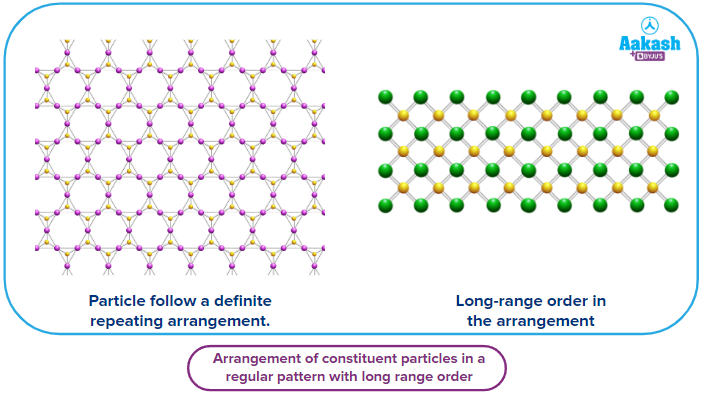
A solid is said to be crystalline if its various constituent particles are arranged in a definite geometric pattern in three-dimensional space so that there is a long-range order of the constituent particles.
Based on the nature of constituent particles & the binding force present between the particles, crystalline solids are classified as:
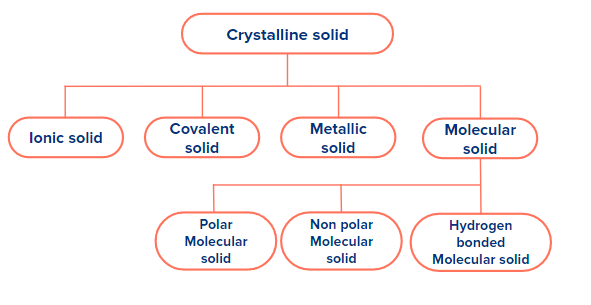
Classification of Crystalline Solids
Ionic solids
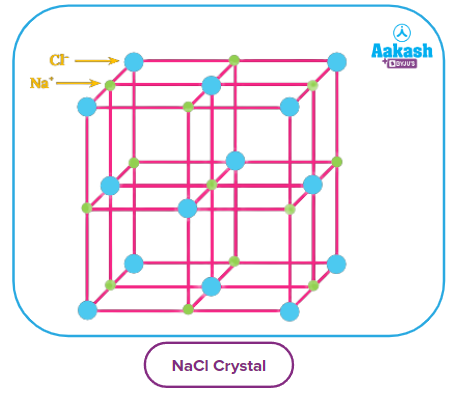
- Ions are the constituent particles of ionic solids, and these are held together by the electrostatic force of attraction.
- They are formed by the three-dimensional arrangement of cations and anions bound by strong electrostatic forces of attraction.

Characteristics of Ionic solids:
- They are hard and brittle.
- They have high melting and boiling points.
- Since the ions are not free to move, they are electrical insulators in solid state.
- However, in a molten state or when dissolved in water, the ions become free to move and conduct electricity. Examples: NaCl, ZnS, CsCl, CaF2, etc.
Covalent Solids
- A wide variety of crystalline solids of non-metals result from the formation of covalent bonds between the adjacent atoms throughout the crystal.
- In other words, the atoms or chemical subunits (the part of the crystal that is repeated to give the entire crystal) are bonded by conventional covalent bonds in a continuous network to form a covalent solid.
- They are also known as giant molecules or network solids. Examples: Diamond, graphite, and silicate.

Characteristics of Covalent Solids :
- Due to the strength and the directional nature of covalent bonds, the atoms are held very strongly at their positions. Hence, they are hard and brittle.
- They have extremely high melting points and may even decompose before melting.
- They are insulators. Examples: Diamond, graphite, quartz (SiO2), silicon carbide, etc.
- Diamond is the hardest natural substance.
Metallic Solids
- Metallic solids are composed of positively charged metal ions in a three-dimensional arrangement.
- These positive ions are surrounded and held together by a sea of free electrons.
The positively charged gold metal ions are surrounded by a sea of free electrons.
Characteristics of Metallic solids:
- Metallic solids possess lustre and are coloured in certain cases.
- They are highly malleable (made into sheets on applying pressure) and ductile (can be drawn into thin wires) in nature.
- They show high thermal and electrical conductivity due to the presence of free and mobile electrons. Examples: Fe, Cu, Ag, Mg, etc.
Molecular solids
In these solids, the constituent particles are molecules. Depending on the nature of molecules, these are subdivided into the following three types:
| Non-polar Molecular solids | Polar Molecular solids | Hydrogen bonded Molecular solids |
| The constituent particles are either atoms like those of noble gasses or nonpolar molecules like H2,Cl2 ,I2,CH4, etc. | The constituent particles are polar molecules like HCl, SO2 etc. |
The constituent particles are such molecules that contain a hydrogen atom linked to a highly electronegative atom that is small in size such as F, O or N. Examples: H2O, NH3, etc. |
| The forces operating between them are weak dispersion forces or London forces. | The forces holding these molecules together are dipole-dipole forces of attraction. | The strong hydrogen bond is holding the molecules together. |
| These are generally soft and due to weak intermolecular forces present in them, non-polar molecular solids are usually gaseous or liquid at room temperature and pressure. | These are soft. Polar molecular solids also exist as gases or liquids at room temperature and pressure. | They exist as volatile liquids or soft solids at room temperature and ordinary pressure. |
| They are non-conductors of electricity as there are no ions present. | They are non-conductors. | They are non-conductors of electricity. |
| As they are soft, they have low melting and boiling points. | Their melting and boiling points are comparatively higher than non-polar solids, though not so high. | Their melting and boiling points are higher than non-polar and polar molecular solids. |
Practice Problems
Q1. Wax is an example of:
A. Ionic crystal
B. Covalent crystal
C. Molecular crystal
D. Amorphous crystal
Answer: C)
Wax is a molecular crystal solid. Here, the constituent particles are molecules and the molecules are held together by the weak Van der Waals forces of attraction.
Q2. Is H2O (s) a crystalline solid?
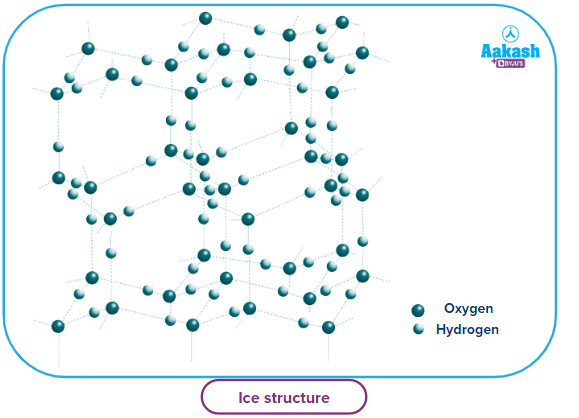
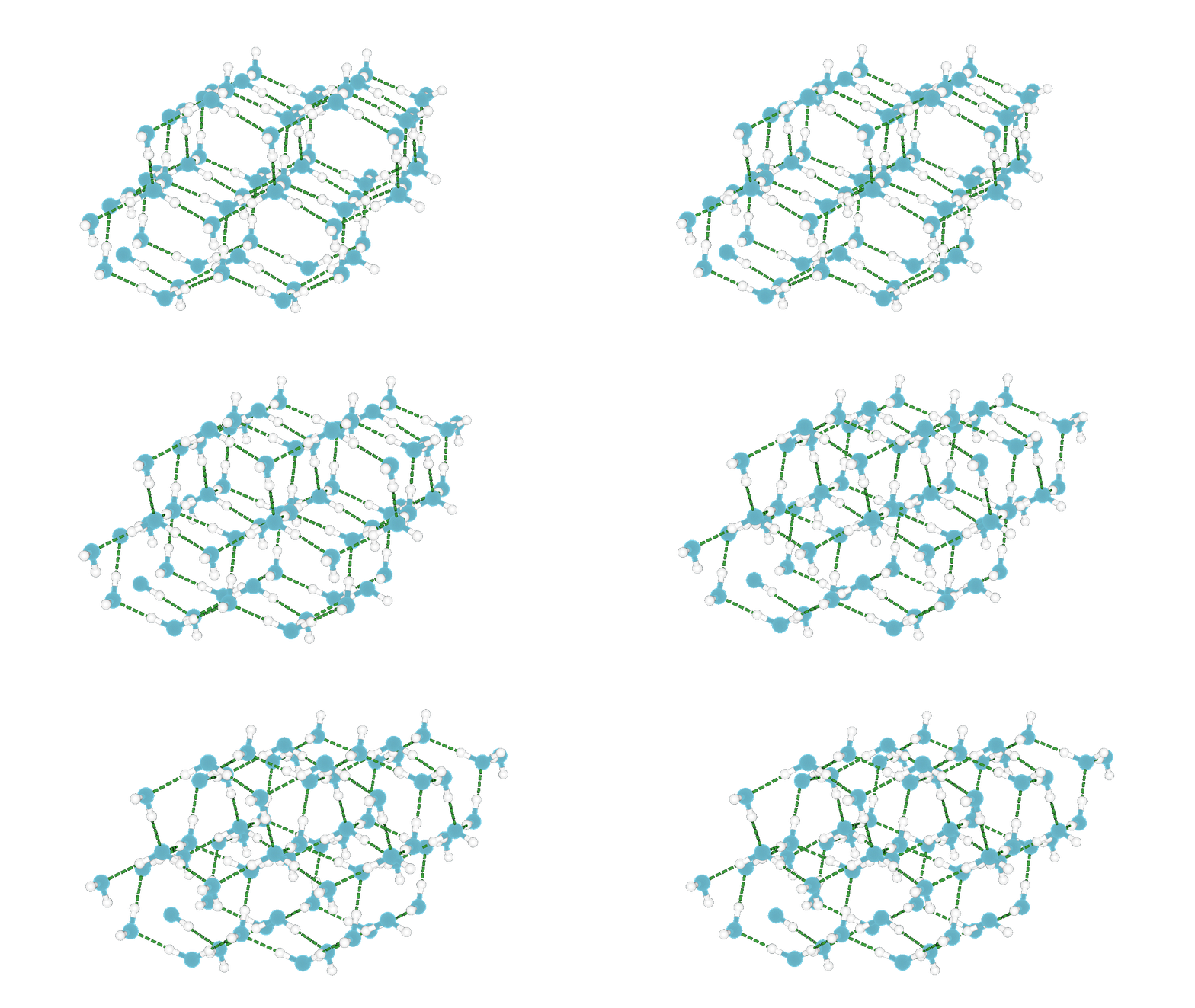
Answer: H2O (s) or Ice is a hydrogen bonded crystalline solid. Each H2O molecule in ice is tetrahedrally bonded to 4 other H2O molecules via hydrogen bonds. The cage-like structure of water molecules has a long-range order. Hence, H2O (s) or ice is a crystalline solid.
Q3. Iodine molecules are held in the crystal lattice by
A. London force
B. Dipole-dipole interaction
C. Covalent bond
D. Coulombic force
Answer: A)
Iodine molecules are non-polar molecular solids in which the constituent particles (molecules) are held together by the London force.
Q4. Graphite is a good conductor of electricity due to the presence of
A. Lone pair of electrons
B. Free valence electrons
C. Cations
D. Anions
Answer: (B)
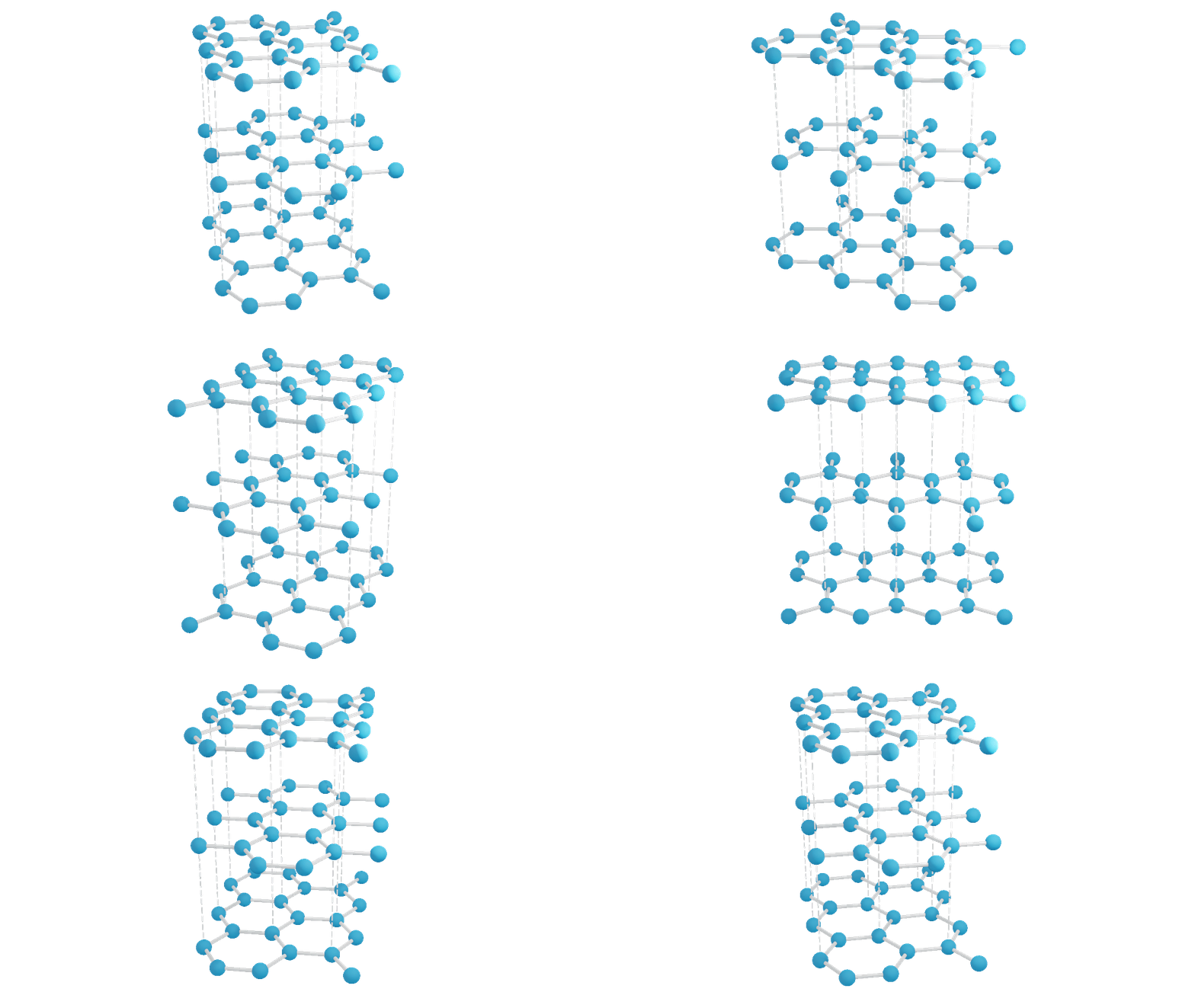
Graphite is an allotrope of carbon. Here, the carbon atom is bonded to 3 other carbon atoms leaving one free valence electron, as there are 4 valence electrons in a carbon atom. This electron is responsible for the conduction of electricity.
Frequently Asked Questions - FAQ
Question 1. How to distinguish a metallic solid from an ionic solid?
Answer: A metallic solid conducts electricity in the solid state whereas an ionic solid doesn’t conduct electricity in the solid state but conducts only in the aqueous solution or molten state.
Question 2. What type of solid is SiC?
Answer: SiC is a covalent solid as Si and C areboth non-metals and they are held together by a covalent bond which forms a network. SiC is very hard and brittle, it has an extremely high melting point and SiC is an insulator which are the properties of covalent or network solids.
Question 3. Can NaCl (s) conduct electricity?
Answer: NaCl is an ionic crystalline solid. To conduct electricity in any substance there should be particles that possess a carrier to transfer electrons. In the case of ionic solids, the carriers are ions, which only dissociate in their aqueous or molten state. Hence, NaCl (s)can not conduct electricity in its solid state.
Question 4. Are crystalline solids ductile?
Answer: All crystalline solids have some common properties such as anisotropy, long-range order, and sharp melting point, but ductility and malleability properties are shown by only metallic crystalline solids.
Examples: Cu, Ag, Au and Al.
Related Topics
| Types of Solids | Voids |
| Crystal Defects | Types of Unit Cell & Crystal Lattice |
| Crystal system and Bravais lattice | Magnetic properties |

 Call Now
 Let's Chat
 Share
Share