-
Call Now
1800-102-2727


Condensation Polymers- Definition, Examples of Condensation Polymer, Bakelite, Polymers With Monomers, Practice Problems and FAQs

We all have used switches to switch on fans and lights in our house, but do you know what these switches are made of? Yes! These switches are made of a special type of product which has properties like high resistance against electricity, heat and other chemical action and is known as bakelite. Between 1907-1909 Leo Baekeland, a Belgian chemist, successfully developed the first synthetic moulding plastic called Bakelite.
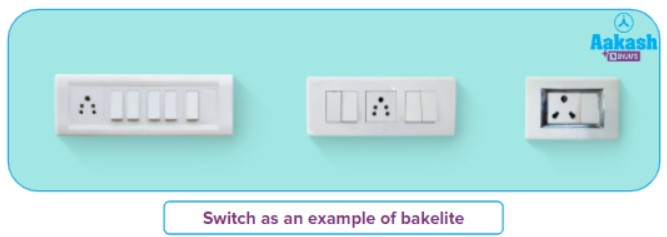
Table of Contents
- Definition of condensation polymer
- Examples of condensation polymers
- Bakelite
- Polymers with monomers
- Practice problems
- Frequently asked questions-(FAQs)
Definition of condensation polymer
- Condensation polymers are formed as a step-growth polymerization technique where smaller molecules or monomers react with each other to form larger structural units (called polymers) while releasing small by-product molecule. The by-products are normally referred to as condensate.
- In a step-growth polymerization process, two bifunctional monomers condense to form dimers, which then produce tetramers, and so on, with the loss of simple molecules such as H2O, CO2, HCl in reactions.
Examples of condensation polymerisation
Polyesters: Polyesters are polymers of ester monomers. They are formed by the condensation reaction which results in the release of simple molecules like H2O, CO2, etc,
1. Terylene:
- It is the polymer which is formed by the polymerisation of ethylene glycol [OH-(CH2)2-OH] and terephthalic acid [HOOC - C6H4 - COOH]
- It is crease-resistant, long-lasting, and has a low moisture content. It is resistant to both acidic and alkaline substances, as well as pests such as moths.
- It is used to make wash-and-wear fabrics.
- Terrycot and Terrywool are made by combining them with cotton and wool, respectively.

2. Glyptal:
- The condensation polymerisation of phthalic acid and ethylene glycol gives glyptal.
- Polyethene phthalate is a thermoplastic which is used as an adhesive in paints and lacquers.

Polyamides: Polyamides are polymers of amide monomers. Proteins and nylons are some examples of polyamides.
1. Nylon-6,6: The condensation polymerisation of hexamethylenediamine and adipic acid gives Nylon-6,6.

2. Nylon-6,10: The condensation polymerisation of hexamethylenediamine and sebacic acid gives Nylon-6,10.

3. Nylon-6: It is obtained by heating caprolactam at a temperature of 533 K to 543 K. Nylon-6 is also called Perlon-L.

Melamine-Formaldehyde resins
1. Melmac:
- It is formed by the polymerisation of melamine and formaldehyde.
- It is used in the manufacture of unbreakable plastic crockery i.e., plates and cups.

2. Phenol-Formaldehyde resins:
- It is the polymer formed by the polymerisation of phenol and formaldehyde.
- They have been widely used for the production of moulded products including billiard balls, laboratory countertops, and coatings and adhesives.

3. Novolac (or) Resol: It is formed by polymerisation of phenol or substituted phenol with formaldehyde. It is a thermoplastic used in the manufacture of adhesives. When the ratio of phenol to formaldehyde (P/F ratio) is greater than 1, this polymer is formed.

4. Polyurethanes: The reaction of isocyanates with alcohols give urethanes, which are carbonate esters. When diols react with diisocyanates, polyurethanes are obtained.


Polyurethanes are used in the manufacture of polyurethane foams (PUF). During the manufacture of PUF, a small amount of water is added, which reacts with some of the diisocyanates to give carbamic acid. Carbamic acid loses CO2 rapidly to give an aromatic diamine. The liberated CO2 is trapped in the bulk of the polymer, giving a spongy product called polyurethane foam (PUF).

Bakelite
- It is a condensation polymer is made up of phenol and formaldehyde monomers.
- Bakelite is also known as polyoxybenzyl methylene glycol anhydride.
- It is one of the oldest man-made polymers.It is the also an example of a thermosetting plastic.

Preparation: When phenol is taken in excess under an acidic medium then the product of this condensation reaction is acidic. The quantity of formaldehyde is considered as more than the quantity of phenol in the mixture and the reaction occurs as a basic medium and the product formed is known as Resol. The reaction that takes place is highly exothermic.

The preparation of Bakelite is done in the following steps:
1. Phenol and formaldehyde combine to form ortho and para hydroxy benzyl alcohols.
2. Formation of Novolac takes place from hydroxy benzyl alcohol and a water molecule is removed from the process.
3. Bakelite is formed from novolac.
4. Preparation of bakelite involves heating of phenol and formaldehyde in the presence of catalyst ZnCl2, HCl or NH3.
Properties:
- It is the commercial name for phenol-formaldehyde resin.
- It can be made into a variety of bright colours.
- Bakelite can be quickly moulded.
- It is malleable and liquefiable when heated and becomes permanently hard after cooling. So it is also known as thermosetting plastic.
- It has high resistance against electricity, heat and other chemical action. So, it is preferred to make electronic gadgets, switches, and automobile parts.
Uses of bakelite
- Bakelite is a good insulator used in non-conducting parts of radio and electric devices like switches, automobile distribution caps, insulation of wires, Sockets, etc.
- It is used to make clocks, buttons, washing machines, toys, kitchenware, etc.
- It can be made into different colours so it is used in producing vibrant and attractive products.
- Many things like plastic handles of utensils, bangles, and automobile parts are made up of Bakelite.
Polymer with monomers
|
Polymer |
Monomer |
Structure |
|
Terylene |
glycol and terephthalic acid |
|
|
Glyptal |
phthalic acid and ethylene glycol |
|
|
Nylon-6 |
caprolactam |
|
|
Nylon-6,6 |
hexamethylenediamine and adipic acid |
|
|
Nylon-6,10 |
hexamethylenediamine and sebacic acid |
|


Practice problems
Q 1. Which of the following is a step growth polymer?
a. Polyacrylonitrile
b. Polyisoprene
c. Nylon
d. Polyethylene
Answer: C)
Since condensation polymerisation generates polymers in a stepwise manner, it is also called step growth polymerisation, and the polymers obtained by this process are called step growth polymers. Among the given options, the compounds given in options a), b) and d) are obtained by addition reaction, whereas the class of compound given in option c) is obtained by condensation polymerisation. Thus, nylon is a step growth polymer. So, option C) is the correct answer.
Q 2. Terylene is a:
a. Polyvinyl polymer
b. Polyethylene polymer
c. Polyester polymer
d. Polyamide polymer
Answer: C
Terylene is the polymer of ester molecule and is classified as polyester polymer which is formed by the polymerisation of ethylene glycol and terephthalic acid
Q 3. Bakelite is a:
a. Polyvinyl polymer
b. Polyethylene polymer
c. Polyester polymer
d. Polyamide polymer
Answer: D
Bakelite is a thermosetting plastic that is made up of phenol and formaldehyde monomers. It is a type of polyamide polymer.
Q 4. When the ratio of phenol to formaldehyde (P/F ratio) is greater than 1, the polymer is formed is:
a. Bakelite
b. Novolac
c. Melmac
d. Nylon-6
Answer: B
When the ratio of phenol to formaldehyde (P/F ratio) is greater than 1, Novolac polymer is formed.
Frequently asked question(FAQs)
Q 1. What is diference between condensation and addition polymer?
Answer: condensation polymer takes place those compound having bi or tri functional group with elimination of small molecules such as water, ammonia, alcohol etc. Whereas, addition polymer is formed by combining monomers and no byproduct is formed.
Q 2. Why bakelite is an example of a thermosetting plastic?
Answer: Novolac on heating with formaldehyde forms an infusible solid mass called bakelite. It is an example of thermosetting plastic because it forms 3-D network solid once converted into infusible mass cannot be reused.
Q 3. What is difference between polyamides and polyesters?
Answer: Polyamides is a type of condesation polymer formed when monomer are linked with amide linkage with the elimination of small molecules such as water, ammonia, alcohol etc for example- Nylon-6,6. Polyesters is the type of condensation polymer which contains ester linkage for example-Dacron or terylene
Related topics
|
Use Of Polymer |
Biodegradable Polymer |
|
Molecular mass of polymer |
Rubber |
|
Classification of polymer |
Addition polymerisation |

 Call Now
 Let's Chat
 Share
Share