-
Call Now
1800-102-2727


Combustion of Alkynes- Complete and Incomplete Combustion of Alkynes, Example, Practice Problems and FAQs

You might have seen miners, and hunters, having a light on their cap for vision in darkness. Can you guess the source of the light? It is the “ acetylene lamp “. Acetylene lamps produced no carbon monoxide, used less oxygen, produced a brighter 4-6 candlepower light, and has a higher diffused light quality than the candles or oil-wick lamps it replaced. These are also referred to as carbide lamps. The reaction of calcium carbide (CaC2) with water powers these lamps (H2O). This reaction generates acetylene gas (C2H2), which burns with a pure white flame. They operate on the principle of in-situ combustion of alkyne acetylene. Let us go over the combustion of alkynes in greater detail.
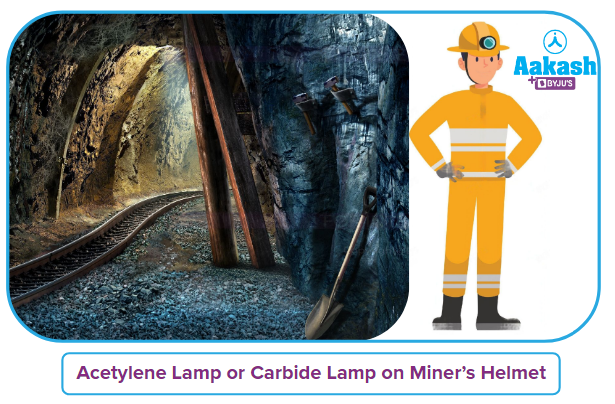
Table of Contents
- Combustion Reactions
- Complete Combustion Reaction
- Incomplete Combustion Reaction
- Complete Combustion of Alkynes
- Incomplete Combustion of Alkynes
- Practice Problems
- Frequently Asked Questions
Combustion Reactions
In general, combustion reactions are highly exothermic redox reactions between an oxidant and a fuel. The oxidized fuel is typically the product of a combustion reaction (which is mostly liberated in the gaseous state). This is commonly known as smoke.
Complete Combustion Reaction
Complete combustion reactions, also known as clean combustion reactions, entail the complete oxidation of the fuel (usually a hydrocarbon). Such reactions frequently produce only water and carbon dioxide as byproducts. The combustion of wax candles is a common example of a clean combustion reaction.
Incomplete Combustion Reaction
Incomplete combustion reactions (also known as 'dirty' combustion reactions) are combustion reactions that produce byproducts such as CO, ash and soot. It is common for such combustion reactions to produce carbon monoxide (a highly poisonous gas with the chemical formula CO) and water.
Complete Combustion of Alkynes
The general reaction for the complete combustion of alkynes is given as follows:
|
Alkyne |
Complete combustion reaction |
|
C2H2 |
|
|
C3H4 |
|
|
C4H6 |
|
|
C5H8 |
Incomplete Combustion of Alkynes
The general reaction for the incomplete combustion of alkynes is given as follows:
|
Alkyne |
Incomplete combustion reaction |
Balanced Incomplete combustion reaction |
|
C2H2 |
||
|
C3H4 |
||
|
C4H6 |
||
|
C5H8 |
Practice Problems
Q1. Which of the following has the same hybridisation as its combustion product, CO2?
- Ethane
- Ethyne
- Ethene
- Ethanol
Solution: Steric number (SN) of carbon in CO2 = () = 2
Hence, carbon is sp hybridized in CO2. It has a linear geometry. In ethyne (CHCH), carbon has sp hybridisation. Hence, ethyne has a linear geometry.
Hence, option (B) is the correct answer.
Q2. Calculate the number of moles of oxygen used respectively when complete and incomplete combustion of 2 moles of But-2-yne is done?
- 11, 11
- 7, 7
- 11, 7
- 7, 11
Solution: When complete combustion of But-2-yne occurs, it would produce carbon dioxide and water. The balanced equation shows that 11 oxygen molecules are required.
When incomplete combustion of But-2-yne occurs, it would produce carbon monoxide and water. The balanced equation shows that 7 oxygen molecules are required.
Hence the correct answer is an option (C).
Q3. Calculate the number of moles of carbon dioxide formed when complete combustion of Propyne is done?
- 2
- 5
- 4
- 3
Solution: When complete combustion of But-2-yne occurs, it would produce carbon dioxide and water. The balanced equation shows that 3 carbon dioxide molecules are formed.
Hence the correct answer is an option (D).
Q4. Calculate the number of moles of water molecules formed when complete and incomplete combustion of Cycloheptyne is done?
- 10, 10
- 5, 5
- 5, 10
- 10, 5
Solution: When complete combustion of Cycloheptyne occurs, it would produce carbon dioxide and water. The balanced equation shows that 10 water molecules are formed.
When incomplete combustion of Cycloheptyne occurs, it would produce carbon monoxide and water. The balanced equation shows that 5 water molecules are formed.
Hence the correct answer is an option (D).
Frequently Asked Questions- FAQs
Q1. Is combustion an exothermic or endothermic process?
Ans. Overall, combustion is an exothermic reaction, which means that energy is released. During a combustion reaction, heat and light are typically released.
Q2. Why is oxygen required during combustion?
Ans. The chemical processes that occur during fire are aided by oxygen. When fuel burns, it reacts with oxygen in the surrounding air to produce heat and combustion products (gases, smoke, embers, etc.). This is referred to as oxidation.
Q3. How are alkynes burned?
Ans. Alkynes, like other hydrocarbons, burn-in oxygen to produce carbon, carbon monoxide, carbon dioxide, and water, depending on the temperature and amount of oxygen present. The principles of complete combustion of alkynes are the same as those of alkanes or alkenes.
Q4. What are the primary applications of acetylene combustion?
Ans. The primary application of acetylene is as fuel gas. In fact, it is the only fuel gas suitable for welding. It's also great for brazing, cutting, flame gouging, spot heating, hardening, texturing, cleaning, and thermal spraying.
Q5. How is acetylene made?
Ans. Acetylene can be made in three ways: by reacting water with calcium carbide, by passing a hydrocarbon through an electric arc, or by partially burning methane with air or oxygen.

 Call Now
 Let's Chat
 Share
Share