-
Call Now
1800-102-2727


Classification of polymers - Monomers, Polymers, Classification of polymers, Natural Polymers and its use, Practice Problems and FAQs

Polymers have huge range of application in daily life which includes protein molecule which is essential for body growth, serve as a source of energy and is one of the important nutrient for human body. Protein molecule is formed by combining smaller molecules known as amino acid. Polymer is derived from the Greek terms poly and mer, which imply many units or components, respectively. Polymers have huge molecular masses, and each polymer molecule is made up of a large number of simple structural units linked together in a regular pattern by covalent bonds.
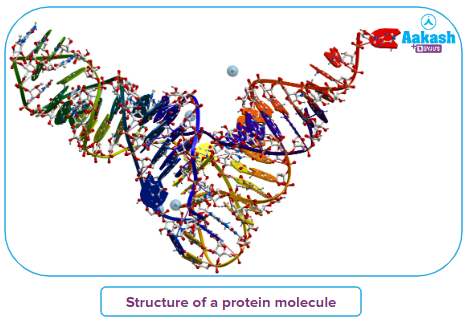
Table of Contents:
- Monomers
- Polymers
- Classification of polymers
- Natural polymer and its use
- Practice problems
- Frequently asked questions-FAQs
Monomers
The simple repeating structural units from which the polymers are built are called monomers. Examples: Ethylene, Vinyl chloride, butadiene, acrylonitrile, neoprene etc.
Polymers
Polymers are macromolecules consisting of simple molecules(i.e monomers) are joined together by covalent bonds. The process by which monomers are linked to form a polymer is called polymerisation. Examples: Polyethylene, Buna-S, Buna-N etc
Classification of Polymers
1. Classification of Polymers based on monomers
- Homopolymers: Polymers formed by the polymerisation of one type of monomeric units are called homopolymers.
Examples: Polyethylene, Polyvinyl chloride (PVC), etc,.
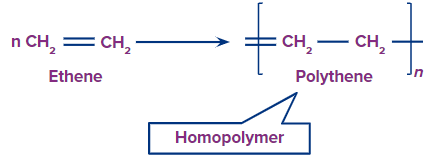
- Copolymers: Polymers formed by the polymerisation of two or more different monomeric species are called copolymers.Examples: Buna-S, Nylon-6,6, Buna-N etc,.
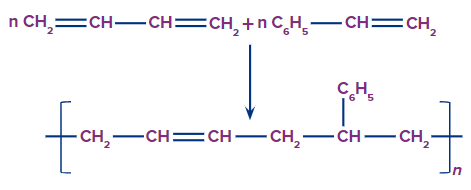
Co-polymerisation of 1,3-Butadiene and Styrene to form Buna-S
2. Classification of Polymers based on source of availability
- Natural polymers: Natural polymers are the type of polymers found in living systems and are composed of either organic or inorganic subunits. These are present naturally and participate in the vital functioning of an organism. For example, cellulose and starch are polysaccharides that are polymers of sugars; proteins are polymers of amino acids, natural rubber.
- Synthetic polymers: Synthetic polymers are synthesised in the laboratory as a by-product of certain chemical reactions. These macromolecules are not naturally present but can only be synthesised. An example of synthetic polymers is polyethylene, Polyethylene, Buna-S, Nylon-6,6, etc,.
- Semi-Synthetic polymers: These are derived from naturally occurring cellulose and petroleum byproducts. The source of the polymer is natural, but is eventually synthesised in the laboratory. Hence, the name is semi-synthetic polymers.Examples: Rayon, Cellulose nitrate, etc,.
3. Classification of polymers based on structure
- Linear polymers: Polymers consisting of long straight chains of polymers that are stacked over each other are called linear polymers. Due to their well-packed structure, they have high melting points, tensile strengths and densities.Examples: High density polyethylene (HDP), Nylon, etc,
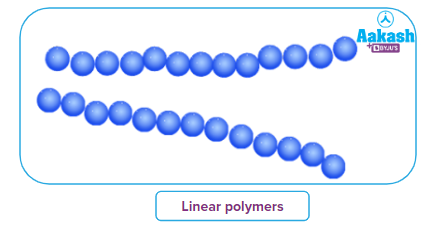
- Branched-chain polymers: In these polymers, the long straight chains of polymers are branched along the main chain. Due to branching these polymers do not pack well. Therefore they have low melting points, tensile strengths and densities.Examples: Low density polyethylene (LDP), glycogen, amylopectin, etc,.

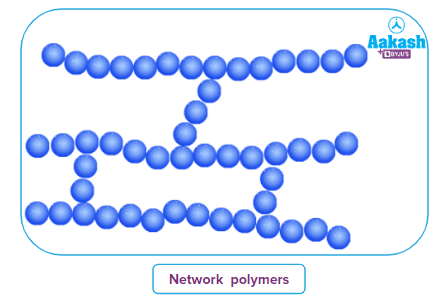
- Cross-linked or network polymers: In these polymers, the long straight chains of polymers are joined together to form a three-dimensional structure. These polymers are hard, rigid and brittle.Example: Bakelite, Melamine, etc.
Classification of polymers based on synthesis
- Addition polymers: The molecules of the same or different monomers add on one another in addition polymerisation, resulting in the production of a macromolecule. The molecular formula of the repeating unit of the polymer is the same as the parent monomers. Example: polyethylene, polyacrylonitrile(PAN), buna-S, buna-N etc
- Condensation polymers: Monomers combine with the loss of simple molecules such as water, carbon dioxide, ammonia, etc. in condensation polymerisation to generate a macromolecule. The molecular formula of the repeating unit of the polymer differs from the parent monomers.
Example: Dacron, Nylon-6, Nylon-6,6 etc.
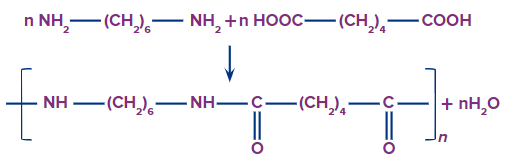
Condensation polymerisation of Hexamethylene diamine
and adipic acid to form Nylon -6,6
Classification of polymers based on molecular forces
Intermolecular forces of attraction control the mechanical properties of polymers such as tensile strength, elasticity, and toughness. The polymer chains are held together by intermolecular forces of attraction such as van der Waals forces and hydrogen bonds.
- Elastomers: These are the polymers with the weakest intermolecular forces of attraction. Elastomers can be stretched up to ten times their original length and still keep their shape when the force is withdrawn. While the van der Waals forces permit the polymer to be stretched, the cross-links aid the polymers in regaining its shape.Examples: Natural rubber, Buna-S, etc.,
- Fibres: The strongest intermolecular forces of attraction are found in fibres. Hydrogen bonding and dipole-dipole interactions are responsible for these forces. Fibres have a high tensile strength and low flexibility due to strong intermolecular forces of attraction. Examples: Nylon-6,6, Terylene, etc,.
- Thermoplastics: They have intermolecular forces in between elastomers and fibres. These are linear polymers which are hard at room temperature and become soft and viscous on heating. On cooling, they again become rigid. The process of heating and cooling can be repeated as many times as required without any change in the chemical composition and mechanical properties.
Examples: Polythene, polyvinyl chloride, etc,.
- Thermosetting polymers: These are low molecular weight polymers which on heating in a mould undergo a change in chemical composition to hard, infusible and insoluble mass. The hardening is due to extensive cross-linking between the polymers. Examples: Bakelite, melamine, etc,.
Note: Certain plastics do not soften on heating. These plastics can be made soft and ready for use by the addition of certain organic compounds called Plasticisers. Some common plasticisers are dialkyl phthalates and o-cresyl phosphates
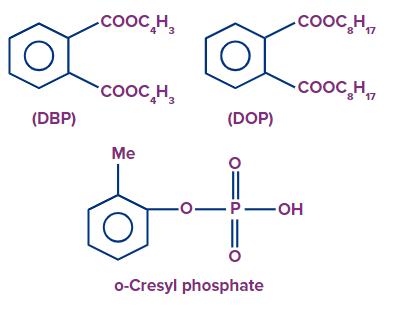
Here, DBP stands for Di n-butylphthalate; DOP stands for Di n-octyl phthalate
Natural polymer and its use
It is type of natural polymer which is found in plants and animals. The subunits of natural polymers are either monosaccharides, amino acids, or nucleotides. The functions performed by natural polymers found in the body include providing structural integrity to the cell, carrying genetic information across generations, serving as a source of energy, and contributing to various metabolic activities of the biological system.
- For example, cellulose and starch are polysaccharides that are polymers of sugars; proteins are polymers of amino acids.
- Various other natural polymers also have great commercial value.
- For example, the plant exudate latex (rubber) is used in the industries. Rubber is a polymer of isoprene.
- The naturally occurring allotropes of carbon, i.e. graphite and diamond, are also natural inorganic polymers formed by the catenation of carbon.
- organic polymers are important in living organisms because they provide fundamental structural elements and participate in important life processes
Practice problems
Q1. Polymers formed by the polymerisation of two or more different monomeric species are called _______ .
- Monomers
- Elastomers
- Copolymers
- Homopolymers
Answer: B
Solution: Polymers formed by the polymerisation of two or more different monomeric species are called copolymers.Examples: Buna-S, Nylon-6,6, Buna-N etc,.
Q2. Which of the following is a synthetic polymer?
- Cellulose acetate
- Cellulose nitrate
- Nylon-6,6
- Starch
Answer: B
Solution: Nylon-6,6 is a synthetic polymer. Whereas, cellulose nitrate , cellulose acetate is a semisynthetic polymer and starch is a natural polymer.
Q3. Which of the following is a network polymer?
- Bakelite
- HDP
- LDP
- Amylopectin
Answer:A
Solution: Bakelite is an example of cross linked or network polymer, amylopectin is an example of branched polymer and LDP, HDP is the example of a linear chain polymer.
Q4. Which of the following has the weakest intermolecular forces?
- Elastomers
- Fibres
- Thermopolymers
- Thermosetting polymers
Answer:A
Solution: Elastomers is a type of polymer which have weak vanderwaal force of attraction and has the ability to get stretched to 10times of its original length.
Frequently asked questions-FAQs
Question 1. Why are polymers like starch and protein natural as well as biodegradable polymers?
Answer. Starch and protein are natural polymers because they are obtained from natural sources like plant and animal. But these polymers are also biodegradable polymers because they can be decomposed into simpler unit in the presence of microorganism or enzyme.
Question 2. How can we differentiate elastomers and fibers on the basis of its intermolecular strength?
Answers. Elastomers is a type of polymer which have weak vanderwaal force of attraction and has the ability to get stretched to 10 times of its original length for example, Buna-S, Buna-N etc. Whereas, fibres have comparatively stronger force of attraction forces like hydrogen bond or dipole-dipole interaction and because of this they have high tensile strength, for example- polysters, polyamides etc.
Question 3. Why cellulose acetate also known as rayon is a semisynthetic polymer while cellulose is a natural polymer?
Answer. Rayon which is also known as cellulose acetate is a semisynthetic polymer because it is derived from natural occurring cellulose but is synthesised in the laboratory. Cellulose is polymer which is found mainly in the cell wall of plant and therefore it is a natural polymer.
Question 4. What is the importance of vulcanisation of natural rubber?
Answer. In natural rubber there is weak vanderwaal force of attraction. Thus on increasing temperature its tensile strength and elasticity decreases, In order to increase the tensile strength and elasticity of natural rubber sulphur is mixed at high temperature resulting in crosslinked procuct and is known as valcunisation of rubber.
Related topics
|
Condensation polymer |
Preparation of polythene with mechanism |
|
Use Of Polymer |
Biodegradable Polymer |
|
Molecular mass of polymer |
Rubber |

 Call Now
 Let's Chat
 Share
Share