-
Call Now
1800-102-2727


Claisen Condensation

Claisen condensation is one of the significant reactions from organic chemistry, focusing on carbon-based compounds and their interactions. It plays an important role in synthesising complex organic molecules, making it an organic reaction providing numerous advantages in the real world.
Table of Contents
- What is Claisen Condensation?
- Mechanism of Claisen Condensation
- Variation of Claisen Condensation
- Limitations of Claisen Condensation
- Applications of Claisen Condensation
- Practice Problems
- Frequently Asked Question
What is Claisen Condensation?
A carbon-carbon bond generated between a single ester and a carbonyl compound or between the two esters is called Claisen condensation. A strong base is required to continue the Claisen condensation reaction. The end product of the reaction will be beta-diketone or beta-keto ester. The reaction was named after the German scientist Rainer Ludwig Claisen as he discovered it.
Mechanism of Claisen Condensation
The mechanism of the Claisen condensation reaction continues with the following steps.
Step 1: Removal of Alpha Proton
The elimination of an alpha proton is because of the strong base. It leads to the formation of an enolate ion. Because of the localisation of the negative charge of electrons, an enolate ion is comparatively stable.

Image: Formation of an enolate anion.
Step 2: Resonance Stability
Now the enolate anion targets the nucleophilic attack on the carbonyl carbon of the second ester reactant. It results in the elimination of the alkoxy group and the renewal of the conjugate base of alcohol. Thus, the created doubly alpha proton is then eliminated by an alkoxide anion to form a fresh resonance-stabilised enolate anion.
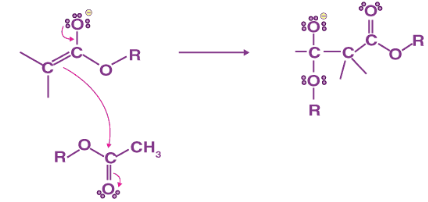
Image: Resonance stabilised enolate anion
Step 3: Formation of beta-diketone or beta-keto ester
Proceeding with the third step of the reaction involves the addition of an aqueous acid like sulphuric or phosphoric acid. It is used to neutralise the negative charge of the enolate along with the remaining bases, forming a beta-keto ester and beta-diketone. Furthermore, the formed compounds are isolated, and the rest is discarded.

Image: Final step condensation reaction
Variation of Claisen Condensation
The Claisen condensation reaction involves modified variations. They are as follows.
- The original Claisen condensation reaction involves two molecules of an ester consisting of compounds, and the ester can be enolised further in the procedure.
- A cyclic beta-keto ester is formed when two ester groups from the same molecule react intramolecularly during Dieckmann condensation.
- A crossed Claisen condensation reaction combines an enolisable ester or ketone with a non-enolisable ester.
- Another modified variation of Claisen condensation is Stobbe condensation. It involves a reaction with relatively weaker bases. During the procedure, a succinic acid-based diethyl ester is used.
Limitations of Claisen Condensation
Claisen condensation is one of the versatile reactions that occur in organic chemistry though it involves some challenges.
- Steric hindrance can impact the Claisen condensation reaction, resulting in a fluctuation in selectivity and efficiency.
- The electronic effect may negatively influence the effectiveness of Claisen condensation reaction.
- Claisen condensation reaction involves the formation of unwanted byproducts.
- Control of reaction procedures may get challenging at times.
Applications of Claisen Condensation
The distinct applications of Claisen condensation reactions have led to recent advancements. They are as follows.
- The reaction is utilised for the development of a catalytic system.
- It helps in the exploration of distinct circumstances of new reactions.
- It enables the breakdown of complex molecules with enhanced efficacy.
Practice Problems
Q1. Claisen condensation is an important reaction potentially used in
A. Inorganic chemistry
B. Organic chemistry
C. Biophysics
D. All of the above
Answer: B. Organic chemistry
Claisen condensation reaction is widely used in organic chemistry.
Q2. Who discovered Claisen condensation reaction
A. Mendel
B. Ray
C. Einstein
D. Ludwig
Answer: D. Ludwig
Rainer Ludwig Claisen was a German scientist who discovered the organic reaction, Claisen condensation.
Q3. Choose the variations of Claisen condensation
A. Stobbe condensation
B. Dieckmann condensation
C. Both a and b
D. None of the above
Answer: C. Both a and b
Both Stobbe and Dieckmann condensation are the modified variations of Claisen condensation.
Frequently Asked Question
Q1. State a similarity between Aldol and Claisen condensation reaction.
Answer: Both are organic condensation reactions involving the addition of enolates with the organic compounds.
Q2. State a difference between Claisen condensation and aldol reaction.
Answer: Aldol condensation reaction involves adding enolates to esters. On the other hand, the aldol condensation reaction involves adding enolates to aldehydes or ketones.
Q3. Is it necessary to learn condensation reactions for NEET preparation?
Answer: Yes. Organic chemistry evolves around reactions, where condensation reactions play a major role. It is important to learn these reactions to understand the procedure and the formation of products. It boosts the scores and increases your chance of selection.

NEET Related Links
JEE MAIN Related Links
JEE Advanced Related Links
JEE Advanced Eligibility Criteria
JEE Advanced Chemistry Syllabus
JEE Advanced Registration Dates
CUET Related Links
Important Topics
Anemometer : Measurement of Wind Speed
Angular Acceleration Atomic Theory Audible and Inaudible Sound Average Speed and Average Velocity Average Velocity Avogadros Number Avogadros Hypothesis Azimuthal Quantum Number Balanced Force Bar Magnet Biconvex Lens Boyles Law Buoyancy Calorimeter Carnot Engine Celestial Bodies Centripetal And Centrifugal Force Concave and Convex Lenses Concave Convex Mirrors Contact and Non Contact Force Controlled Thermonuclear Fusion Convection Currents Convex Lens Convex Mirror Destructive Interference Difference Between Conduction Convection and Radiation Difference Between Electric Field and Magnetic Field Difference Between Heat And Temperature Difference Between Series And Parallel Circuits Differences Between Acceleration And Velocity Distance and Displacement Distance Time Graph Electrical Force : Electric Forces and Their Types Electromagnetic Waves : Definition, Equation and Properties of Electromagnetic Waves Electromagnetism Electron Spin Fluid Flow : Bernoullis Equation Derivation and Fluid Mechanics Fluid Friction : Types and Factors of Fluid Friction Frames of Reference : Inertial and Non- Inertial Frame of Reference Frequency and Wavelength Frictional Force Importance of Hydrosphere Instantaneous Speed and Velocity Introduction to Motion Kinetic and Potential Energy Difference Law Of Conservation of Energy Layers of the Earth Light Energy Light Sources List of physics scientists and Their inventionsLoudness of Sound
Magnetic Dipole Moment Magnetic Field Non - Contact Force Non - Renewable Energy Ohms Law Optics P Wave Physics Symbols Plane Mirrors Poissons Ratio Projectile Motion Properties of Water : Anomalous Expansion of Water Radius of Gyration Reflection of Light Reflection of Waves Relative Density Resonance Reverberation Rolling Friction Rotation and Revolution Screw Gauge Semiconductors and Insulators Sliding Friction Speed Time Graphs Static Friction Stefan Boltzmann Law Stress Tension Tension Force Thermometer: Clinical Laboratory Thermometer Types of Rocks Types of Waves Uniform Motion and Non Uniform Motion Unit of Voltage Uses of Convex Lens Uses Of Convex Mirror Uses of Electromagnet Uses of Optical Fibre Wave Wavelength of Light What is Scattering of Light Working of Electric Bell Conventional and Non-conventional Sources of Energy Buoyant Force Bulk Modulus of Elasticity Bernoulli’s Principle Angular Momentum Difference Between Speed And Velocity ForceUnit of Heat
Difference between Distance and Displacement Simple Microscope Derivation Of Equation Of Motion Thermometer: Clinical & Laboratory Thermometer Difference between Concave and Convex LensDerivation Of Lens Maker Formula
Unit Of Pressure Velocity Uses of Plane Mirror
Wave Theory of Light
Unit of Density Unit of Light Unit of Force Unit of Magnetic Field Unit of wavelength Unit of Viscosity Uses of Electroplating Young's Modulus
What is the Scattering of Light
Lenz Law Space Wave Propagation Schrodinger Wave Equation Relation between Fahrenheit and Celsius Refractive Index Potentiometer Working Pascal Law Oscillatory Motion Optical Instruments Newton's Laws of Motion - First Law Modulation and Demodulation Magnetic Flux Lens Formula and Magnification Kaleidoscope Faradays Law Epsilon Naught Value Energy Bands Electrostatics Electroscope AC Generator Unit of Current Lithosphere Bending Equation Derivation Difference Between Pound and Kilogram Semiconductor Devices OTEC - Ocean Thermal Energy Conversion Hall Effect Rectilinear Propagation of Light Difference Between Ammeter and Voltmeter Coefficient of Linear Expansion Ampere’s Law Cyclone and Thunderstorm Save The Environment From Pollution Particle Nature of Light Types of DC Motor Uses Of Transistor Derivation of Phase Rule Unit of Humidity

 Call Now
 Let's Chat
 Share
Share