-
Call Now
1800-102-2727


Bohr’s Model of a Hydrogen Atom – Postulates, Mathematical Forms, Importance, Limitations, Practice Problems and FAQ

For many years, people believed that the sun and the other planets rotated around the earth, placing it at the centre of the solar system. Nicolaus Copernicus proposed that the solar system's centre is the sun, and that the planets orbit it, in 1543. The term for this is the heliocentric theory. Galileo Galilei's observation that the moons Callisto, Europa, Ganymede, and Io are in orbit around Jupiter further supported this theory.
I assume you are aware of the solar system. What relevance does it have to this concept page, though? Calm down; we'll get to that in a second.
In an atom, the nucleus lies at the centre and the electrons orbit it, just like the sun and planets do. Rutherford presented this model of an atom, therefore the name Rutherford's model of an atom. He was unable to demonstrate the location, arrangement, and the reason why the electrons did not fall back onto the nucleus due to electrostatic forces.
You may be thinking, "Isn't this page about Bohr's model? "
For hydrogen or species that are similar to hydrogen (like H, He+, Li2+), Niels Bohr suggested a new model of atoms that addressed some of the features that Rutherford's model was unable to explain. The postulates that served as the foundation for Bohr's theory were based on Planck's quantum theory.

In this concept page, we will get to know more about the Bohr’s model of the atom.
TABLE OF CONTENTS
- Postulates of Bohr’s Model
- Mathematical Forms of Bohr’s Postulates
- Calculation of Radius of Bohr’s Orbit
- Calculation of Velocity of an Electron in Bohr’s orbit
- Calculation of Time Period of Revolution of an Electron in Bohr’s Orbit
- Calculation of Frequency of an Electron
- Calculation of Energy of an Electron in Bohr’s Orbit
- Limitations of Bohr’s Model
- Practice Problems
- Frequently Asked Questions - FAQ
Postulates of Bohr’s Model
- The electrons revolve around the nucleus in a fixed circular orbit of definite energy. As long as the electron stays at this energy level, it does not radiate energy. These orbits are known as stationary orbits (energy level).

- An electron can revolve only in the orbits whose angular momentum (mvr) is an integral multiple of (where h is the Planck’s constant).
(where n is the orbit number in which the electron is present)
- Energy is emitted or absorbed only when an electron jumps from one energy level to another. An electron jumps to a higher energy orbit on absorbing energy. This is known as an excited state. The electron that is in an excited state can emit energy and drop to a lower energy state, as the excited state is unstable.
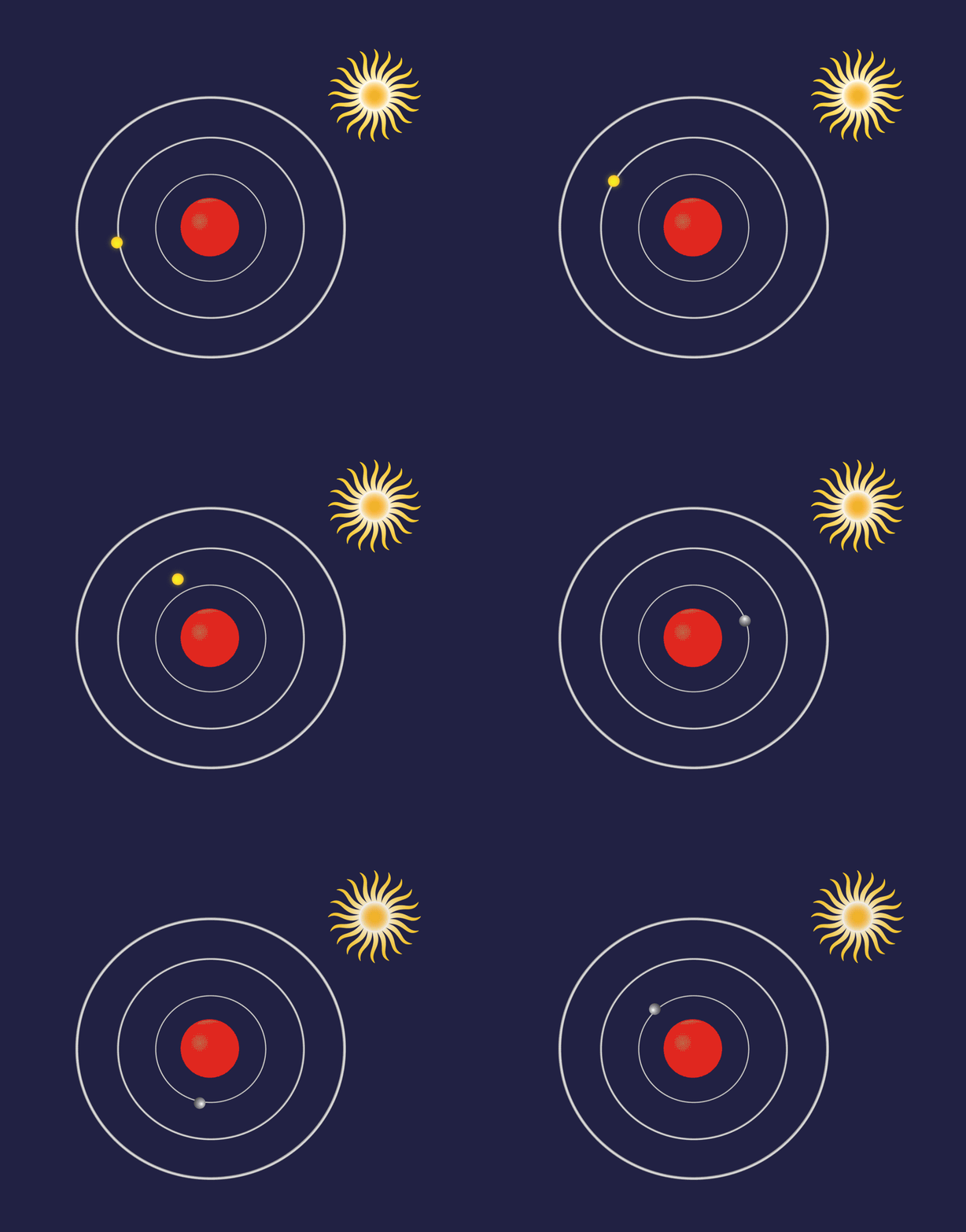


- In an atom, the electrons and nucleus are held together by the electrostatic forces of attraction. Like in a solar system, planets and the sun are held together by gravitational force.
Mathematical Forms of Bohr’s Postulates
Assume an electron having mass m and charge e revolving in orbit around the nucleus of an atom.
The atomic number of atom = Z = number of proton
Charge of nucleus = Ze (where, e = charge of an electron)
Radius of orbit = r A0
Tangential velocity of the electron in orbit = v m sec-1.
Calculation of Radius of Bohr’s Orbit
For a stable orbit
Centrifugal force on electron = Electrostatic force of attraction between the nucleus and electron
=
= ………………… (i)
From the postulates of Bohr’s model,
mvr =
v = ………………… (ii)
Substituting (ii) in (i),
=
r = ………………… (iii)
Where, n= energy level
h = Plank’s constant
m = mass of electron
K= Coulomb's constant = =
Z = atomic number of element
e = charge on single electron
= The permittivity of free space
On substituting the values of e, h,m, K and , the radius of nth Bohr orbit can be calculated.
Calculation of Velocity of an Electron in Bohr’s Orbit
We know that,
r =
mvr=
v=
Substituting the value of r in v,
v = ........................ (iv)
Where, n = energy level
h = Plank’s constant
m= mass of electron
K = coulomb's constant
Z = atomic number of element
e = charge on single electron
Substituting the values of e, h,m, K and , the velocity of an electron in Bohr’s orbit can be calculated.
m sec-1
Calculation of Time Period of Revolution of an Electron in Bohr’s Orbit
Time period of revolution (T) is defined as the time required by an electron to complete one revolution in its orbit. The time period of revolution can be calculated by taking the ratio of the radius of Bohr’s orbit and the velocity of an electron in an orbit.
Mathematically,
Time period (T) ∝ ........................ (v)
From equation (iii), the radius of Bohr’s orbit
From equation (iv), the velocity of an electron in an orbit
Where, n = energy level
Z = atomic number of the element
Substituting the values of the radius of Bohr’s orbit and the velocity of an electron,
Time period (T) ∝
Time period (T) ........................ (vi)
Calculation of Frequency of Revolution of an Electron
Frequency of revolution is defined as the number of revolution completed by an electron in one sec. It is calculated by taking the reciprocal of the time period of the revolution.
Mathematically,
Frequency of the revolution (f) =
From equation (vi),
Frequency of the revolution (f) ∝ ........................ (vii)
Calculation of Energy of an Electron in Bohr’s Orbit
We know that the total energy of an electron moving in an orbit (T.E) = Kinetic energy (K.E) + Potential energy (P.E)
Kinetic energy (K.E) =
Potential energy (P.E) = -
(nuclear charge = Ze and charge of electron = - e)
T.E = - ........................ (viii)
Substituting (i) in (vii),
T.E = - = - ...................... (ix)
Substituting the value r in (viii),
E = -
Where, 'n' represent the orbit in which electron revolves
h = Plank’s constant
m = mass of electron
K = Coulomb's constant
Z = atomic number of element
e = charge on single electron
Substituting the values of e, h,m, K and , the energy of an electron in Bohr’s orbit can be calculated.
Note: T.E = and T.E = - K.E
Conclusions from the equation of energy
- The negative sign of total energy indicates that there is an attraction between the negatively charged electron and positively charged nucleus.
- All the quantities on R.H.S. in the energy equation are constant for an element having the atomic number Z except for n which is an integer such as 1,2,3, etc. i.e. the energy of an electron is constant as long as the value of n is kept constant.
- The energy of an electron is inversely proportional to the square of n with a negative sign.
Limitations of Bohr’s Model
- It violates the Heisenberg Uncertainty Principle. According to the uncertainty principle, the exact calculation of momentum and position at the same time is impossible.
- He could not explain the line spectra of atoms containing more than one electron.
- In the presence of a magnetic field, the spectral lines split into many components. This is called the Zeeman effect and Bohr’s model failed to explain this phenomenon.
- In the presence of an electric field, the spectral lines split into many components. This is called the Stark effect and Bohr’s model failed to explain this phenomenon too.
- He was unable to explain the de-Broglieís concept of the dual nature of matter.
- No conclusion was given for the principle of quantisation of angular momentum.
Recommended Video
Structure of Atom Class 11 Chemistry (Ch-2) | JEE Main Important Topics | JEE 2022 Exam Preparations
[54:07 to 1:05:06]
Practice Problems
Q1. Calculate the radius ratio for 3rd orbit of Li2+ ion & 4th orbit of Be3+ ion.
A.
B.
C.
D.
Answer: A)
Solution: We know that, r=0.529 A0
………………… (i)
………………… (ii)
Dividing (i) by (ii),
=
So, option A is the correct answer.
Q2. Find the orbit number of Li2+ ion in which the electron is revolving with a speed of.
A. 4
B. 3
C. 2
D. 1
Answer: A)
Solution: We know that,
n= =4
So, option A is the correct answer.
Q3. Bohr’s model can be applied for
A. Hydrogen
B. Helium
C. Boron
D. None of the above
Answer: A)
Solution: Helium has 2 electrons and boron has 5 electrons. Bohr’s model is only applicable for single-electron species like H, He+ etc.
So, option A is the correct answer.
Q4. The approximate radius of 1st Bohr’s orbit of hydrogen atom is
A. 1 Å
B. 0.229 Å
C. 0.345 Å
D. 0.529 Å
Answer: D)
Solution: We know that,
For a hydrogen atom, Z =1 and n = 1
So, option D is the correct answer.
Frequently Asked Questions - FAQ
Q1. Why Bohr’s atomic model is only valid for hydrogen or hydrogen-like species?
Answer: Bohr’s atomic model is only valid for hydrogen or hydrogen-like species because only Coulombic interactions between one proton and one electron are considered in Bohr's model for a hydrogen atom. It cannot be extended to include other atomic species with more than one electron. Because, in this case, the interactions between electrons of the same species occur in addition to the interactions between the nucleus and the electron. Bohr was unable to solve this problem, which is now successfully explained by later developed quantum mechanics. However, Bohr's model can be successfully applied to hydrogen-like species such as He+, Li2+ and so on. Therefore it applies only to single electron species.
Q2. Are all postulates of Bohr’s atomic model correct according to the advancements in scientific research?
Answer: No, the concept of a fixed path (orbit) is not valid after future research. Bohr’s orbit does not follow Heisenberg's uncertainty principle.
Q3. Why doesn’t a flawless model for atomic structure exist?
Answer: Since the atoms are too small to even view through a microscope, no one can tell what the shape of an atom is. The theories and models of atoms mentioned have been proposed after years of research and are true to date.
Q4. How does Bohr’s atomic model explain the stability of an atom?
Answer:According to Bohr’s atomic model, electrons revolve in a fixed path known as the orbit with a particular amount of energy. The value of energy does not change until and unless it absorbs or emits energy. This model also explains the stability of atoms as an electron cannot lose more energy than it has in the smallest orbit, n = 1. The model also explains the Balmer formula for hydrogen spectral lines.

NEET Related Links
JEE MAIN Related Links
JEE Advanced Related Links
JEE Advanced Eligibility Criteria
JEE Advanced Chemistry Syllabus
JEE Advanced Registration Dates
CUET Related Links
Important Topics
Anemometer : Measurement of Wind Speed
Angular Acceleration Atomic Theory Audible and Inaudible Sound Average Speed and Average Velocity Average Velocity Avogadros Number Avogadros Hypothesis Azimuthal Quantum Number Balanced Force Bar Magnet Biconvex Lens Boyles Law Buoyancy Calorimeter Carnot Engine Celestial Bodies Centripetal And Centrifugal Force Concave and Convex Lenses Concave Convex Mirrors Contact and Non Contact Force Controlled Thermonuclear Fusion Convection Currents Convex Lens Convex Mirror Destructive Interference Difference Between Conduction Convection and Radiation Difference Between Electric Field and Magnetic Field Difference Between Heat And Temperature Difference Between Series And Parallel Circuits Differences Between Acceleration And Velocity Distance and Displacement Distance Time Graph Electrical Force : Electric Forces and Their Types Electromagnetic Waves : Definition, Equation and Properties of Electromagnetic Waves Electromagnetism Electron Spin Fluid Flow : Bernoullis Equation Derivation and Fluid Mechanics Fluid Friction : Types and Factors of Fluid Friction Frames of Reference : Inertial and Non- Inertial Frame of Reference Frequency and Wavelength Frictional Force Importance of Hydrosphere Instantaneous Speed and Velocity Introduction to Motion Kinetic and Potential Energy Difference Law Of Conservation of Energy Layers of the Earth Light Energy Light Sources List of physics scientists and Their inventionsLoudness of Sound
Magnetic Dipole Moment Magnetic Field Non - Contact Force Non - Renewable Energy Ohms Law Optics P Wave Physics Symbols Plane Mirrors Poissons Ratio Projectile Motion Properties of Water : Anomalous Expansion of Water Radius of Gyration Reflection of Light Reflection of Waves Relative Density Resonance Reverberation Rolling Friction Rotation and Revolution Screw Gauge Semiconductors and Insulators Sliding Friction Speed Time Graphs Static Friction Stefan Boltzmann Law Stress Tension Tension Force Thermometer: Clinical Laboratory Thermometer Types of Rocks Types of Waves Uniform Motion and Non Uniform Motion Unit of Voltage Uses of Convex Lens Uses Of Convex Mirror Uses of Electromagnet Uses of Optical Fibre Wave Wavelength of Light What is Scattering of Light Working of Electric Bell Conventional and Non-conventional Sources of Energy Buoyant Force Bulk Modulus of Elasticity Bernoulli’s Principle Angular Momentum Difference Between Speed And Velocity ForceUnit of Heat
Difference between Distance and Displacement Simple Microscope Derivation Of Equation Of Motion Thermometer: Clinical & Laboratory Thermometer Difference between Concave and Convex LensDerivation Of Lens Maker Formula
Unit Of Pressure Velocity Uses of Plane Mirror
Wave Theory of Light
Unit of Density Unit of Light Unit of Force Unit of Magnetic Field Unit of wavelength Unit of Viscosity Uses of Electroplating Young's Modulus
What is the Scattering of Light
Lenz Law Space Wave Propagation Schrodinger Wave Equation Relation between Fahrenheit and Celsius Refractive Index Potentiometer Working Pascal Law Oscillatory Motion Optical Instruments Newton's Laws of Motion - First Law Modulation and Demodulation Magnetic Flux Lens Formula and Magnification Kaleidoscope Faradays Law Epsilon Naught Value Energy Bands Electrostatics Electroscope AC Generator Unit of Current Lithosphere Bending Equation Derivation Difference Between Pound and Kilogram Semiconductor Devices OTEC - Ocean Thermal Energy Conversion Hall Effect Rectilinear Propagation of Light Difference Between Ammeter and Voltmeter Coefficient of Linear Expansion Ampere’s Law Cyclone and Thunderstorm Save The Environment From Pollution Particle Nature of Light Types of DC Motor Uses Of Transistor Derivation of Phase Rule Unit of Humidity

 Call Now
 Let's Chat
 Share
Share