-
Call Now
1800-102-2727


Antihistamines - Introduction, Classification, Side-effects, Mechanism of Action, Practice Problems, FAQs

John, a class 12th student was studying in his room. His mom was doing some household work. She entered John’s room and found that things were here and there and there were a lot of specks of dust on the table, window and over the floor. She scolded John for being so untidy. She said that this time she is cleaning his room but next time this may not happen, he has to maintain his place neat and tidy.
While cleaning and dusting the room her mother started sneezing. After some time John found that her mom might be allergic to dust particles. Her mother thought that she might be not feeling well, maybe a cold and a cough attacked her. Then John asked her mother to stop dusting and explained the reason that there are histamines in our body which attack certain parts and that triggers an allergy. If she stops dusting and avoids contact with dust particles then she might feel better.
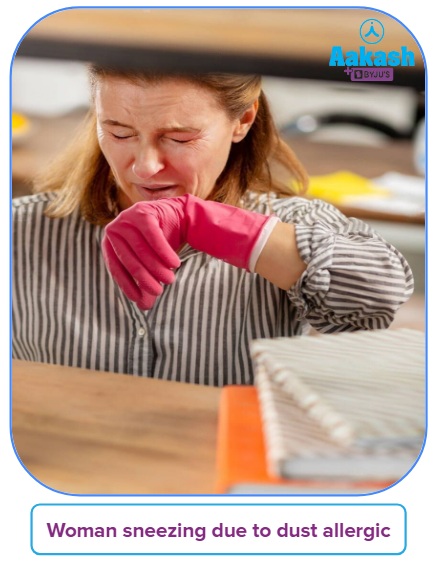
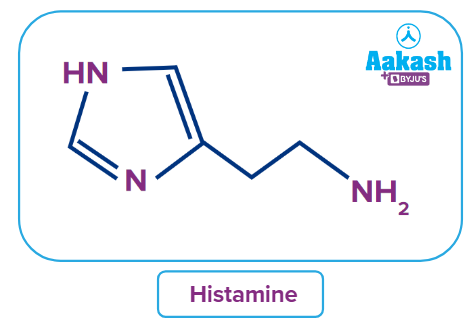
Here we can learn about how we can control the effect of histamines. On this content page, we are discussing Anti-histamines which work on the effect of histamines and control their attack. We will learn about their classifications, Side-effects, and working actions in a bit more detail.
TABLE OF CONTENT
- What are Antihistamines?
- Antihistamine – Classification
- Antihistamine – Side Effects
- Antihistamine – Mechanism of action
- Practice Problems
- Frequently Asked Questions – FAQs
What are Antihistamines?
Here are a few points which would explain Antihistamines in a better way. Let us go through them.
- Antihistamines are medications used to treat allergies, allergic rhinitis, the common cold, the flu, and other illnesses.
- Piperoxan was the first substance with antihistamine properties to be recognised, having been found in 1933.
- Antihistamines are often used by individuals as a cheap, non-patented generic medication that can be purchased without a prescription and has few adverse effects while relieving nasal congestion, sneezing, or hives brought on by allergies to pollen, dust mites, or animals.
- Antihistamines are typically used as a temporary fix. Chronic allergies raise the risk of illnesses that antihistamines may not be able to cure, such as lower respiratory tract infections, sinusitis, and asthma.
- For individuals who want to utilize antihistamines for a longer period of time, seeing a doctor is advised to them.
- Although most people associate the term "antihistamine" with medications used to treat allergies, doctors and scientists really refer to a family of medications that work to inhibit the body's histamine receptors.
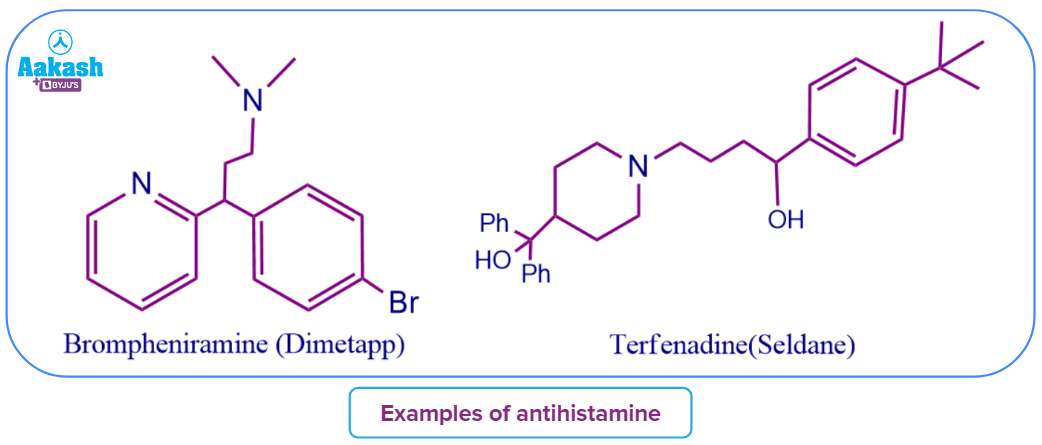
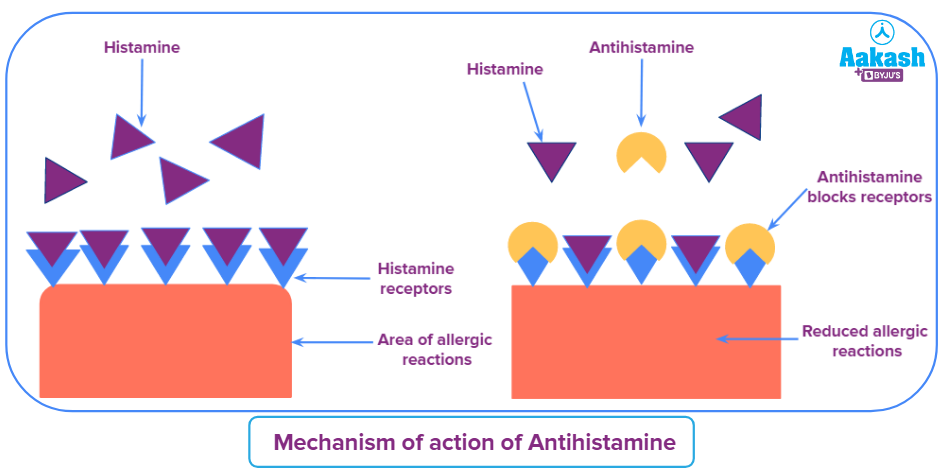
- Terfenadine (Seldane) and brompheniramine (Dimetapp), two synthetic medications, work as antihistamines. By competing with histamine for the receptor binding sites where histamine exerts its impact, they obstruct the normal functioning of histamine.
Antihistamine – Classification:
Drugs that target the H receptors are categorized into four categories of antihistamines. These are
H1-antihistamines, H2-antihistamines, H3-antihistamines and H4-antihistamines. Let us see one by one in a bit more detail.
H1-antihistamines:
- There were two class of H1-antihistamine. One is H1-first generation and other one is H1-second generation.
- H1 are a class of drugs that inhibit histamine's activity at the H1 receptor, providing relief from allergic reactions.
- The H1 receptor normally binds to histamine, which increases the receptor's activity. Receptor antagonists work by binding to the receptor and preventing histamine from activating it. In contrast, inverse agonists bind to the receptor, block histamine from binding, and reduce the receptor's constitutive activity, the opposite of what histamine does.
- Clinically, mast cell-related diseases and allergic responses are treated using H1 -antihistamines.
- Additionally, H1 -antihistamines might lessen inflammation.
- The first-generation antihistamines' release signalled the start of the medicinal management of nasal allergies.
- Antihistamines of the second generation penetrate the blood-brain barrier substantially less than those of the first generation. Due to their concentrated impact on peripheral histamine receptors, they reduce sedative effects. Second-generation antihistamines can cause drowsiness when taken in larger quantities since they start to affect the central nervous system at high doses.
H2-antihistamines:
- Like H1-antihistamines, H2-antihistamines can act as neutral antagonists or inverse agonists.
- They work by activating the natural signalling system for gastric acid production, which is mostly present in the parietal cells of the stomach mucosa. Drugs that block H2 signalling thereby lessen stomach acid output since histamine normally acts on H2 to induce acid release.
- Peptic ulcers and gastroesophageal reflux disease are among the gastrointestinal disorders that
H2-antihistamines are used as first-line treatment.
- Ranitidine, Cimetidine, Famotidine, etc., which decrease stomach acid production and are typically used as a backup therapy or in conjunction with proton pump inhibitors (PPIs).
H3-antihistamines:
- A family of medications known as H3-antihistamines is used to prevent histamine from acting on the H3 receptor. H3 receptors, which are inhibitory autoreceptors situated on histaminergic nerve terminals and are largely present in the brain, regulate the release of histamine.
- Through activation of H1 receptors in the cerebral cortex, histamine release in the brain causes subsequent release of excitatory neurotransmitters including glutamate and acetylcholine.
H3-antihistamines are used to prevent histamine release.
- Consequently, H3-antihistamines have stimulating and cognition-modulating effects as opposed to the sedative effects of H1-antihistamines.
- Ciproxifan and Conessine are famous examples of H3-antihistamines
H4-antihistamines:
- The histamine H4 receptor, the newest member of this family of histamine receptors, is expressed in the liver, pancreas, bile ducts, and the whole gastrointestinal system.
- The control of immune-mediated responses in gut inflammation, including colitis, ischaemia/reperfusion damage, radiation-induced enteropathy, and allergic gut reactions, is well supported by the data. H4 receptors may play a part in these processes.
- H4 receptor targeted therapy is used to treat a variety of gastrointestinal conditions, including cancer, irritable bowel syndrome, and inflammatory bowel disease.
Antihistamine – Side Effects:
Antihistamines have a negative side effect profile, although some are significantly worse than others.
- The first generation of antihistamines, which are older and include Benadryl and Chlor-Trimeton, are more dangerous. They notably make people drowsy.
- The more recent generation of antihistamines, such as Allegra, Clarinex, and Zyrtec, is, on the other hand, considerably less dangerous.
- Antihistamines that act on the H1 receptor typically have clinically significant side effects that vary on dosage. First-generation antihistamines are significantly more prone to these adverse effects.
- H2 receptor antihistamines, particularly cimetidine, can block the cytochrome system, resulting in drug toxicity and interactions with other medicines.
- The possibility of male gynecomastia is correlated with cimetidine's anti-androgenic properties. It may also result in galactorrhea in females.
- Although uncommon, prolonged use of second-and third-generation non-sedating antihistamines may cause minor liver damage.
Antihistamine – Mechanism of action:
When a person comes into contact with a material that is safe for them to be around but which their body misinterprets as an invasive disease, they get an allergic reaction. Allergens are things that cause allergic responses, and they range from pollen and pet dander to certain proteins present in food.
Histamines are released by immune system cells in response to an allergen getting into the body or coming into contact with skin. These histamines attach to receptors on cells all throughout the body.
Histamines cause a number of common allergic responses once they bind to these receptors, including the enlargement of blood vessels and the contraction of smooth muscle tissues.
Antihistamines are a class of drugs used to treat cold and flu symptoms, motion sickness, and certain allergy symptoms. Histamine receptors are blocked by antihistamines.
Practice Problems:
Q1. Which among the following is considered the first antihistamine?
A. Piperoxan
B. Ethylenediamine
C. Tricyclics
D. Alkylamines
Answer: A
Solution: While creating a guinea pig animal model of anaphylaxis, Jeff Forneau and Daniel Bovent made the discovery of piperoxan in 1933. In 1957, they were awarded the Nobel Prize. Ethylenediamine, ethanolamines, alkylamines, piperazines, and tricyclic antihistamines are first-generation H1 receptor antagonist antihistamine classes.
Q2. What enzyme is required for the transformation of histidine into histamine?
A. Histidine phosphorylase
B. Histidine amylase
C. Histidine decarboxylase
D. Histidine hydrolase
Answer: C
Solution: Histamine is created from the amino acid histidine by the enzyme histidine decarboxylase. When histamine is produced, it increases vasodilation, capillary permeability, and promotes smooth muscle contraction, mucus production, and parasympathetic nerve activation, all of which contribute to inflammation.
Q3. Seldane is an example of __________.
A. Histamine
B. Antihistamine
C. Tranquilizers
D. Antacid
Answer: B
Solution: Seldane is a synthetic drug that works as an antihistamine. By competing with histamine for the receptor binding sites where histamine exerts its impact. They obstruct the normal functioning of histamine.
Q4. H3 receptors are mainly found in the _______.
A. Brain
B. Stomach
C. Liver
D. Hands
Answer: A
Solution: Histamine H3 receptors are present in the central nervous system where they regulate histamine turnovers through feedback inhibition of histamine production and release and operate as autoreceptors in presynaptic histaminergic neurons. Therefore, H3 receptors are mainly found in the brain.
Frequently Asked Questions – FAQs:
Q1. Can taking an antihistamine to raise blood pressure?
Answer: Combining an antihistamine with a blood pressure medicine you currently take for high blood pressure might make you feel more ill and raise your blood pressure. Your options should be discussed with your healthcare practitioner.
Q2. Which antihistamine works the best?
Answer: Zyrtec and Claritin are two popular over-the-counter antihistamines. They are regarded by doctors as effective and secure allergy treatments. Both are second-generation antihistamines. Compared to first-generation antihistamines, these antihistamines are less sedating.
Q3. Which fruits contain a lot of histamines?
Answer: Citrus fruits include things like pears, bananas, pineapple and strawberries. Vegetables include things like beans, avocados, tomatoes, olives, and eggplant. Dairy goods include things like processed cheese, cheese, and yoghurt.
Q4. Can antihistamines affect immunity?
Answer: Our results suggest that sedating first-generation H1 antihistamines and H3 blockers may impair and affect immune responses to germs and that these medications should be used cautiously in patients with serious bacterial infections.

 Call Now
 Let's Chat
 Share
Share