-
Call Now
1800-102-2727


Ag2O - Introduction, Properties, Preparation, Uses, Practice Problems and FAQs

Micky, a 15-year-old boy, visited a showroom with his mother. He demanded a wristwatch as his birthday present. Micky’s mom took him to a famous showroom where a variety of designer watches were available. Micky picked a watch which cost around 5000 rupees.
Isn’t this watch costly for a 15-year-old boy? The same thought came to his mother’s mind. Then she asked the shopkeeper what are the qualities of such a costly watch. Then the shopkeeper shows her mother a booklet where the qualities were mentioned. Her mother noticed that this watch contains a battery inside which is used from a chemical compound silver oxide. Then she asked the shopkeeper for a different watch at a lower price with the same silver oxide battery to give Micky on his birthday!

Well, To study more about such interesting compounds silver oxide, let's come and understand the importance of silver oxide in chemistry and its properties in a bit detail!
TABLE OF CONTENT
- Ag2O- Introduction
- Ag2O-Physical Properties
- Ag2O- Chemical properties
- Ag2O- Uses
- Silver oxide battery
- Practice Problems
- Frequently asked questions-FAQs
Ag2O- Introduction:
- The chemical substance with the formula Ag2O is called silver oxide.
- The preparation of various silver compounds uses this fine, black or dark brown powder.
- It is considered one of the important compounds of silver. Two positive silver ions are linked to a negative oxygen ion in silver oxide.
- When silver loses one electron, it becomes Ag+ , a positively charged ion. The negatively charged ion O2- is formed when oxygen gains two electrons and thus together forms silver oxide.
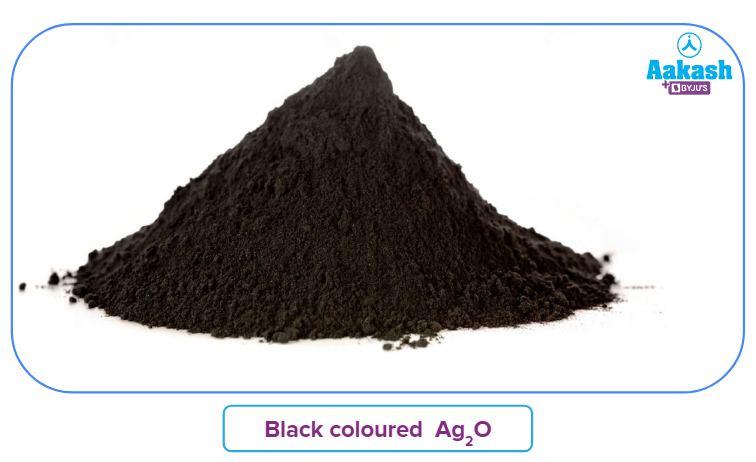
Ag2O-Physical Properties:
|
Molecular Formula |
Ag2O |
|
Molar mass |
231.74 g mol-1 |
|
Relative density |
7.143 % |
|
Decomposition temperature |
230 °C |
|
Water solubility |
Slightly soluble |
Ag2O- Preparation:
- In an aqueous neutralizing solution containing sodium hydroxide or potassium hydroxide, Ag2O powder is produced from silver salt. At this point in the process, the pH is about 12. To get Ag2O powder, the precipitate is filtered, cleaned, and dried after the reaction.
- When elemental silver reacts in the presence of oxygen in the air, this process occurs spontaneously. This must occur at temperatures below 195° C
Ag2O-Chemical properties:
- Hydrogen halides such as hydrogen fluoride, hydrogen bromide, hydrogen iodide, and hydrogen chloride are effectively reacted with it. The overall response is shown below:
- Used in the Tollen’s test: The dark silver oxide precipitate that forms when NH4OH is added to a solution of silver nitrate dissolves in excess ammonia to create a complex salt.
Ag2O- Uses:
There are several uses for silver oxide. Its limited applications are covered under:
- In silver oxide batteries, Ag2O are utilized. It is utilized as a gentle oxidizing agent authorized in a variety of reactions, including those that convert aldehydes into carboxylic acids.
- It is used in a variety of mixes. Additionally, it is utilized during the entire process of Tollen's reagent.
- It is suitable for optic and earth applications because of its thermal predictability.
- Flight and energy components are also being studied for their uses.
- As a consequence, the silver oxide would have significant properties such as minimal internal delivery, good thermodynamic security, and therefore an extended time period of tolerable ease of use.
- A 1.46 eV band gap Ag2O is used as a p-type semiconductor that may be utilized for optical and magneto-optical storage.
Silver oxide battery:
- A primary cell that uses zinc for the anode and silver oxide as the cathode is a silver-oxide battery.
- During discharge, these cells keep their nominal voltage practically constant until completely depleted.
- They are offered in tiny sizes as button cells, where the amount of silver used is negligibly small and does not contribute significantly to the cost of the final product.
- Because of its excellent energy-to-weight ratio, silver-oxide batteries were utilized on lunar missions for the lunar module and lunar rover power supply.
Practice Problems:
Q1. _____________ is the oxidation state of Silver in Ag2O.
a. 0
b. +1
c. +2
d. +3
Answer: B
Solution: Let the oxidation state of silver in Ag2O be x.
For calculating this we know that the oxidation state of the oxygen we consider is -2.
Now, calculating this we get,
Hence, +1 is the oxidation state of Silver in Ag2O .
Q2. When Ag2O is treated with HCl ,_____________ coloured precipitate is formed.
a. Yellow
b. White
c. Grey
d. Black
Answer: B
Solution: Hydrogen halides such as hydrogen chloride reacts with Ag2O very effectively. The reaction that occurs is mentioned below.
Here AgCl formed is a white-coloured precipitate.
Hence, the correct answer is option B.
Q3. At a temperature of 300 °C, Ag2O decomposes, releasing metallic silver and oxygen gas. 0.104 g of oxygen gas were produced from a 1.60 g sample of silver oxide. Calculate the percentage by mass of silver oxide in the present sample.
a. 90.25%
b. 30.34%
c. 94.25%
d. 99.8%
Answer: C
Solution: To solve this question, first we have to write the chemical equation for the decomposition of Ag2O.
To calculate the percentage by mass, we know-
First, calculating the moles of O2 as the given weight is 0.104 g.
mol
From the above equation we can see that 1 mole of O2 is obtained from 2 moles of Ag2O.
∴ 0.00325 mol of O2 is produced from 0.00325 2 = 0.0065 mol of Ag2O.
Mass of Ag2O in the given sample mixture can be calculated using this formula;
Molar mass of
Mass of Ag2O in the sample =
Now, calculating % mass;
Hence, the correct option is C.
Q4.What are the correct uses of silver oxide?
a. It's also used in medicine and in producing organic dye stuff as an oxygen carrier.
b. Used in the electroplating and polishing of mirrors
c. Used in the colourimetric analysis of phenols.
d. Used as batteries in watches.
Answer: D
Solution: A primary cell that uses zinc for the anode and silver oxide as the cathode is a silver-oxide battery. These are frequently used in wristwatches.
Frequently asked questions-FAQs:
1. Is Ag2O irritating to the human body?
Answer: High quantities of silver compounds, such as silver nitrate or silver oxide, in dust can irritate the throat, induce stomach ache, and make it difficult to breathe.
2. Can we treat Ag2O as an oxidizing agent in organic chemistry?
Answer: Silver oxide is employed as a moderate oxidizing agent in organic chemistry. As an example, it converts aldehydes to carboxylic acids. When the silver oxide is made in situ from silver nitrate and alkali hydroxide, such reactions frequently work well.
3. What are other important compounds of silver? Name a few of them.
Answer: Silver is a whitish, soft metal with a gleaming finish which is a very important element in the periodic table. The major important compounds which are generated from silver apart from silver oxide are silver chloride (AgCl), Silver nitrate (AgNO3) etc.
4. How are batteries made of silver oxide recycled?
Answer: Used batteries and cells are broken down into their constituent parts and particles in a crusher. After that, a unique treatment procedure is used to recover the silver oxide and other components. The materials are either used to make new batteries or given to licensed speciality businesses.

 Call Now
 Let's Chat
 Share
Share