-
Call Now
1800-102-2727


Adsorption vs Absorption – Adsorption, Absorption, Difference Between Adsorption and Absorption, Practice Problems and FAQ

Let's conduct a simple experiment. Take a piece of chalk stick and soak it for 10 seconds in an ink solution.
How does the chalk fare?
The adsorption of the coloured molecules (pigments) in the ink on the surface of the chalk stick is what causes the surface to maintain the ink's colour. On the other hand, because of absorption, the ink's solvent penetrates the stick deeply. We can see that the interior of the chalk stick is still white after breaking it.

We see two distinct phenomena in this simple experiment, namely adsorption and absorption.
The focus of this idea page is on these two phenomena. Let's learn more about adsorption, absorption, and their differences without further ado.
TABLE OF CONTENTS
- Adsorption
- Absorption
- Positive and Negative Adsorption
- Difference Between Adsorption and Absorption
- Difference Between Adsorption and Absorption – Example
- Sorption
- Practice Problem
- Frequently Asked Questions – FAQ
Adsorption
Adsorption is the process of a substance's molecules being drawn to and held onto the surface of a solid or liquid, resulting in a larger concentration of those molecules there than in the bulk. Adsorption causes the surface energy to be reduced.
Adsorbent – The substance on whose surface adsorption takes place is called the adsorbent.
Adsorbate – The substance which gets adsorbed on the surface of the adsorbent due to intermolecular attractions is called the adsorbate.
Desorption – It is the process of removing an adsorbate from the surface that it had adsorbed to. It is the opposite of adsorption and can happen when the pressure is increased or decreased.
Occlusion – It is the name given to the process by which gases adsorb on the surface of metals. The adsorbate can be a gas or a solute in a solution, and the adsorbent can be either solid or liquid.
Example: The pressure of a gas, such as carbon monoxide, hydrogen, oxygen, chlorine, sulphur dioxide, ammonia, or phosgene, is seen to fall when it is taken in a closed vessel containing powdered charcoal. The charcoal's surface is where the gas molecules condense, or where the gases are adsorbed. In this instance, gas molecules serve as the adsorbate while charcoal serves as the adsorbent.
Absorption
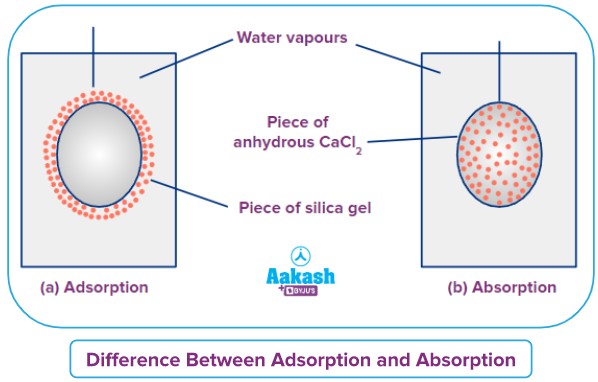
Adsorption and absorption are two distinct words. Adsorption is a phenomenon when a different substance has a higher concentration on the surface than in the bulk. On the other hand, the molecules of material are uniformly dispersed throughout the body of another substance as a result of absorption.
Positive and Negative Adsorption
Positive Adsorption – When the concentration of the adsorbate is more on the surface of the adsorbent relative to its concentration in the bulk, it is called positive adsorption.
Negative Adsorption – When the concentration of the adsorbate is less on the surface of the adsorbent relative to its concentration in the bulk, it is called negative adsorption.
Difference Between Adsorption and Absorption
|
Absorption |
Adsorption |
|
|
|
|
|
|
Difference Between Adsorption and Absorption – Example
It is possible to distinguish between adsorption and absorption using water vapour as an example. Silica gel absorbs water vapour when it is placed in a watery environment. The water vapours are concentrated in high amounts near the surface of the silica gel. On the other hand, anhydrous calcium chloride absorbs water when it is exposed to a water environment. The water vapours evenly disperse throughout the calcium chloride body.
Sorption
Sometimes it is impossible to tell the difference between adsorption and absorption when they happen together. In these circumstances, the chemical is equally distributed throughout the solid's bulk, yet its concentration is higher at the surface than it is throughout. This behaviour is known as sorption.
Recommended Videos
Surface Chemistry Class 12 Chemistry One-Shot (Full Chapter Revision) Concepts+Ques | JEE Main 2022
Practice Problems
1. Which of the following is true about absorption?
a. It is the phenomenon in which the liquid or gaseous particles are distributed uniformly throughout the body of the solid.
b. Throughout the substance, the concentration is constant. It is therefore a bulk phenomenon.
c. The rate of absorption is constant.
d. All of these
Answer: D
- Absorption is the phenomenon in which liquid or gaseous particles are distributed uniformly throughout the solid.
- The concentration is constant throughout the body. It is therefore a bulk phenomenon.
- The rate of absorption is constant.
Hence, all the given statements are true about absorption.
So, option D is the correct answer.
2. Which of the following is true about adsorption?
a. It is the phenomenon in which the concentration of the liquid or gaseous particles is more as compared to the body of the solid.
b. Throughout the substance, the concentration is constant. It is therefore a bulk phenomenon.
c. The rate of adsorption is constant throughout the process.
d. All of these
Answer: A
- It is a phenomenon that occurs when the surface of a solid has a higher concentration of gas or liquid particles than the interior.
- The concentration in the bulk is different from the concentration on the surface of the adsorbent. It is therefore only a surface phenomenon.
- Adsorption starts out quickly and slows down over time. Hence, the rate of adsorption is different at different intervals of time.
Hence, among the statements given in the options, only the statement given in option A is true about adsorption.
So, option A is the correct answer.
3. What is occlusion?
a. The process by which solids adsorb on the surface of metals is known as occlusion.
b. The process by which liquids adsorb on the surface of metals is known as occlusion.
c. The process by which gases adsorb on the surface of metals is known as occlusion.
d. The process by which gases adsorb on the surface of liquids is known as occlusion.
Answer: C
Solution: The adsorption of gases on the surface of metals is referred to as occlusion. We may therefore state that it is a sort of adsorption in which the adsorbent is metal and the adsorbate is a gas.
So, option C is the correct answer.
4. Which of the following statements is true for surface chemistry?
a. In sorption, the chemical is equally distributed throughout the solid's bulk, yet its concentration is higher at the surface than it is throughout.
b. The quantity of adsorbate adhering to the surface of the adsorbent increases with surface area.
c. Desorption is the removal of adsorbate from the surface to which it has attached itself.
d. All of these
Answer: D
- The chemical is evenly dispersed throughout the solid's bulk during sorption, although its surface concentration is larger than its interior concentration.
- With increased surface area comes more adsorbate adhering to the adsorbent's surface.
- Adsorbate is removed from the surface it had attached to through desorption.
Hence, all the given statements are correct.
So, option D is the correct answer.
Frequently Asked Questions – FAQ
1. How are a variety of organic substances in the form of their solutions decoloured using animal charcoal?
Answer: It has been noticed that when a solution of an organic dye, such as methylene blue, is agitated with animal charcoal, the solution becomes colourless. The coloured component, which is often an organic dye, becomes adsorbed on the surface of the animal charcoal, which causes the colour to release.
2. How can adsorption contribute significantly to the discolouration of sugar?
Answer: Aqueous raw sugar solutions, which have a yellowish-brown colour, flow across beds of animal charcoal and lose their colour because the charcoal has absorbed the colouring agents.
3. How do physisorption and chemisorption differ?
Answer: The weak van der Waals forces in physisorption are the cause of gas accumulation on solid surfaces. Due to the weak van der Waals forces present, physisorption results in the concentration of gas on the surface of a solid. It is multilayer adsorption, which often takes place at low temperatures.
In chemical adsorption or chemisorption, chemical bonds hold the gas molecules or atoms of the adsorbate to the solid surface of the adsorbent. Covalent and ionic bonds are two types of chemical bonding. It is monolayer adsorption and typically takes place at high temperatures. Chemisorption is also referred to as activated adsorption because it needs a lot of energy to activate.
4. What is Freundlich Isotherm?
Answer: Freundlich gave an empirical relationship between the extent of adsorption (x/m) and pressure (p), at a particular temperature. Freundlich gave the relationship between the amount of gaseous adsorbate per unit weight of the adsorbent with respect to the change in pressure. It can be mathematically expressed as

 Call Now
 Let's Chat
 Share
Share