-
Call Now
1800-102-2727


Uterus: Location, Anatomy, Histology, Functions, Common problems, Practice Problems, and FAQs

We know that humans are sexually reproducing organisms and the human females give birth to young ones (viviparous) under normal conditions. But, have you ever wondered why only females can give birth or how they are able to carry a baby for 9 months in their body? The answer to all these questions lie in the specialities of the reproductive system of females.
There are various organs present in the female reproductive system. It includes the uterus or the womb also. This is the organ where the foetus develops for 38 weeks. It is the safe place where the baby is protected and provided with all the necessary nutrients to grow and develop until it is delivered. Now you would like to know more about this wonderful organ. So in this article we will take a deep dive into the details of the uterus.
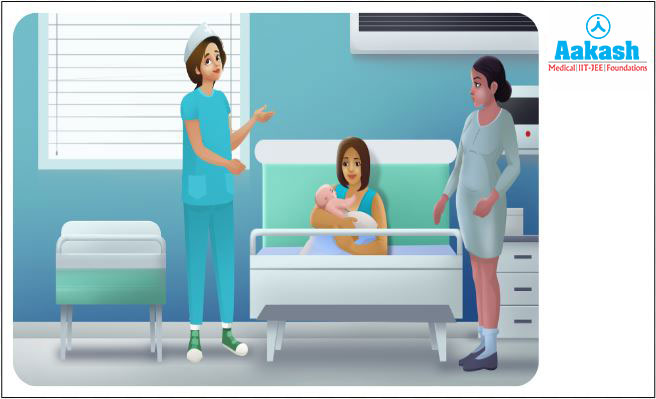
Fig: A mother with her new born baby
Table of Contents
- Female reproductive system
- Uterus
- Location of uterus
- Anatomy of uterus
- Histology of uterus
- Functions of uterus
- Common uterine problems
-
Practice Problems
- FAQs
Female reproductive system
The organs of the female reproductive system lie in the pelvic cavity. These organs can be categorised into primary sex organs, secondary sex organs and external genitalia. Primary sex organs includes the gonads (ovaries). Secondary sex organs include oviducts, uterus, vagina, accessory glands and mammary glands. External genitalia is called vulva.
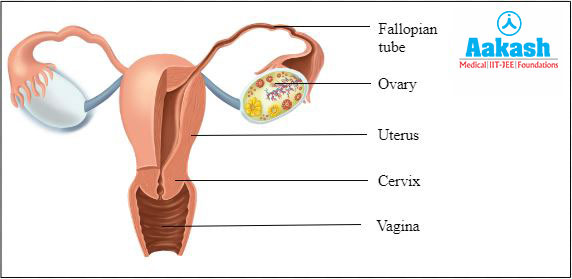
Fig: Female reproductive system
Primary sex organs
Ovaries are the primary female sex organs. They are small, oval shaped and paired structures. Ovaries are responsible for the production of the female gamete, ovum, by oogenesis and the secretion of the female sex hormones, estrogen and progesterone.
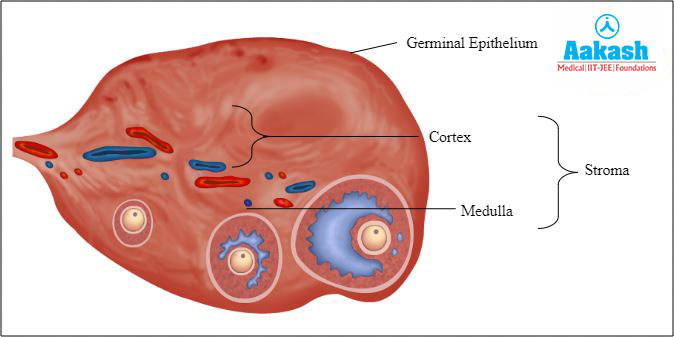
Fig: Section of an ovary
Secondary sex organs
These organs in females assist in various reproductive processes such as in sex, menstruation, pregnancy, and childbirth. The following are the secondary sex organs:
Oviducts
These are 10 - 12 cm long, paired, tube-like structures responsible for transport of the female gamete to the site of fertilisation and then transport of embryo (blastocyst) to the womb. They are also called fallopian tubes. Each fallopian tube has three parts as follows:
Infundibulum
It is the first part of the fallopian tube, found closest to the ovary. It possesses finger-like projections on its edges, called fimbriae. These fimbriae catch the secondary oocyte released by the ovary and send it inside the oviduct or fallopian tube.
Ampulla
It is the second and widest part of the fallopian tube and is the site of fusion of male gamete with the female gamete. This process is called fertilisation.
Isthmus
It is the last part of the fallopian tube and has a narrow lumen. It opens into the uterus at the point called uterine cornua or horns of the uterus.
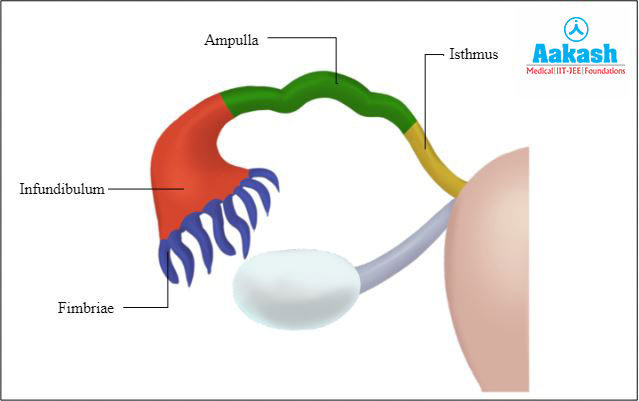
Fig: Structure of fallopian tube
Vagina
It is a fibro-muscular tube that continues from the cervix of the uterus and opens to the outside in the vulva. It is the copulatory organ that receives penis during sexual intercourse. Vagina along with the cervical canal forms the birth canal during delivery of the baby.
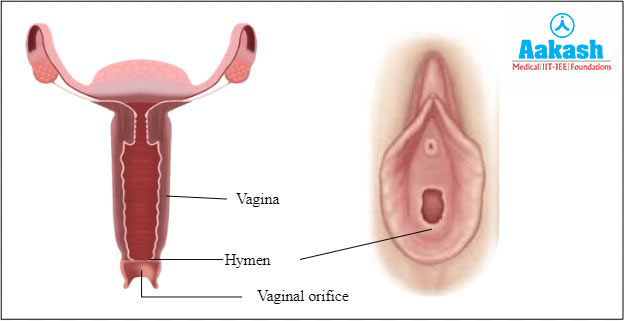
Fig: Vagina
External genitalia
The accessory sex organs present outside the body are called external genitalia. It is also called vulva or pudendum. It consists of mons pubis, labia majora, labia minora, hymen, clitoris and vestibule.
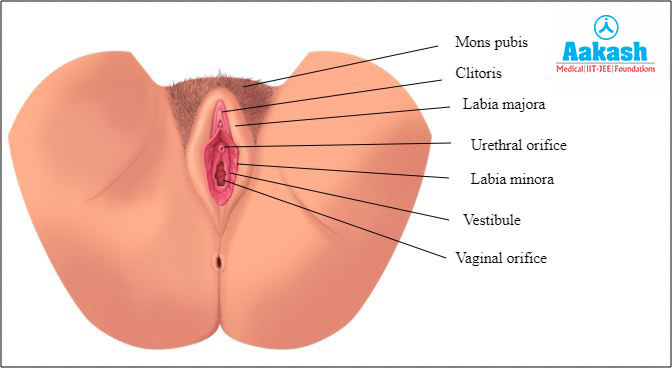
Fig: External genitalia
Accessory glands
They are also called vestibular glands. These are of two types such as greater vestibular glands or Bartholin’s glands and lesser vestibular glands, glands of Skene or paraurethral glands. The secretions of these glands provide lubrication and neutralise urinary acidity.
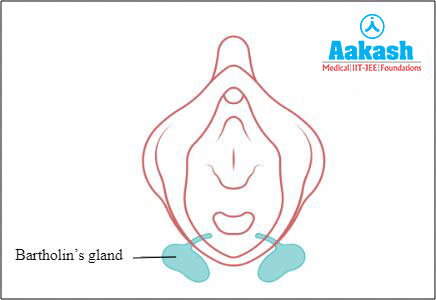
Fig: Bartholin’s glands or greater vestibular glands
Mammary glands
These are paired, modified sweat glands present in the chest region.. They are rudimentary in males, but functional in females. Mammary glands contain tissues that secrete milk for nourishing the young one after birth.
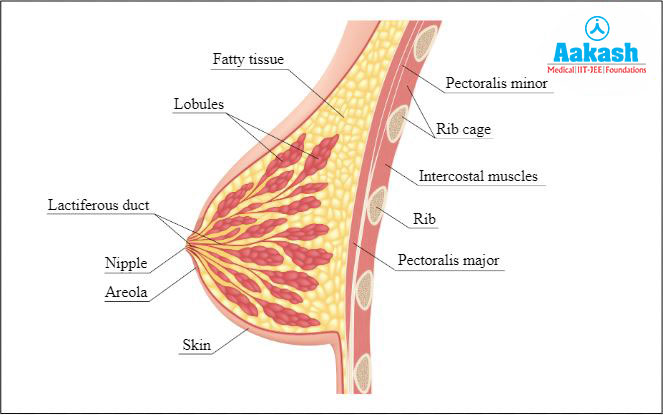
Fig: Sagittal section of the human mammary gland
Uterus
Uterus or womb is an inverted pear- shaped, hollow and muscular organ. It is also called hystera. In females who never got pregnant, it is 7.5 cm long, 5 cm wide and 2.5 cm thick.
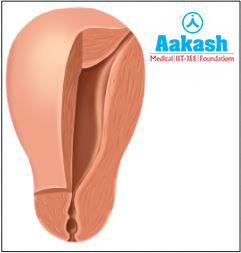
Fig: Uterus
Location of uterus
It is situated between the urinary bladder and rectum. There are various ligaments that support and hold the uterus in its place. The paired broad ligaments are double fold of peritoneum attach uterus to either side of pelvic cavity. The two cardinal ligaments extend from the pelvic cavity and support the cervix and vagina. The round ligaments extend from below the oviducts and support the uterus and labia majora of external genitalia. The uterosacral ligament lying on either side of rectum attaches the cervix and sacral vertebrae. These ligaments hold the uterus in an anteflexed position (projected anteriorly and superiorly to the urinary bladder).
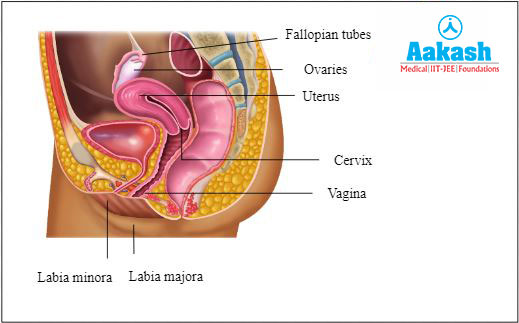
Fig: Location of uterus
Anatomy of uterus
There are 3 parts of the uterus as follows:
Fundus
It is the upper, dome shaped part of the uterus present above the opening of the fallopian tubes.
Corpus or body
It is the main, middle part of the uterus. The cavity of the uterus is called the uterine cavity.
Cervix
It is the lower, narrow part of the uterus. It opens into the uterus via the internal os and into the vagina via the external os. The cavity in the cervix is called the cervical canal.
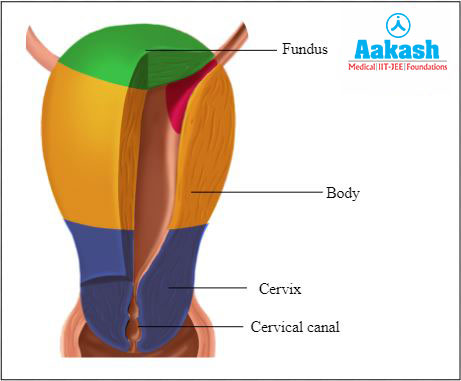
Fig: Parts of the uterus
Histology of uterus
Uterus has three layers as follows:
Perimetrium
It is the outermost layer, made of peritoneum and also called as serosa. It is made up of simple squamous epithelium and areolar connective tissue.
Myometrium
It is the middle layer consisting of three layers of smooth muscles. It contracts vigorously during labour and the coordinated contractions help to expel the foetus out leading to childbirth.
Endometrium
It is the innermost, highly vascularised layer.
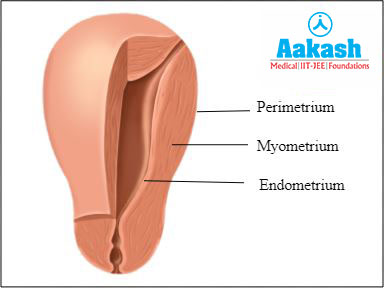
Fig: Layers in the walls of uterus
Components of endometrium
Endometrium possess three components as follows:
- An innermost layer of simple ciliated columnar epithelium lining the uterine cavity and consisting of secretory cells.
- Below the epithelium present a dense stroma of lamina propria.
- Uterine glands that extend till the myometrium. The secretions of uterine glands possess ions, lipids, carbohydrates (glucose), proteins like enzymes like proteases, cytokines, hormones, growth factors, transporters, etc.
Layers of endometrium
Endometrium has the following two layers:
Stratum functionalis
It lines the uterine cavity and is sloughed off during menstruation.
Stratum basalis
It is the basal permanent layer that gives rise to stratum functionalis thereby restoring the functionalis layer after every menstruation.
Functions of uterus
The following are the major functions of uterus:
Pathway for sperms
It is the pathway for sperms as they move from vagina towards the secondary oocyte in the fallopian tube.
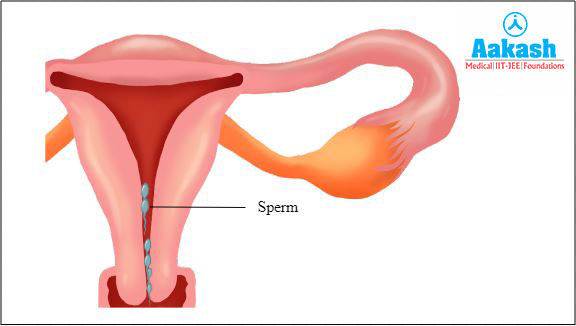
Fig: Pathway for sperm
Site of implantation
It is the site of implantation. Embryo (blastocyst) is implanted here after fertilisation.
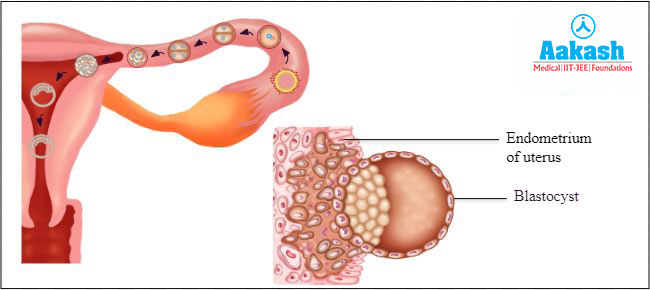
Fig: Site of implantation
Site of development of foetus
It is the site where the foetus grows and develops during pregnancy.
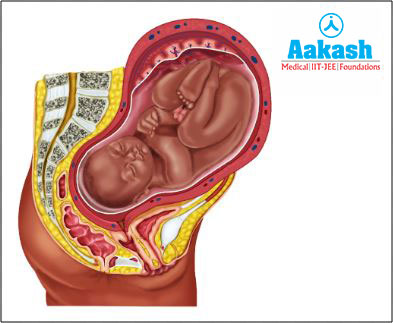
Fig: Site of development of foetus
Helps in parturition
It contracts vigorously and in coordinated manner to push the baby out, thus aids in delivery or parturition.
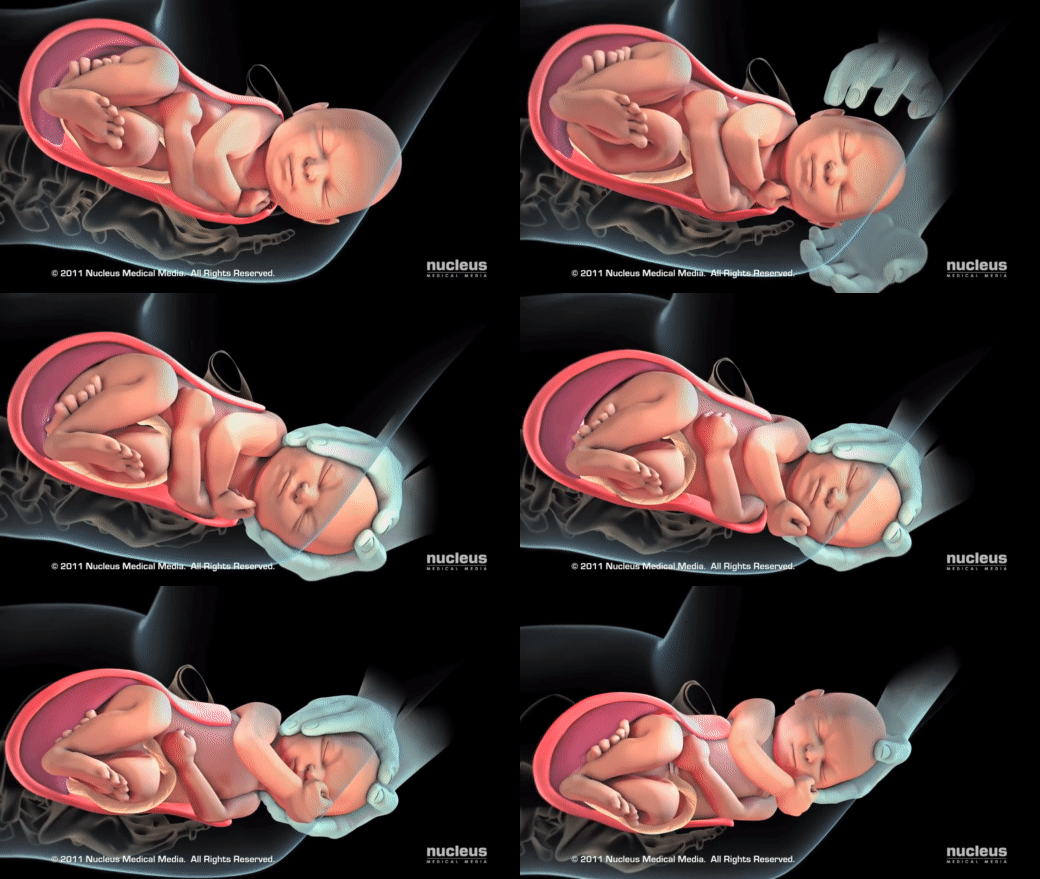
GIF: Childbirth
Site of menstrual cycle
When implantation does not occur, the endometrium layer is sloughed off during menstruation or the bleeding phase of the menstrual cycle.
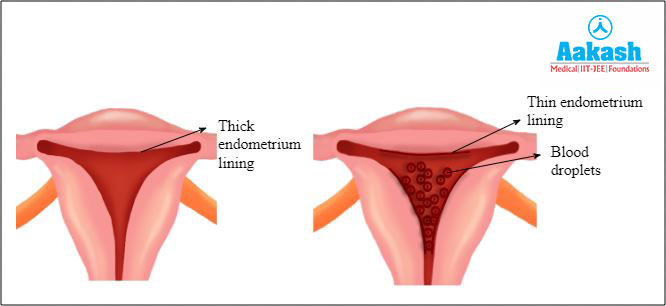
Fig: Menstruation
Formation of placenta
It helps in the formation of the placenta. Placenta is a temporary endocrine structure formed in pregnant females and releases several hormones like hCG (human chorionic gonadotropin), hPL (human placental lactogen), progesterone, estrogens, etc., required for pregnancy. Placenta also allows movement of nutrients like sugars and proteins from mother to the foetus and movement of wastes like carbon dioxide and urea from foetus to mother for elimination.
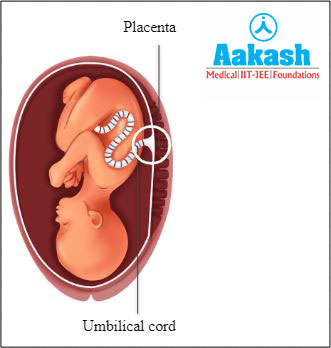
Fig: Placenta formed by foetal and endometrial tissue
Common uterine problems
The following are the common uterine problems:
Uterine prolapse
It is the falling down or displacement of the uterus from its original position due to weakening of ligaments that hold its position. Treatment involves pelvic exercises, weight loss if the patient is overweight, pessary therapy (placement of a rubber device around the cervix that helps to push the uterus up) or hysterectomy (surgical removal of the uterus).
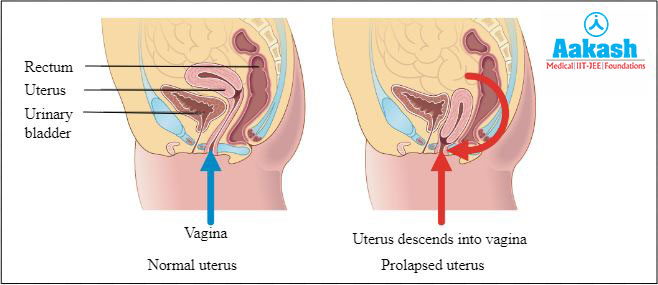
Fig: Uterus
Endometriosis
This condition of the uterus is characterised by growth of endometrial tissue outside the uterus. During every menstrual cycle, this tissue proliferates, breaks down and bleeds. It can cause pain, scarring, inflammation and infertility.
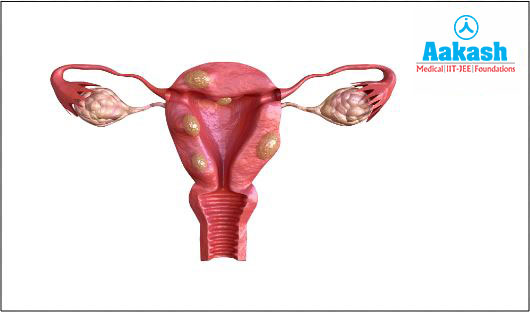
Fig: Endometriosis
Cervical cancer
It is the carcinoma of the cervix, that means it affects the epithelial tissue. It can be detected via a pap test or pap smear test in early stages. In pap tests, a smear of cells taken from the cervix is used to check abnormalities. It can be linked to sexually transmitted viral diseases like genital warts, HPV (Human papillomavirus). The treatments include surgery, radiotherapy, chemotherapy and brachytherapy.
Fibroids
These are non-cancerous tumours that grow in the myometrium. These are composed of muscular and fibrous tissues. These can grow because of high levels of estrogen, so they do not grow before puberty or stop growing after menopause. Symptoms include abnormal menstrual bleeding, pain or pressure in the pelvic area. The treatment methods include medications, laparoscopic surgery, myomectomy (removal of uterine fibroids which is good for those who want to plan pregnancy), and endometrial ablation (destroying the tissues).
Practice Problems
Q1: Which of the following options represent external genitalia of human females?
a. Labia majora, labia minora and vagina
b. Labia minora, clitoris and mons pubis
c. Mons pubis, cervix and clitoris
d. Mons pubis, labia majora and ovary
Solution: The female external genitalia is called vulva which consists of mons pubis, labia majora, labia minora, hymen, vestibule and clitoris. Hence, the correct option is b.
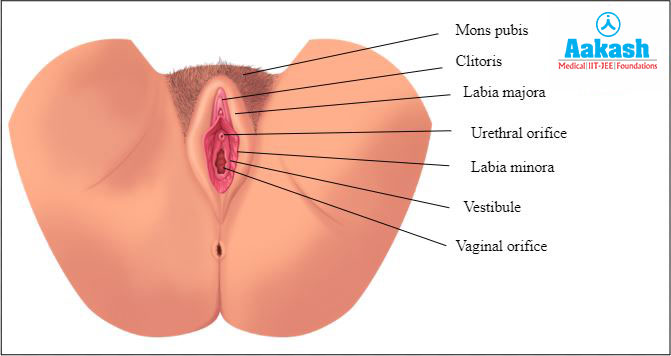
Fig: Human female external genitalia
Q2: Gestation period in humans is _____________.
a. 10 weeks
b. 28 weeks
c. 32 weeks
d. 38 weeks
Solution: The duration of pregnancy is called the gestation period. It refers to the time from conception to birth. In humans, it is 9 months +/- 2 weeks or 38 weeks. Hence, the correct option is d.

Fig: 9 months of gestation period
Q3: When does the primary oocyte complete its meiosis I?
a. Before birth
b. Just after birth
c. During foetal life
d. After puberty
Solution: Primary oocytes are formed during foetal life. They start meiotic division I before birth of the baby girl, but the division gets arrested at prophase I. No development happens after birth, through childhood and until puberty. As the girl hits puberty, the primary oocytes complete meiosis I and produce two haploid cells of unequal sizes. The large haploid cell is called a secondary oocyte whereas the other cell is tiny and called the 1st polar body. Hence, the correct option is d.
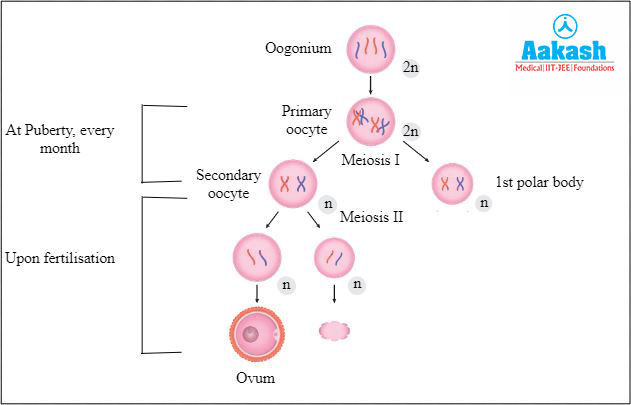
Fig: Oogenesis
Q4: Female accessory sex glands include ____________.
a. Bartholin’s gland
b. Bulbourethral gland
c. Cowper’s gland
d. Seminal vesicles
Solution: Bulbourethral glands or Cowper’s glands, seminal vesicles and prostate glands are the male accessory sex glands. Bartholin’s gland or greater vestibular glands, and glands of Skene, or lesser vestibular glands are called the female accessory sex glands. Hence, the correct option is a.
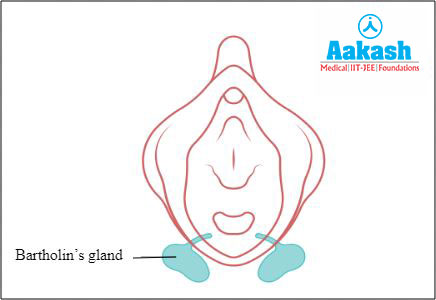
Fig: Location of Bartholin’s glands or greater vestibular glands
FAQs
Q1: The clitoris in human females is homologous to which organ in human male?
Answer: The organs that are found in different organisms but have similar structure but perform different functions are called homologous organs. In human males the copulatory organ, penis, is made up of erectile tissues, corpora cavernosa and corpora spongiosum. These tissues help in erection of penis upon sexual arousal. The clitoris in human females has corpora cavernosa. Since, clitoris and penis have same tissue, they are considered as homologous structures.
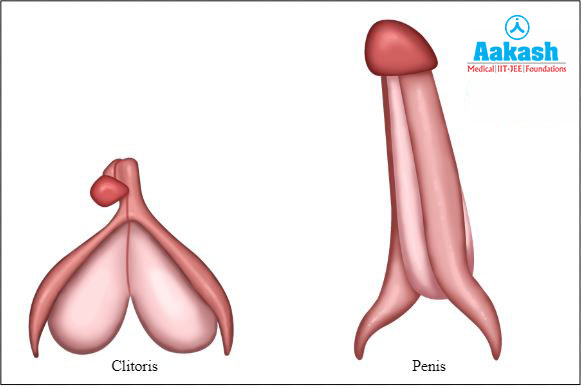
Fig: External genitalia of female and male
Q2: Which cells are the largest and smallest in the human body?
Answer: The female gamete (ovum) is the largest cell with a diameter of about 0.1 mm, whereas the male gametes (sperms) are the smallest cell in the human body measuring only 0.4 micrometres in length.
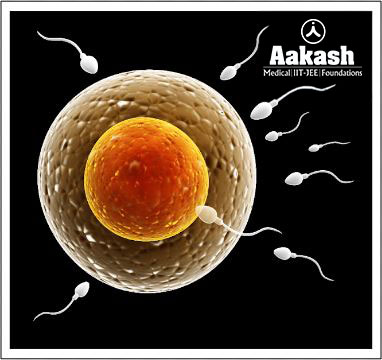
Fig: Comparison of size of ovum with sperms
Q3: What is castration?
Answer: The surgical removal of the testes is called castration. It can be done in cases of testicular cancers. But, it was performed on choir boys until 1903 to make sure their testosterone levels stay low and their vocal cords do not become thick and thus they can sing high pitch notes. It is also performed on bulls to make them docile and to domesticate them. So that people can use bulls in their agricultural fields.
Q4: What is oophorectomy and how does it affect health?
Answer: The surgical removal of one or both ovaries is called oophorectomy. It was earlier called ovariectomy. It is done in cases of ovarian cysts or ovarian cancer. Early menopause, reduced fertility, cardiovascular diseases, cognitive impairment or dementia, osteoporosis and bone fractures are some complications of this procedure.

 Call Now
 Let's Chat
 Share
Share