-
Call Now
1800-102-2727


Tongue: Location, Structure, Functions, Conditions Affecting Tongue, Practice problems, FAQs

You have learnt in lower classes that we have 5 senses organs, namely eyes, ears, skin, nose and tongue. We are able to enjoy our meal because of two sense organs from these, right? Yes, nose and tongue. But can you tell me which organ is responsible for taste? Well the answer is really simple, it is the tongue that helps us to taste all kinds of food like noodles, soup, meat, gulab jamuns, etc.
So many times has it happened that we are in a hurry and accidentally drink very hot tea or coffee. As soon as it happens you feel a tickling sensation on your tongue and then you realise you burnt your tongue. Then for a few days you are not able to recognise any taste. So, how come after a few days you are able to perceive tastes? This is possible because there are specialised cells on our tongue that regenerate after every 10 days. Therefore, after around a week you burnt your tongue, your tongue is absolutely healthy as if nothing ever happened and you are ready to relish all the different tastes. Isn’t it amazing!

Fig: Tongue
Tongue is a very important organ in the mouth. It not only acts as a sensory organ, but has many other functions too. Let’s understand more about the tongue in this article.
Table of contents
- Tongue
- Location
- Structure
- Taste buds
- Conditions affecting tongue
- Functions of tongue
- Practice problems
- FAQs
Tongue
Tongue is a flat, accessory digestive, muscular organ. It is made up of skeletal muscles, covered by mucous membrane. Since the skeletal muscles are voluntary muscles we can move our tongue as per our will. It is responsible for taste.
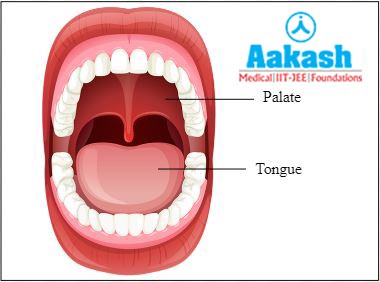
Fig: Tongue
Location
The tongue is located at the floor of the buccal or oral cavity. It is attached to the floor with the help of a fold of mucous membrane called lingual frenulum. Its proximal end is attached to the hyoid bone located in the middle of the neck. The distal end lies in the mouth and is free.
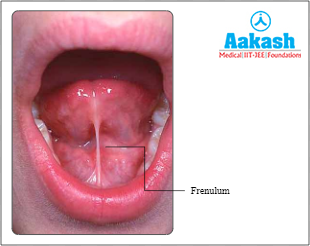
Fig: Frenulum
Structure
Tongue is a sensory organ and is divided into two halves by a median septum. A V-shaped furrow called sulcus terminalis on the upper surface of the tongue divides it into two parts such as anterior oral part and posterior pharyngeal part. There are uneven projections of mucous membrane on the dorsal surface called papillae. Papillae contain taste buds in them.
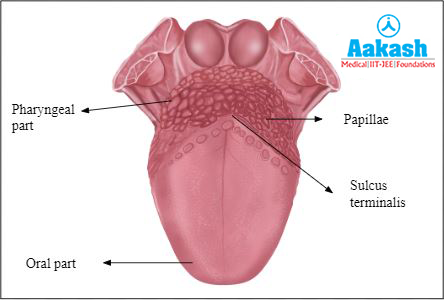
Fig: Structure of tongue
Types of papillae
There are 4 types of papillae in the tongue as follows:
Circumvallate papillae
These are the largest papillae, situated at the base of the tongue along the sulcus terminalis. They are arranged in the form of an inverted V-shape and contain 100 - 300 taste buds.
Fungiform papillae
These are the most numerous papillae and are present on the tips and sides of the tongue. Each papillae contains 3 - 5 taste buds. These papillae also help in sensation of touch and temperature.
Foliate papillae
These are present on the lateral back side of the tongue. But are absent in adult humans.
Filiform papillae
These are the most numerous and smallest papillae, present all over the surface of the tongue and contain no taste buds.
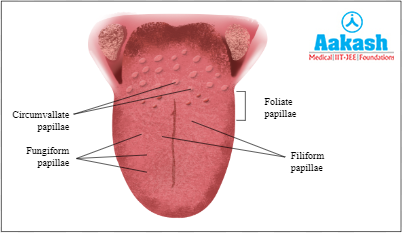
Fig: Types of papillae
Taste buds
Taste buds are the true organs of gustation or taste. Each taste bud has numerous sensory cells (columnar epithelial cells) that are connected to nerve fibres. Chemicals for taste present in our food get dissolved in our mouth and then only in their liquid form they can interact with the sensory cells. Upon interaction the sensory cells send signals to the nerve fibres, from there the signals are then carried to the taste centre in our brain.
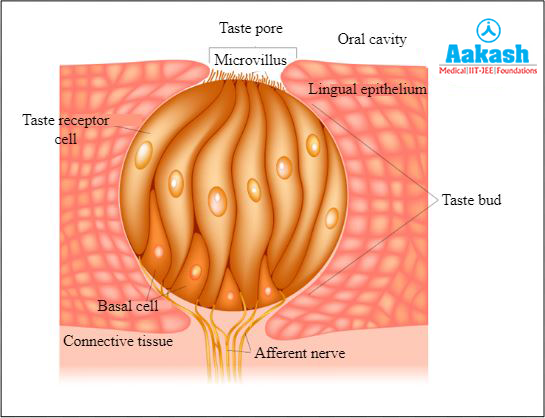
Fig: Structure of taste buds
Tastes
The flavour of any meal comes from a complex mix of smell, taste, temperature and texture. There are 5 basic tastes such as salty, sweet, sour, bitter and umami or savoury. Savoury taste is newly discovered and it comes from high glutamate or aspartate concentration in food. Unlike the old school thought, different tastes are perceived on different parts of the tongue. Recently it has been found that all the 5 tastes are sensed by all parts of the tongue. There is one exception to this fact, the back of the tongue is more sensitive to bitter taste. The taste buds are sensitive to all five basic tastes, but at different levels.
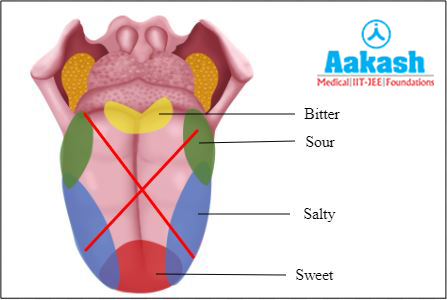
Fig: Different tastes are perceived on different areas of the tongue is a myth
Conditions affecting tongue
Some of the common conditions associated with the tongue are as follows:
Atrophic glossitis
In this condition the tongue lacks some or all types of papillae, thereby giving smooth appearance to the upper surface of the tongue.
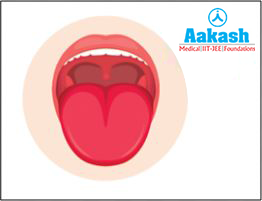
Fig: Atrophic glossitis
Ankyloglossia or tongue-tie
In this condition lingual frenulum is abnormally short or rigid. It leads to speech impairment. It can be corrected with speech therapy, but sometimes, may require surgery.
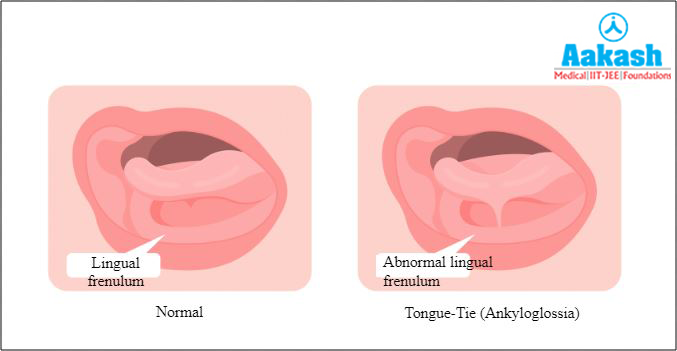
Fig: Ankyloglossia or tongue-tie
Canker sores
In this condition small painful ulcers formed on the tongue and inside the mouth. These are different from cold sores that appear because of herpes virus. It can be easily treated with steroid gels or silver nitrate.
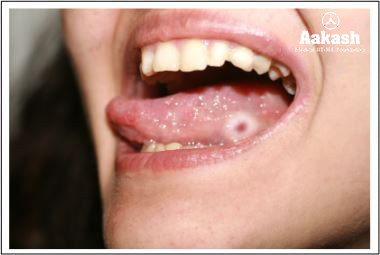
Fig: Canker sores
Oral thrush or candidiasis
This is a fungal infection caused by Candida albicans (yeast) on the surface of the tongue. It can be treated with antifungal medicines.

Fig: Oral candidiasis
Geographic tongue
This is a harmless condition. A map-like pattern appears on the tongue, with red and smooth patches (papillae loss) surrounded by white borders in this case.
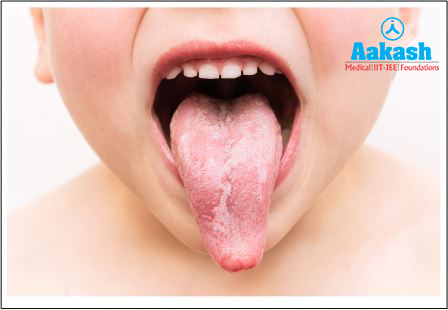
Fig: Geographic tongue
Oral leukoplakia
In this condition white patches appear on the mucosa of the tongue. They can develop due to smoking, tobacco chewing or long term alcohol intake. These patches can be scraped off or can be removed via surgery.
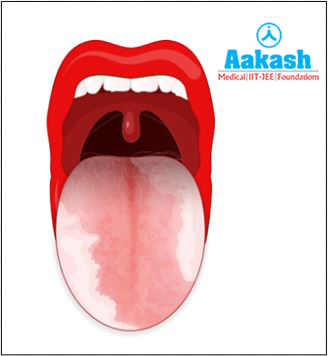
Fig: Oral leukoplakia
Oral cancer
It is the presence of tumorous or ulcerous growth on the tongue. It can be removed via surgery.
Functions of tongue
We now clearly understand that the tongue is an important sensory organ of gustation. But this flat muscular structure in the mouth also performs many other functions as follows:
- It acts as an accessory digestive organ.
- The tongue helps in mixing of saliva (containing amylase and lysozyme) with the food.
- It helps in lodging the food between the grinding surfaces of teeth.
- It helps in the formation of bolus.
- It acts as a brush and helps in cleaning the teeth.
- It pushes the food backwards towards the pharynx.
- Tongue also helps in licking and swallowing and speech.
Practice problems
Q1: Which of the following is incorrect with respect to the taste buds?
- Present on oral part of the tongue
- Present only along sulcus terminalis
- Absent in filiform papillae
- Contain sensory cells
Solution: Taste buds are present in papillae, which are distributed all over the surface of the tongue. Thus, taste buds are present all over the tongue. Each taste bud contains numerous sensory cells. Filiform papillae contain sensory cells for temperature, pain, touch and texture, but no taste buds. Hence, the correct option is b.
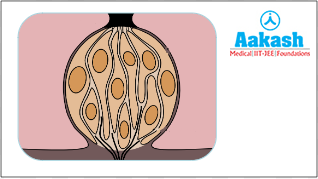
Fig: Taste buds
Q2. In which of the following conditions the tongue lacks papillae giving a smooth appearance to the tongue, but no white patches are seen?
- Oral leukoplakia
- Geographic tongue
- Ankyloglossia
- Atrophic glossitis
Solution: Atrophic glossitis is the condition in which the tongue lacks one or many papillae, thereby the tongue appears smooth. In oral leukoplakia, white patches form on the tongue due to smoking or tobacco chewing or alcohol consumption. Ankyloglossia is called tongue tied as the lingual frenulum is short or rigid. Geographic tongue is a condition where a map-like pattern appears on the tongue. Hence, the correct option is d.
Fig: Atrophic glossitis
Q3. Which of the following is true about tongue?
- The distal part is attached to the hyoid bone
- Pharyngeal part contains all taste buds
- Anterior part is called the oral part
- Sulcus terminalis is a straight furrow
Solution: The proximal part of the tongue is attached to the hyoid bone, whereas the distal part is free. Tongue is divided into 2 parts via a V-shaped groove, sulcus terminalis. The anterior oral part contains papillae, some of which contain taste buds and the posterior part is called pharyngeal part. Hence, the correct option is c.
Fig: Structure of tongue
Q4. Which of the following is not a taste?
- Spicy
- Savory
- Sweet
- Salty
Solution: Spicy or hot is not technically a taste. It is rather a pain signal sent by nerves sensitive to temperature and touch. Capsaicin is a chemical compound naturally found in chilli peppers and jalapenos. This chemical acts as an irritant for mammals, including humans. Hence, the correct option is a.
FAQs
Q1. How is our tongue different from the tongues of animals like tigers, lions and cats?
Answer: The tongues of tigers, lions and cats have many small, sharp and rear facing papillae. These not only help the animal to drink liquids like water, but also makes the tongue so strong that these animals could lick off the paints on your wall. In the wild this type of tongue helps the animal to remove the skin off prey while feeding.
Q2. How can I judge if my tongue is healthy or not?
Answer: A healthy tongue should be pink in colour (dark or light), with small projections on its upper surface. If you notice discoloration of your tongue, it could be an indication of some infection or abnormal condition.
Q3. How many muscles and nerves are present in our tongue?
Answer: Our tongue has two groups of muscles such as large extrinsic and small intrinsic muscles. The large extrinsic muscles perform all gross movements of the tongue. Small intrinsic muscles aid in changing the shape of the tongue. Together both of them help in speech.
The tongue is innervated by 5 types of cranial nerves as follows:
(i) Facial nerve - It innervates the anterior 2/3rd of the tongue and carries a sensation of taste.
(ii) Glossopharyngeal nerve - It innervates the posterior 1/3rd of the tongue and carries a sensation for taste.
(iii) Vagus nerve - It supplies back the tongue, taste and general sensations.
(iv) Trigeminal nerve - It carries sensations of pain, pressure and touch from the tongue.
(v) Hypoglossal nerve - It innervates the muscles of the tongue and helps in their movement.
Youtube link: Introduction to Digestion and Absorption Class 11 Biology (Chapter 16) Explained | NEET 2024 Exam

 Call Now
 Let's Chat
 Share
Share