-
Call Now
1800-102-2727


Reflex Action and Reflex Arc, Practice Problems and FAQs

We all respond to external stimuli and you know that our body’s reaction and response to any stimulus is brought about by the action of neurons. They are the structural and functional units of the nervous system. We also know that our brain and spinal cord forms the central nervous system or CNS while peripheral nervous system or PNS constitutes all the nerves (cranial and spinal nerves) that branch out from the CNS and extend to all the body parts.
What do we do when we want to hold a glass? We move our hand and hold it. But what will happen when we touch an item which is hot? We make a sudden and unexpected withdrawal of our hand. Why is it happening?
GIF: Reflex action in response to heat

The body movements which occur with an individual’s will are called the voluntary movements, whereas the involuntary movements are the ones which take place without an individual’s will. Well, it is the involuntary movement of our hand which opposes contact with the hot surface.
But, what is this sudden and unexpected movement called? These movements are called reflex actions. How does this take place in the body? Intriguing, isn’t it? So, let’s take a deep dive into the details of reflex action in this article.
Table of contents
- Reflex action
- Types of reflex actions
- Mechanism of reflex action
- Reflex arc
- Parts of the reflex arc
- Importance of reflex action
- Common examples of reflex actions
- Practice Problems
- FAQs
Reflex action
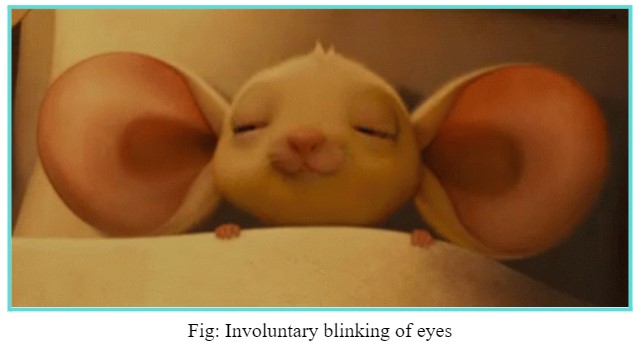
It is a type of behaviour in which stimulation of a sensory organ causes the activity of another organ without the need of willpower. It is a completely natural, instinctive mechanical response to the stimuli. A reflex action is the complete process of responding to a peripheral nerve stimulus that occurs spontaneously, that is, without conscious effort or thinking, and that involves a component of the central nervous system. Examples include involuntary blinking of eyes (corneal reflex)
Common characteristics of reflex action
- Reflex action is nerve-mediated.
- It is a rapid action.
- It is an automated stereotyped behaviour.
- It is a short lived response.
- It is an involuntary action.
Types of reflex action
There are two types of reflex actions as follows:
- Natural reflex or unconditioned reflex
- Conditioned reflex
Natural reflex
It refers to reflexes that do not require prior learning, i.e., reflexes inherited from parents or are inborn. They can be evoked immediately after birth. They do not require any previous encounter with the stimulus. Examples include salivation, breast feeding of newborns, swallowing, peristalsis, involuntary eye blinking, and so on.

Fig: Breast feeding of newborns
Conditional reflex
It refers to the reflexes that a person develops or learns during the course of their life. It is learned by experience rather than being passed down via the generation. It is also called the acquired reflex. These reflexes are an individual's entity. They may disappear and reappear again. Examples include a hungry dog's salivation in response to a dinner bell, playing a musical instrument, pedalling cycle, salivation at sight or smell of deliciou food etc.

Fig: Salivation at sight or smell of delicious food
Mechanism of reflex action
There are five components that must be present for a reflex response to take place as follows:
The afferent nerve fibres deliver a signal from the receptor organ to the central nervous system when a stimulus is received by the receptor. Motor impulses go from the CNS to the effector organ through the efferent neuron. This whole process finally results in a response.
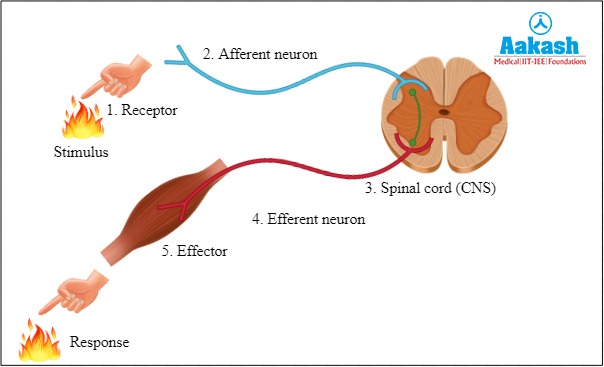
Fig: Mechanism of reflex action
Types of mechanism of reflex actions
Depending upon whether the brain or spinal cord is used, the reflex actions are of two types as follows:
Cerebral reflex actions
It is a reflex action which uses the brain for re-routing the reflex. It is controlled by the brain. Cerebral reflex action has two subtypes as follows:
Action under the knowledge of the brain
It includes some instant actions which are performed by the brain and are under the knowledge of the brain. Examples include sudden closure of eyes when somebody flashes the light and salvation on seeing or hearing or smelling delicious food.
Action not under the knowledge of the brain
It includes some instant actions which are performed by the brain but are not under the knowledge of the brain. Examples include salivation at the time of swallowing, gaseous exchange, peristalsis, release of hormones and enzyme actions.
Spinal reflex actions
It is a reflex action which uses the spinal cord for re-routing reflexes. The reflex actions which are controlled by the spinal cord. Examples include such as withdrawal of hand or foot on being pricked.
Reflex arc
The reflex arc is the neural pathway that the reflex action follows. The neural pathway in reflex action starts with the sensory neuron at the receptor and ends at an effector with the motor neuron.
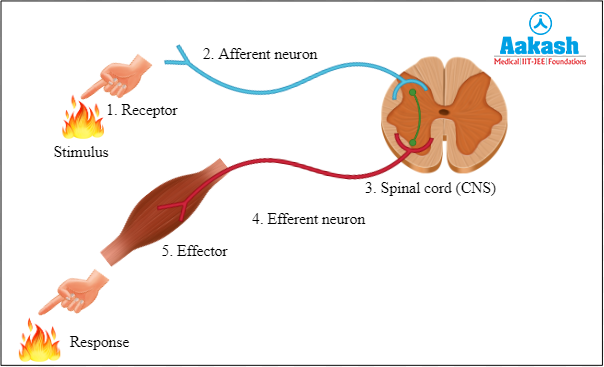
Fig: Reflex arc
Parts of the reflex arc
The neural pathway in the reflex arc starts with the receptor, afferent or sensory neuron, interneuron, efferent or motor neuron and ends with the effector organ.
Receptor
It is a tissue, cell or organ which receives an external or internal stimulus such as skin, eye, ear, etc. It sets up the sensory impulse. This receptor end is found in a sensory organ on a specialised receptor cell or a specific dendrite. It is extremely sensitive to any internal or external changes that occur as a result of the stimulation.
Afferent or sensory neuron
It transmits sensory data to the brain or spinal cord. The impulse generated by the receptor is taken by sensory or afferent nerve fibres to the central nervous system through the dorsal or posterior root of the spinal nerve. A sensory neuron's dendrite, cell body, and axon are all present to help it do its purpose.
Interneurons
Interneurons may exist between sensory and motor neurons. They are also known as a relay neuron because they act as a processing centre for nerve impulses that travel from a sensory neuron to a motor neuron. Interneurons are the communication hubs of neural circuits, connecting sensory and motor neurons to the central nervous system (CNS).
Efferent or motor neuron
It is a nerve cell that transports motor output to the periphery and is part of the pathway that impulses travel from the spinal cord to a gland or muscle (effector). These fibres carry the motor impulses generated in the central nervous system to specific effectors. In the spinal cord, the motor nerve fibres come out through the ventral or anterior root.
Effector
Muscles, organs, and glands that function in response to a stimulus are known as effectors. It is activated by motor impulse and produces an effect or response to suitably deal with the stimulus.
It reacts to motor neuron activation by eliciting a reflex, which is a behavioural reaction.
Importance of reflex action
The importance of reflex action are as follows:
- It permits the organisms to be protected from any unexpected stimuli that might hurt them.
- It secures the survival of a living organism.
- It relieves the brain of excess effort, keeping it from being overworked.
- Many circumstances necessitate speedy responses. There isn't enough time to consider and act. In such situations, reflex actions are crucial.
Examples of reflex action
Following are the common examples of reflex actions.
Examples of natural or unconditioned reflex
Some common examples of natural or unconditioned reflex actions are as follows:
- Infants' grasp reflexes.
- Coughing or sneezing due to nasal irritants.
- The closing of eyelids when particles reach the eyes.
- Shivering of the body in response to extreme cold - Shivering is a bodily function in response to cold in warm-blooded animals. When the core body temperature drops, the shivering reflex is triggered to maintain homeostasis.
- Sudden retraction of hands and legs when comes in contact with something hot or prickly.
Examples of conditioned or acquired reflex actions
Some examples of conditioned or acquired reflex actions are as follows:
- Typing action on the computer.
- Typing of shoelaces.
- Playing a musical instrument.
- Learning to sing and dance.
- Using brakes when suddenly someone appears in front of you while driving.
Practice problems
Q 1. Which of the following statements is incorrect regarding reflex actions?
a. It is faster than normal body actions
b. It can only take place with a stimulus
c. It involves the brain and spinal cord
d. Motor neurons carry out the response
Answer: The reflex pathway is maintained short and involves the least number of neurons and synapses feasible, thus, a reflex response occurs quickly. The receptor receives a stimulus and the afferent or sensory neurons pass the impulses to the central nervous system (CNS). The interneuron connects the sensory neuron with the motor neuron. The impulses from the CNS are carried by the motor neurons to the effector organs. The effector muscles, organs or glands carry out the response to the stimulus. Hence, option d is correct.
Q 2 . Assertion (A): Natural reflex actions are also called inborn reflex actions.
Reason (R): These reflexes do not require previous learning or experience.
a. Both A and R are correct, R is the correct explanation of A.
b. Both A and R are correct, R is not the correct explanation of A.
c. A is correct and R is incorrect.
d. Both A and R are incorrect.
Answer: Natural reflex actions are also called inborn reflex actions or unconditioned reflex actions, as these are reflexes which are inherited by an individual from its parents, thus, are present at birth. Natural reflexes are unconditioned, i.e, they do not need prior learning or experience to exert their action. Examples include involuntary blinking of eyes. Hence, option b is correct.
Q 3. Choose the correct sequence of parts through which the impulses pass in the reflex arc.
a. Receptor → Sensory neuron → Effector → Interneuron →Motor neuron
b. Sensory neuron → Receptor → Interneuron → Motor neuron → Effector
c. Receptor → Sensory neuron → Motor neuron → Interneuron →Effector
d. Effector → Interneuron → Sensory neuron → Motor neuron → Receptor
Answer: A reflex arc is a basic neural route that controls the reflex action. The receptor organ contains afferent or sensory neurons that receive the stimuli. The sensory information is transmitted from the receptor organ to the spinal cord through the sensory neuron. The CNS processes the information and relays it to the motor or efferent neurons through the interneuron. The signal from motor neurons is sent to the effector organs (muscles, glands etc).
through the motor pathway
Q 4. State the significance of reflex action?
Answer: The significance of reflex action are as follows:
- It allows organisms to be protected from any unexpected stimuli that might be harmful to them.
- Reflex actions are crucial in the circumstances where an immediate and speedy response is required.
- It keeps the brain from being overloaded by relieving it of extra effort.
FAQs
Q 1. Brain is not involved in reflex action. Give reason.
Answer: Although the brain receives sensory input during reflex action, most sensory neurons do not pass directly into the brain. It instead synapses in the spinal cord, allowing reflex actions to occur relatively more quickly by activating the spinal motor neurons. This prevents the delay of signal routing through the brain.
Q 2. What can possibly happen if we do not have reflex action?
Answer: A reflex action is a quick, instinctive response to a stimulus that is not controlled by the brain. Reflexes control body functions such as digestion and blood pressure too. Most responses do not entail a visible and quick movement, they go unnoticed. If the response is excessive or non-existent, it might suggest that the central nervous system has been damaged. This suggests that the parts like nerve root, spinal cord, peripheral nerve, or effectors have been damaged. It may also be due to the disruption of the sensory or motor nerves or both. It can badly affect the body.
Q 3. Why do reflexes become slower with age?
Answer: With ageing, reflexes slow down. The speed of conduction is slowed by physical alterations in nerve fibres. In addition, the areas of the brain that govern motor function lose cells as time passes. The impact of ageing on reflexes and response time, on the other hand, varies widely from person to person.
Q 4. What controls the speed of reflexes?
Answer: The cerebellum is the region of the brain that governs reflexes. The cerebellum controls motor reflexes and is involved in muscle and balance coordination. The brainstem connects and delivers information from the brain to the spinal cord, regulating activities including breathing, heart rate, and attentiveness.
YOUTUBE LINK: Can Reflexes Be Conditioned? | Classical Conditioning & Reflexes | Wicket To Wicket |
Related Topics
|
Neuron: Structural and functional unit, Practice Problems and FAQs |
|
Synapse and Transmission of impulses, Practice Problems and FAQs |
|
Central neural system: Brain and Spinal cord, Practice Problems and FAQs |

 Call Now
 Let's Chat
 Share
Share