-
Call Now
1800-102-2727



Phylum Hemichordata, Practice Problems and FAQs
Have you heard about a centaur? It is a Greek mythological creature having a human upper body part and the lower body and legs of a horse. They can be neither included under humans nor in horses. They exist as a separate group with more powers by showing both the characters of humans and horses.
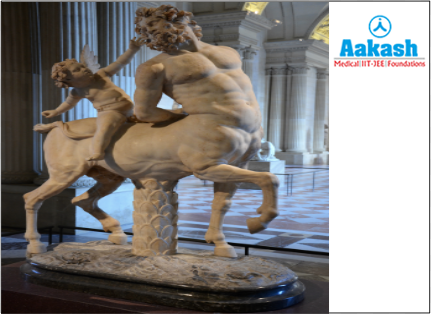
Fig: Centaur
Now just observe the image of the organism given below. Can you identify the organism? In which category you can include them? What do you think, are they vertebrates or invertebrates?

Fig: Saccoglossus
These organisms are also like centaurs. They are called the hemichordates. They show half the characteristics of one phylum and half the characteristics of another phylum. Can you believe these worm-like organisms connect the invertebrates and vertebrates! But they are included under the category of non-chordates even though they show many similar characteristics of chordates, because they lack notochord. Then how will the body organisation of these organisms be? What are the specialised organs of hemichordates? Let’s find out answers for all these questions in this article. So now we are going to discuss more about phylum Hemichordata.
Table of contents
- Phylum Hemichordata
- Classification of phylum Hemichordata
- Reasons for the creation of a separate phylum for Hemichordata
- Practice Problems
- FAQs
Phylum Hemichordata
Hemichordata was initially placed under the phylum Chordata but now is categorised under non-chordates. The word Hemichordata has been derived from two words ‘hemi’ meaning half and ‘chordata’ meaning notochord. So they are half chordates which look like small worm-like animals. Some members of this phylum are commonly called acorn worms and others are called pterobranchs. Examples include Balanoglossus, Saccoglossus, Cephalodiscus, Rhabdopleura etc.
General characteristics of phylum Hemichordata
The following are the general characteristics of the phylum Hemichordata:
Body
The body is soft, unsegmented, fragile and worm-like. It is divided into proboscis, collar and trunk.
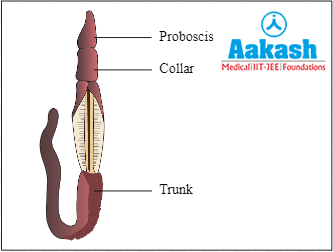
Fig: Body
Presence of stomochord
Collar region of hemichordates consist of a rudimentary structure known as stomochord which is very similar to notochord. This is an identifiable characteristic of the phylum Hemichordata. It is a flexible, hollow tube. It arises in embryonic development from the roof of the embryonic gut. In adult organisms, they are present on the dorsal side from the pharynx into the proboscis. It communicates normally with the oral cavity. It acts as a support for the heart-glomerulus complex.
Habitat
They are well-adapted to marine environments. They can be seen inside the burrows.
Symmetry
They are bilaterally symmetrical, that means here the body can be divided into two equal halves through a single plane passing through the centre of the body.
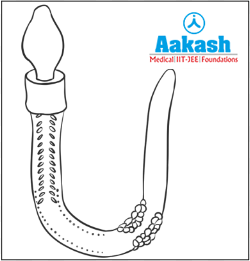
Fig: Bilateral symmetry in hemichordates
Level of organisation
They possess an organ system level of body organisation, where division of labour can be seen between different organ systems.
Germ layer organisation
They are triploblastic. They possess three germ layers which include the outer ectoderm, middle mesoderm and inner endoderm.
Coelom
They are coelomates. They have a body cavity present between the walls of the body and gut which is lined by mesoderm. Here the coelom is divided into three distinct regions such as protocoel, mesocoel (in the collar region) and metacoel corresponding to the three regions of the body.
Body wall
It is a single layered epidermis along with musculature.
Body plan of hemichordates
They possess a tube within a tube body plan with two openings such as the mouth (anterior end) and anus (posterior end).
Organ systems of hemichordates
The following are the major organ systems in hemichordates:
Digestive system in Hemichordata
The digestive tract is complete with the mouth (anterior end) and anus (posterior end). Buccal diverticulum or stomochord is a hollow protrusion from the buccal cavity found in Proboscis. In the past, it was thought to be a notochord.
Circulatory system in Hemichordata
Hemichordates have an open circulatory system which is characterised by flowing blood through sinuses and body cavities. Thus the cells and tissues are directly bathed in blood. They have a dorsal heart and two longitudinal vessels (a dorsal and ventral vessel). These are interconnected by lateral vessels and sinuses. Blood is colourless in them.
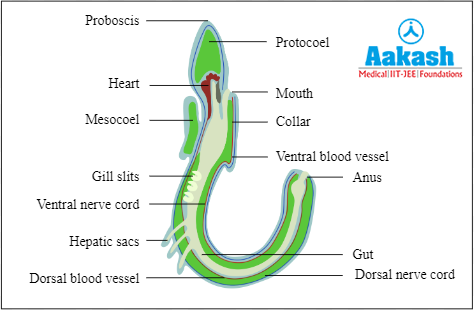
Fig: Open circulatory system in Hemichordates
Respiratory system in Hemichordata
Respiration in hemichordates occurs through the numerous paired gill slits present on the body surface.
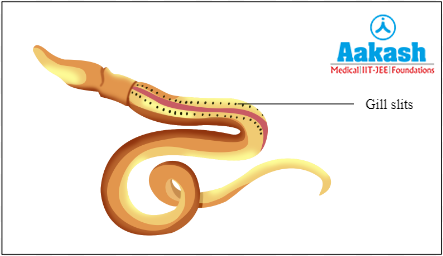
Fig: Respiratory organ in Hemichordates
Excretory system in hemichordates
A single glomerulus is present in the proboscis in hemichordates. This helps in excretion.
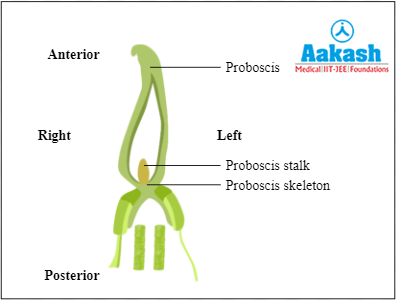
Fig: Excretory organ in Hemichordata
Sense organs
They do not possess any specialised sensory organs. But the sensory cells of the epidermis are considered to be the sense organs.
Nervous system
It lies embedded in the epidermis and occurs on both the dorsal and ventral surfaces.
Mode of reproduction and development of hemichordates
They are unisexual and shows indirect development.
Sexual nature
Hemichordates are dioecious in nature, that means they have separate sexes. Gonads are one to several pairs in them.
Type of fertilisation
Their fertilisation is external and it is characterised by the fusion of gametes in an external medium such as water.
Type of development
Development is indirect through the presence of larval stages which then transform into adults. Development includes a tornaria larva which is free-swimming.
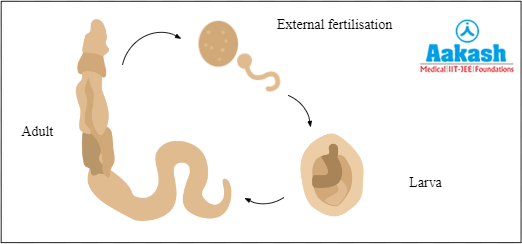
Fig: Life cycle of Hemichordata
Classification of phylum Hemichordata
The Enteropneusta, often known as acorn worms, and the Pterobranchia, which may include graptolites, are the two classes of Hemichordata. Planctosphaeroidea is a suggested third class based on a single species known exclusively from larvae.
Enteropneusta
Acorn worms have a circulatory system that includes a kidney-like heart. Acorn worms have gill-like structures similar to the gills of primitive fish that they use for breathing. As a result, acorn worms are occasionally referred to as a connection link between invertebrates and vertebrates. Some have a postanal tail that looks similar to the postanal tail of vertebrates. Examples include Balanoglossus gigas and Saccoglossus.
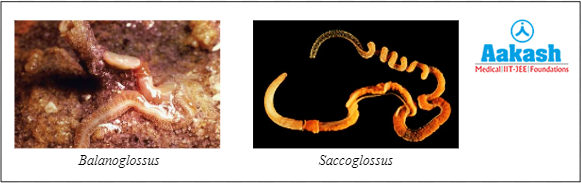
Fig: Animals of class Enteropneusta
Balanoglossus
It is commonly known as an acorn worm because of the shape of the proboscis. They live in ‘U’ shaped burrows in the shallow coastal waters. They possess an elongated and cylindrical body. The body is divided into proboscis, collar and trunk. Proboscis is present in the anterior part of the body which is thick and possesses muscular walls. Collar is short and forms the middle part of the body. The trunk is the largest part of the body. They possess hepatic caeca also.
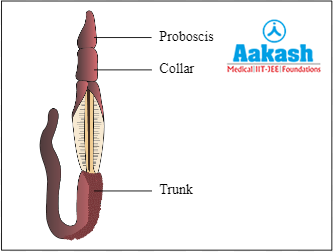
Fig: Balanoglossus
Pterobranchia
Pterobranchia feed using cilia connected to tentacles. It is used to filter plankton from the water. The trunk is bent over such that the anus protrudes upwards and rests dorsal to the collar. It has a simple tubular gut. The proboscis is broad at the tip and contains glands that secrete an organic material in which the pterobranch spends its mature life. Examples include Cephlaodiscus.
Fig: Cephlaodiscus
Planctosphaeroidea
Only the larvae of this species can swim freely. The larvae are called tornaria larva, which have a ciliated band to catch food particles, similar to those of the closely related Enteropneusta. The presence of mucus secreting glands along the ciliated band distinguishes Planctosphaera pelagica from other species. Planctosphaera pelagica is the only member of the Planctosphaeroidea class that has been discovered. The mucus glands could be used to aid in feeding or to ward off predators and parasites.
Reasons for the creation of a separate phylum for Hemichordata
The following reasons lead to the creation of a separate phylum for Hemichordata:
Affinities with phylum Chordata
The hemichordates resemble the chordates in the following features:
- They possess paired pharyngeal gill slits.
- They possess a dorsal tubular nerve cord.
Differences from phylum Chordata
The hemichordates show differences from the chordates in the following features:
- Presence of division of the coelom into protocoel, mesocoel and metacoel.
- Faintly expressed segmentation.
- Intraepidermal position of the nervous system.
- Absence of notochord.
- Presence of a ventral nerve cord.
- Presence of circum enteric connectives.
Affinities with non- chordata
The hemichordates resemble the non-chordates in the following features:
- The tornaria larva shows similarities with bipinnaria larvae of phylum Echinodermata.
- Presence of division of the coelom into protocoel, mesocoel and metacoel.
- Poor development of the nervous system.
- They are similar to annelids (segmented worms) in body form.
- They show burrowing habits like annelids.
- The circulatory system of the tornaria larva is similar to the trochophore larvae of polychaetes (Nereis).
Practice Problems
Q 1 . Identify the correct statements about phylum Hemichordata.
1. Hemichordata was initially placed under Chordates.
2. Collar region of hemichordates consists of a rudimentary structure known as stomochord.\
3. Body of hemichordates is soft and segmented.
4. Development includes tornaria which is a free-swimming larva.
5. The epidermis is considered to be the sense organ.
a. A, B, C, D, E
b. A, B, C
c. A, B, D, E
d. B, C, D, E
Answer: Phylum Hemichordata was initially placed under phylum Chordata but now is categorised under non-chordates. Collar region of hemichordates consist of a rudimentary structure known as stomochord which is very similar to notochord. This is an identifiable characteristic of the phylum Hemichordata. Body of hemichordates is soft and unsegmented. It can be divided into proboscis, collar and trunk. Development is indirect through intervening larval stages which then transform into adults. Development includes the tornaria which is a free-swimming larva. They do not possess specialised sensory organs. But the sensory cells of the epidermis are considered to be the sense organs. Hence the correct option is c.
Q 2. Select the incorrect pair of Hemichordata from the following.
I) Digestive system: Buccal diverticulum
II) Excretory system: Proboscis
III) Fertilisation: Internal
IV) Sense organs : Epidermis
a. I and II
b. III only
c. I and IV
d. III and IV
Answer: The digestive tract is complete with the mouth (anterior end) and anus (posterior end). Buccal diverticulum or stomochord is a hollow protrusion from the buccal cavity found in the Proboscis. In the past, it was thought to be a notochord. Specialised organs known as proboscis glands help in digestion and elimination of waste materials. A single glomerulus in proboscis helps in excreting wastes in hemichordates. They show external fertilisation and it is characterised by the fusion of gametes in an external medium such as water. They do not possess specialised sensory organs. But the sensory cells of the epidermis are considered to be the sense organs. Hence the correct option is b.
Q 3. Explain the circulatory system of hemichordates?
Answer: Hemichordates have an open circulatory system which is characterised by the blood flow through sinuses and body cavities. Thus the cells and tissues are directly bathed in blood. They possess a dorsal heart and two longitudinal vessels (a dorsal and ventral vessel). These are interconnected by lateral vessels and sinuses. Blood is colourless in them.
Q 4. Which class of Hemichordata has only one identified species?
Answer: Planctosphaeroidea is the class of Hemichordata which has only one identified species. Planctosphaera pelagica is the only member of this class that has been discovered till now. The presence of mucus secreting glands along the ciliated band distinguishes Planctosphaera pelagica from other species. The mucus glands could be used to aid in feeding or to ward off predators and parasites.
FAQs
Q 1. Who discovered Balanoglossus?
Answer: Balanoglossus was discovered in 1825 on Mashail Island by J.F. Eschscholtz. He identified it as a worm-like holothurian (sea cucumbers of phylum Echinodermata). The finding of paired gill-slits in this animal by Kovalevsky (1865) led to Gegenbaur's classification of them onto Enteropneusta (1870).
Q 2. How are hemichordates different from Chordates?
Answer: Phylum Hemichordata and phylum Chordata vary in the following characteristics:
- Hemichordata has an epidermal neural system while Chordata has a central nervous system. Chordates have a tubular nerve cord on the dorsal side whereas hemichordates possess dorsal and ventral nerve cords.
- Paired pharyngeal gill slits can be seen in both the phylum Hemichordata and Chordata.
- Chordates possess a post-anal tail and notochord too.
Q 3. What are graptolites?
Answer: The subclass Graptolithina of the class Pterobranchia contains the colony creatures known as graptolites. Fossils from the Middle Cambrian (Miaolingian, Wuliuan) through the Lower Carboniferous are the main source of information about these filter-feeding creatures. The word graptolite is derived from the Greek words graptos, which means ‘written’, and lithos, which means ‘rock’, because many of the fossils found in graptolite resemble hieroglyphic writing on rock.
Fig: Graptolite

Q 4. What is Ambulacraria?
Answer: An Ambulacrarian is a member of the clade of invertebrate phyla known as Ambulacraria or Coelomopora, which contains echinoderms and hemichordates. Echinoderms and hemichordates split roughly 533 million years ago, according to a phylogenetic study. The Chordata, Vetulicolia, and Saccorhytus are also members of the wider group known as the deuterostomes, which also contains the Ambulacraria. Echinodermata and Hemichordata are the two living clades containing representative organisms. These two are together referred to as the lowest deuterostomes.
YOUTUBE LINK: https://www.youtube.com/watch?v=2V-RxvwschU&t=280s
Related Topics
|
Basis of Classification: Levels of organisation, Practice Problems and FAQs |
|---|
|
Basis of Classification: Symmetry, Germ layer organisation, Coelom, Practice Problems and FAQs |
|
Basis of Classification: Body plan, Segmentation, Notochord, Broad classification of Kingdom Animalia, Practice Problems and FAQs |
|
Phylum Echinodermata, Practice Problems and FAQs |
|
Phylum Chordata, Practice Problems and FAQs |

 Call Now
 Let's Chat
 Share
Share