-
Call Now
1800-102-2727



Phylum Arthropoda, Practice Problems and FAQs
You all have seen weightlifters. But how much weight can you lift? Confused. The amount of weight a person can lift is mostly determined by their body weight and practice. But there will always be some exceptional cases. Have you ever seen an ant carrying their food? They have the ability to carry 20 times their own weight. How can they do that? This is due to the fact that their muscles are thicker or have more cross-sectional area in relation to their body size than in larger animals.
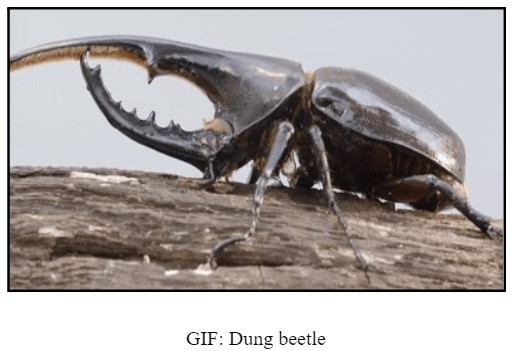
There is another weightlifter like this. It is the dung beetle. It is the longest beetle and is the strongest creature on Earth compared to its body weight. It can carry 850 times its weight! That’s like a person carrying seven elephants! But what is special about them? Nothing much. They have 6 legs, just like the cockroaches. This is interesting right?
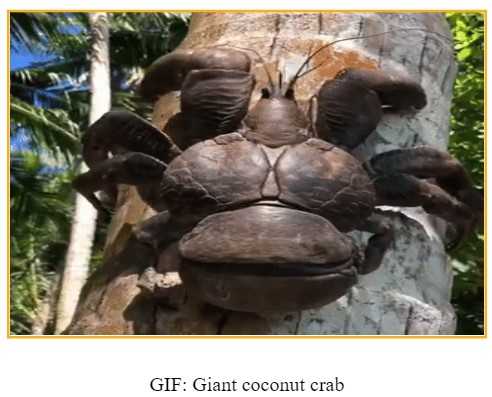
There is another animal called giant coconut crab. It has a weight of up to 4.1 kg (9.0 lb). It can reach a length of 1 m (3 ft 3 in) from tip to tip of each leg.
If you don't know the name of these animals, what will you call them? You might call them insects. Right? Why do we call all of them like that? They look similar in one or another perspective even though their size varies. But you know they really have some characters in common. So all these insects are classified under the phylum Arthropoda. Let’s take a deep dive into the details of phylum Arthropoda in this article.
Table of contents:
- Phylum Arthropoda
- Classification of phylum Arthropoda
- Economically important arthropods
- Practice Problems
- FAQs
Phylum Arthropoda
Phylum Arthropoda is considered as the largest phylum of the animal kingdom. It comprises two-third of all the species discovered till now on Earth. The word ‘Arthropoda’ has been derived from two words ‘arthron’ meaning joint and ‘podos’ meaning foot. Arthropods have characteristic jointed appendages. Animals with jointed appendages have a far wider range of motion and flexibility. Legs of arthropods may be unbranched, like in flies and mosquitoes or branched as seen in prawns or lobsters. Now let’s discuss some general characteristics of phylum Arthropoda.
Fig: Pie chart showing the abundance of phylum Arthropoda among kingdom Animalia

General characteristics of phylum Arthropoda
The following are the major characteristics of phylum Arthropoda:
Habitat
Arthropods are well-adapted to terrestrial as well as aquatic environments. They are as follows:
Terrestrial arthropods
It includes cockroaches, spiders, butterflies, and locusts.
Fig: Terrestrial arthropods

Aquatic arthropods
It includes animals such as prawns, lobster and crabs.
Fig: Aquatic arthropods

Exoskeleton
Arthropods have hard chitinous (nitrogen containing polysaccharide) exoskeleton. Their skeleton will be present outside the body. It is evolved in marine arthropods to defend them from predators. The chitinous wings of insects help them to fly. This exoskeleton allows their survival in harsh environments. The hard cuticle inhibits growth hence it must be replaced on a regular basis. This is known as ecdysis or moulting.
Fig: Difference between endoskeleton and exoskeleton

Symmetry
Body of an arthropod is bilaterally symmetrical. That means the body can be divided into two equal and identical halves, i.e., right half and left half, through only one plane called the median sagittal plane.
Fig: Bilateral symmetry in arthropods

Level of organisation
Arthropods have an organ system level of body organisation, where division of labour can be seen between different organ systems.
Germ layer organisation
Arthropods have triploblastic germ layer organisation. That means they have three germ layers which include outer ectoderm, middle mesoderm and inner endoderm.
Fig: Triploblastic organisation in arthropods

Presence of coelom
A body cavity is present between the gut wall and body wall which is lined by mesoderm, hence they are coelomates.
Fig: Coelom in arthropods

Body segmentation
Body of arthropods is segmented externally. It is not separated by internal septa. The segments in arthropods are specialised for particular functions like feeding, locomotion and reproduction. The segments are grouped into two regions such as head and trunk or cephalothorax and abdomen. The segments can also be divided into three regions like head, thorax and abdomen.
Fig: Three segments of body of arthropods

Organ systems of arthropods
Now we have an idea about the general characteristics of arthropods. They have a developed organ system compared to annelids. So next we are going to check out the organ systems of arthropods. We will discuss the respiratory system, circulatory system, sensory system and excretory system of arthropods.
Respiratory system in arthropods
Vast variety of arthropods have different types of respiratory systems such as gills, book gills, book lungs or tracheal systems. Let’s discuss each of these systems in detail.
Book lungs
They are present in spiders and scorpions. Book lungs have many folds. These folds of the book lungs are filled with the fluid called hemolymph. These folds increase the surface area exposed to air, and maximise exchange of gases with the environment. In most species of arthropods, motion of the plates is not required to facilitate this kind of respiration. There are air spaces between the plates, which enable air to flow through these plates. This leads to gaseous exchange by diffusion. This system looks like pages of a book. Hence the name booklungs.
Fig: Book lungs in arthropods

Tracheal system
It is the respiratory system present in cockroaches. This is the most common respiratory system in arthropods. It involves a system of tracheal tubes connected to air sacs. Tracheal system opens on the surfaces of the thorax and abdomen through openings called spiracles. Hence the exchange of air takes place through the spiracles.
Fig: Tracheal system in arthropods

Book gills
They are the organs for respiration in Limulus. Book gill is like a flap. When they are moving they push water over the lamellae. These lamellae are the thin membranes within the book gills. This movement of the gills helps in circulating blood throughout the lamellae and gaseous exchange occurs by diffusion.
Fig: Book gills in Limulus

Circulatory system in arthropods
Open circulatory system is one of the features of arthropods. Here the blood flows through the sinuses and body cavities. The cells and tissues are directly bathed in blood in this system.
Fig: Open circulatory system in arthropods

Sensory system in arthropods
Organs that help in responding to external stimuli are included in the sensory system. Different sensory organs present in arthropods are eyes, antennae and statocysts.
Eyes
Arthropods have simple and compound eyes for vision. Compound eye consists of many similar units called ommatidia, each with its own lens. This allows mosaic vision.
Fig: Eyes of insect

Antennae
They are sensory appendages generating the olfactory, gustatory, tactile and other senses.
Fig: Antennae of cockroach

Statocyst
They are the balancing organ in some aquatic arthropods like lobsters.
Fig: Statocyst in arthropods

Excretory system in arthropods
Excretory organs differ in arthropods.
Malpighian tubules
Specialised organs known as malpighian tubules present. It opens into the gut and helps in excreting out wastes in arthropods like cockroaches.
Fig: Malpighian tubules in arthropods

Green glands
There is another excretory organ called green glands present. They are present in arthropods like prawns which open directly into the exterior.
Mode of reproduction and development of arthropods
They show sexual reproduction.
Sexual nature
Arthropods are dioecious in nature. That means they have separate sexes.
Fig: Dioecious nature of arthropods

Type of fertilisation
Arthropods exhibit internal fertilisation, that means the fusion of male gamete and female gamete occurs inside the female body.
Mode of birth
Arthropods are oviparous, that means females lay fertilised or unfertilised eggs inside which the development of embryo occurs.
Fig: Eggs of an insect

Type of development
Embryos of an arthropod undergo two types of development such as direct development and indirect development.
Direct development
In direct development the young ones (nymph) and adults look alike.
Fig: Indirect development in arthropods

Indirect development
In indirect development the young ones grow through intervening larval stages which are morphologically different from the adult. Examples include cypris, the larvae of Sacculina, Balanus and Lepas.
Classification of phylum Arthropoda
Animals in arthropods are classified on the basis of body divisions and presence or absence of specific appendages into seven different classes. They are as follows:
- Onychophora
- Crustacea
- Chilopoda
- Diplopoda
- Insecta
- Arachnida
- Merostomata
Class Onychophora
They have a worm-like segmented body and occur in moist habitats. Their bodies have unjointed legs with claws. Respiration occurs by tracheae and excretion is carried out by nephridia. Examples include Peripatus (The walking worm)
Peripatus
It is the connecting link between Annelida and Arthropoda. It shows characters of both annelids and arthropods. It is a terrestrial segmented worm like arthropod. It is nocturnal and insectivorous.
Fig: Peripatus

Class Crustacea
Body of these animals is divided into Cephalothorax (Head and thorax) and abdomen. The cephalothorax is covered with an exoskeleton called carapace (chitin and CaCO3). A pair of compound eyes and two pairs of antennae are present. Examples include Cancer (crab), Palaemon (prawn), Palinurus (lobster), Lucifer (shrimp), Daphnia (water flea), Cyclops etc.
Palaemon
It is the prawn. They are omnivorous. Palaemon demonstrates autotomy. To get out from the enemy's grasp, it tears off its appendages. They exhibit sexual dimorphism. The eggs are carried by female Palaemon on a plateform abdomen formed by appendages.
Fig: Animals of class Crustacea

Class Chilopoda
This class was earlier included in class Myriapoda. The body of these animals is divided into the head and trunk. The body is flat. The first pair of legs are adapted to form poison claws. Single pair of antennae is present. Examples include Scolopendra (centipede).
Scolopendra
It is a nocturnal, carnivorous and swift swimmer insect. They are usually found in decaying woods, under the stones or any humid places.
Fig: Scolopendra

Class Diplopoda
This class was earlier included in class Myriapoda. These animals' bodies are separated into three sections: head, thorax, and abdomen. Each and every abdominal segment except the first pair has two pairs of legs. They have one pair of antennae. Examples include Julus (millipede).
Julus
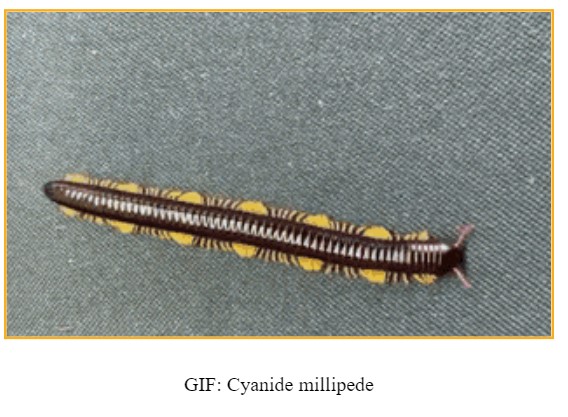
It is a herbivore or has saprobic (decomposer) nutrition. When disturbed, it will roll up into a spiral. Then it will also emit a fluid from stink glands which has a foul smell. Cyanide millipede produces hydrogen cyanide (HCN) to hunt prey and to protect itself against any threats.
Class Insecta
It is the largest class of animals, with around 750000 species. The bodies of these animals can be divided into head, thorax and abdomen. They have a pair of antennae and compound eyes on the head. The thorax is adorned with three pairs of legs and two pairs of wings. The abdomen is devoid of appendages. Insects are oviparous. Examples include silverfishes, cockroaches, locusts, termites, butterflies, beetles, wasps etc.
Fig: Different types of insects from class insecta

Lepisma
It is also known as the silver fish. It is found in books, clothes, picture frames, wallpapers etc. it feeds on starch used for book binding and runs swiftly.
Fig: Lepisma

Mouthparts of insects
The mouthparts of insects are of different types. Usually it consists of one labrum, one labium, one hypopharynx, two mandibles and two maxillae. So now we will check out what are the different types of mouth parts found in insects.
- Biting and chewing types of mouthparts - They are found in insects like grasshoppers, cockroaches and termites.
- Piercing and sucking type - In mosquitoes, aphids and fleas the mouth parts are of this type.
- Chewing and lapping type of mouthparts - It is seen in honeybees, because lap means to drink by scooping with tongue.
- Sponging types of mouthparts - It is seen in house flies and fruit flies.
- Syphoning type of mouthparts - They are present in butterflies and moths.
Class Arachnida
The body of these animals is divisible into cephalothorax and abdomen. They have four pairs of legs. The first pair of legs are called chelicerae. The second pair of legs are called pedipalpi. They do not have antennae. Examples include spiders, scorpions, ticks, mites etc.
Palamnaeus
They are commonly called the scorpion. They are nocturnal animals. They are carnivorous and show cannibalism. Cannibalism is defined as the act of eating another member of the same species as food. It has a poisonous sting at the posterior end of the abdomen. Male and female scorpions show an elaborate courtship which includes dance before copulation. The male is usually eaten up by the female after mating. It shows viviparity.
Fig: Deathstalker Scorpion

Aranea
They are commonly called the spider. It is carnivorous. They just suck the prey's bodily fluids and discard the dirt remnants. In silken ootheca, the female lays her eggs.
Fig: Spider

Class Merostomata
Members of this class possess a large shield which covers the cephalothorax. The compound eyes present here are reduced. The second pair of appendages are called the pedipalps. They resemble the walking legs. They possess a long, spike-like appendage which is called a telson. It projects from the rear of their bodies.
Limulus
It is also called king crab or horseshoe crab. It is the major example of this class. It is considered as a living fossil and they have book gills as their respiratory structure.
Fig: Limulus

Economically important arthropods
Phylum Arthropoda possesses lots of economically important arthropods.
Positive impact
- Palaemon, also known as prawn, is a type of edible arthropod.
- Silkworms are raised for the purpose of producing silk. Sericulture is the name used for this method.
- Apis, sometimes known as the honey bee, is a beneficial insect that produces honey and beeswax. Pollination is also aided by it.
- The lac insect (Laccifer) present in the family Kerriidae produces a natural resin called lac.
Fig: Economically important arthropods

Negative impact
- When the Julus or millipede feeds on the roots of crop plants, it becomes a pest.
- Silver fish or Lepisma, causes harm to books and clothing.
- The plague is transmitted by rat fleas.
- Culex and Anopheles mosquitoes spread filariasis and malaria, respectively.
Practice Problems
Q`1. Following points describe organism ‘X’.
- ‘X’ is characterised by jointed appendages.
- ‘X’ excrete with the help of an excretory organ called malpighian tubules.
- ‘X’ has a hard chitinous exoskeleton.
- ‘X’ is the member of the largest phylum of the animal kingdom.
Which of the following is ‘X’?
a. Starfish
b. Cockroach
c. Lizard
d. Frog
Answer: The largest phylum of the animal kingdom is phylum Arthropoda. Jointed appendages, excretion through malpighian tubules and presence of hard chitinous exoskeleton are all characteristic features of arthropods. Among the given options, cockroaches belong to phylum Arthropoda. Hence, the correct option is b.
Q 2. On an educational trip to the silk factory, students learned that silk is obtained from an insect. Which of the following insects helps in silk production?
a. Bombyx mori
b. Laccifer
c. Apis indica
d. None of the above
Answer: Arthropods help in obtaining some commercially important products like honey and silk. Silk is obtained from silkworm or Bombyx mori. Hence, the correct option is a.
Q 3. Different respiratory organs are found in different arthropods. The names of the arthropods and respiratory organs are given below. Find the correct match of respiratory organs for each arthropod?
|
Respiratory organ |
Arthropod |
|
1. Spider |
|
2. Limulus |
|
3. Cockroach |
a. a - 1, b - 2, c - 3
b. a - 3, b - 1, c - 2
c. a - 2, b - 1, c - 3
d. None of the above
Answer: Spiders belonging to the order Araneae have a unique respiratory system in that they are the only animal group that breathes through their lungs called book lungs and tracheae at the same time. The respiratory structures of Limulus are considered as book gills. The cockroach, like other insects, lacks lungs. Instead, it has a network of tubes called tracheae that open at the surface of the thorax and abdomen through paired valve-like organs called spiracles. Hence the correct option is b.
Q 4. Which of the following is not considered as a sensory organ in arthropods?
a. Simple eyes
b. Compound eyes
c. Antennae
d. Malpighian tubules
Answer: Malpighian tubules are excretory organs in organisms of phylum Arthropoda. Arthropods have sensory organs such as simple eyes, compound eyes, and antennae. A single lens makes up simple eyes, whereas numerous lenses make up complex eyes. The compound eyes are made up of ommatidia, which are structural and functional units. Sensory receptors in antennae detect odour of molecules in the air. Hence the correct option is d.
FAQs
Q 1 . Why are silverfish referred to as fish?
Answer: The term ‘silverfish’ comes from a combination of factors. They have a silvery-blue colour, similar to fish scales. When they move, they move side to side, and their movement resembles a fish tail as they swim through the water. It is the world's oldest insect. The silverfish was named the longest-living insect species. At 400 million years old, these ancient insects have been around almost as long as the oldest fossils. Dragonflies and mayflies are nearly as old as humans, with a lifespan of more than 300 million years.
Q 2. When a millipede is touched, why does it roll?
Answer: Millipedes can't bite, sting, or inject venom. Their main defence mechanisms include coiling up and secreting toxins from the sides of their body. These secretions have been shown to include a variety of undesirable compounds, including hydrogen cyanide, hydrochloric acid, hydroquinones, benzoquinones, alkaloids, and phenols.
Q 3. Do insects fall asleep?
Answer: Insects do, in fact, sleep. Their bodies, like those of other creatures with a central nervous system, require rest and restoration. However, not all bugs sleep in the same way. When an insect needs to eat, its circadian rhythm or regular cycle of awake and sleeping time varies.
Q 4. What insect has a 24-hour lifespan?
Answer: Mayflies have the shortest living life cycle on the planet, lasting only 24 hours. However not all bugs live for a long time. A few bugs have the ability to live for years, even decades.
Q 5. What insect has the ability to taste with its feet?
Answer: Butterflies have taste sensors on their feet (or tarsi), allowing them to sample any substrate by just stepping on it. Flies also taste with their feet, and will reflexively extend their mouthparts if they land on anything appetising.
YOUTUBE LINK: https://www.youtube.com/watch?v=2V-RxvwschU&t=280s
Related Topics
|
Basis of Classification: Levels of organisation, Practice Problems and FAQs |
|
Basis of Classification: Symmetry, Germ layer organisation, Coelom, Practice Problems and FAQs |
|
Basis of Classification: Body plan, Segmentation, Notochord, Broad classification of Kingdom Animalia, Practice Problems and FAQs |
|
Phylum Annelida, Practice Problems and FAQs |
|
Phylum Mollusca, Practice Problems and FAQs |

 Call Now
 Let's Chat
 Share
Share