-
Call Now
1800-102-2727



Photochemical Reactions, Practice Problems and FAQs
Beach is one of the places people used to go for a picnic. You also might have gone to beaches. But what is the time we usually prefer to go to a beach? It will be during early morning or late afternoon, so that the sunlight will be less. But what happens if we go to a beach at the peak noon time? There is a high chance of getting a sunburn which can also cause skin cancer. Do you know what is the chemistry behind this? Sunlight can destroy collagen and elastin that leads to specific reactions in your skin. Here the DNA gets damaged by the formation of cyclobutane pyrimidine dimers.
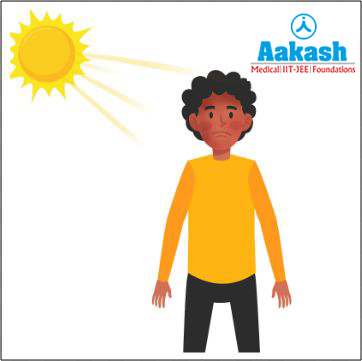
Fig: Sunburn
Can you remember any other example of reactions where sunlight plays a major role? Yes, one of the important reactions is photosynthesis because without sunlight photosynthesis can not happen. So what is the common term for such reactions where the sunlight is absorbed? We know that the term ‘photo’ is related to light, so these chemical reactions can be called photochemical reactions. Not only the above two but also there are many types of photochemical reactions with different examples occurring around us. We will discuss more about the photochemical reaction in this article.
Table of contents
- Photochemical reactions
- Types of photochemical reactions
- Examples of photochemical reactions
- Significance of photochemical reactions
- Applications of photochemical reactions
- Practice Problems
- FAQs
Photochemical reactions
The chemical reactions that take place in the presence or by the absorption of sunlight are called photochemical reactions. When molecules absorb light, they change to their excited states. The physical and chemical properties of the molecules will be different in their excited state.
The branch of chemistry that deals with rates and mechanisms of chemical reactions in the presence of light radiations is called photochemistry. Generally the photochemical reactions absorb ultraviolet light, visible light or infrared radiation and hence sunlight plays an important role in the photochemical reactions.
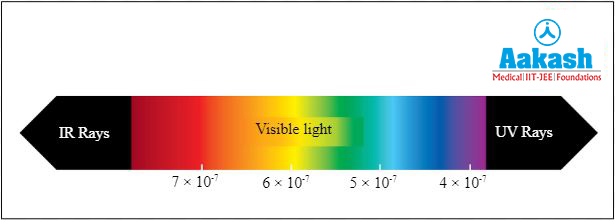
Fig: Light spectrum
Large activation barriers are crossed in a short period of time in these reactions. There are some photochemical reactions which are destructive, like the photodegradation of plastics. Photochemical reactions can take place in solids, gases or liquids.
Types of photochemical reactions
There are many types of photochemical reactions that occur in nature. The major types of photochemical reactions are as follows:
- Photo dissociation reaction
- Photo addition reaction
- Photo substitution reaction
- Photo isomerisation reaction
Photo dissociation reaction
When the substance undergoing reaction dissociates in the presence of light energy, it is called a photo dissociation reaction. It is also called a photo-decomposition reaction or photolysis. The substrate can dissociate into two or more products. Following is the general representation of a photo dissociation reaction:
AB + h𝜈 → A• + B•
Example of photo dissociation reaction
In the presence of sunlight the nitrogen dioxide dissociates into nitric oxide and atomic nitrogen. The equation of this reaction is as follows:
NO2 + h𝜈 → NO + O
Photo addition reaction
When two or more molecules combine to form a single product in the presence of light energy, it is called photo addition reaction. It is exactly the opposite of a photo dissociation reaction. Following is the general representation of a photo addition reaction:
A + B + h𝜈 → AB
Example of photo addition reaction
The generation of the ozone molecule by the addition of oxygen molecules to the atomic oxygen. The equation of this reaction is as follows:
UV
O2 + O → O3
Photo substitution reaction
The substitution reaction, by which one molecule of atom of a substrate is displaced by another substrate to form a new molecule or product in the presence of light energy, is called photo substitution reaction. Following is the general representation of a photo substitution reaction:
A + BC + hν → AB + C
Example of photo substitution reaction
A perfect example of photo substitution reaction is the chlorination of methane molecules. It takes place in the presence of sunlight and HCl. the series of steps involved in the reaction are as follows:
hν
CH4 + HCl → CH3Cl (Methyl chloride) + H2
hν
CH3Cl + HCl → CH2Cl (Methylene chloride) + H2
hν
CH2Cl + HCl → CHCl3 (Chloroform) + H2
hν
CHCl3 + HCl → CCl4 (Carbon tetrachloride) + H2
After the complete chlorination of methane, the product formed is the carbon tetrachloride.
Photo isomerisation reaction
A process where the one isomer is converted into another isomer in the presence of light is referred to as the photo-isomerization reaction. It is also called photo-induced rearrangement reaction. This will result in the formation of a structurally different isomer. Following is the general representation of a photo isomerisation reaction:
A + hν → B
Example of photo isomerisation reaction
The absorption of a photon of light in the visible range, isomerize cis-retinal to all-trans-retinal in the eye. This isomerization causes the proteins to change their shape. This shape change results in the generation of a nerve impulse which helps in vision in the eye.
Examples of photochemical reactions
Many reactions can be found out in nature as an example of photochemical reactions we discussed above. The major examples are as follows:
- Photosynthesis
- Formation of ozone layer
- Skin cancer due to UV rays
- Formation of photochemical smog
Photosynthesis
The most common example of a photochemical reaction is photosynthesis. It is the reaction in which plants fix carbon dioxide into carbohydrates by using water in the presence of sunlight and chlorophyll. They also release oxygen as a byproduct in this reaction.
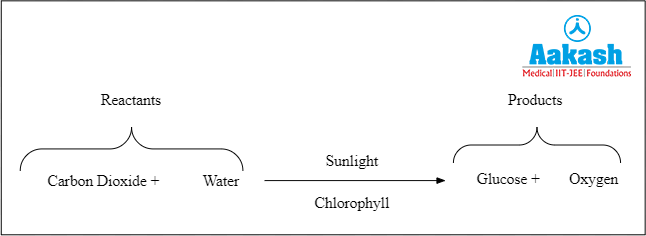
Fig: Equation of photosynthesis
Algae, green plants, sea weeds and certain bacteria obtain energy through photosynthesis. The animal life is sustained through the oxygen released and the carbohydrate stored as a result of the photosynthesis.
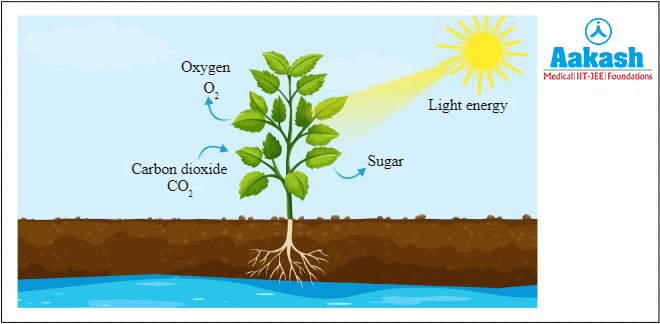
Fig: Photosynthesis
Formation of ozone layer
Ozone layers protect the Earth from harmful ultraviolet rays. The photochemical addition of oxygen molecules (O2) to atomic oxygen (O) results in the formation of ozone molecules (O3). The photochemical dissociation of ozone molecules into atomic and molecular oxygen also occurs.
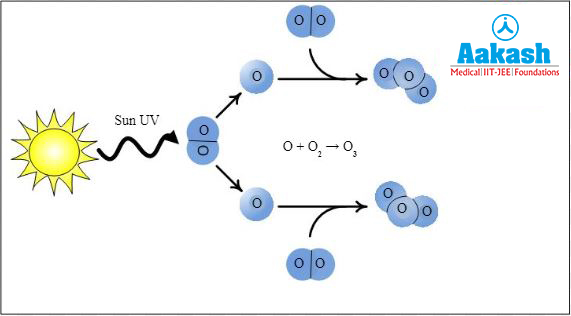
Fig: Formation of ozone
Photochemical addition
hν
O2 → 2O
hν
O + O2 → O3
Photochemical dissociation
hν
O3 → O2 + O
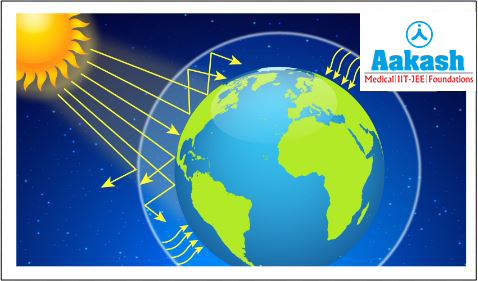
Fig: Ozone layer
Skin cancer due to UV rays
The UV rays cause skin cancer and it is due to the photochemical reactions. UV rays damage the DNA in the skin cells. Formation of cyclobutane dimers formed between pyrimidines is the damage caused by the UV radiations on DNA. This will affect the functioning of the DNA and affects the metabolic activities of the skin cells. Sunlight can destroy collagen and elastin on the skin.
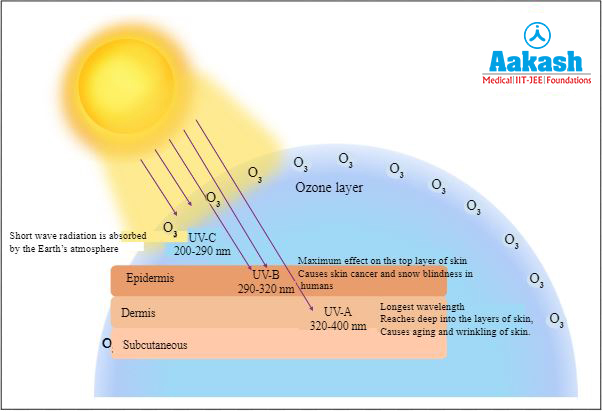
Fig: Effect of UV radiations on skin
Formation of photochemical smog
A mixture of pollutants formed by the reaction between the sunlight with nitrogen oxides and volatile organic compounds (VOCs) forms the photochemical smog in the atmosphere. This will create a brown haze above the cities. Since sunlight is available more during summer, photochemical smog is more during summers than any other seasons.
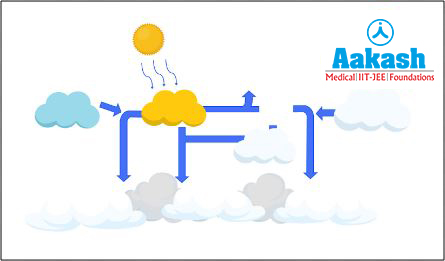
Fig: Photochemical smog
Significance of photochemical reactions
Photochemical reactions are a part of photosynthesis and hence it is considered as an essential reaction that supports life on the planet Earth. Other significances of the photochemical reactions are as follows:
- The different chemical changes occurring in the atmosphere are due to various photochemical reactions.
- The depletion of the ozone layer is studied by the scientists on the basis of photochemical reactions.
- Other consequences like acid rain and global warming are also studied through the photochemical reactions.
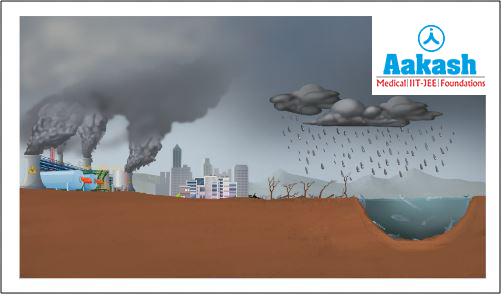
Fig: Acid rain
- The formation of nucleic acids and proteins in nature is due to the photochemical reactions happening to the simple molecules like carbon dioxide, ammonia and methane.
- Since photochemical reactions are taking place with the help of solar energy and the solar energy is abundant, it can happen easily and continuously.
Applications of photochemical reactions
Photochemical reactions are used in various purposes and they are as follows:
- Synthesis of drugs like antimalarial agents.
- Industrial manufacture of benzyl chloride.
- Used in space vehicles and satellites.
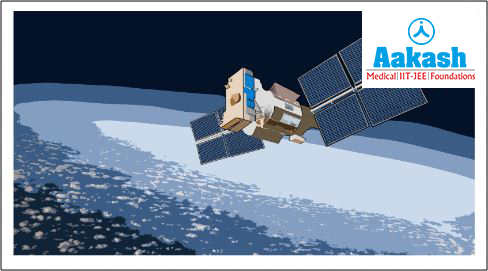
Fig: Satellite
- Synthesis of organic compounds.
- For photography and production of images.
Practice Problems
1. Which of the following is wrong about the photochemical reactions?
- The chemical reaction that takes place in the presence or by the absorption of sunlight
- Photochemical reactions absorb ultraviolet light, visible light or infrared radiation
- Large activation barriers are crossed in a long period of time in these reactions
- Photochemical reactions can take place in solid, liquid or gases
Solution: The chemical reaction that takes place in the presence or by the absorption of sunlight is called a photochemical reaction. When molecules absorb light, they change to their excited states. The physical and chemical properties of the molecules will be different in their excited state. Generally the photochemical reactions absorb ultraviolet light, visible light or infrared radiation. Sunlight plays an important role in the photochemical reactions. Large activation barriers are crossed in a short period of time in these reactions. There are some photochemical reactions which are destructive, like the photodegradation of plastics. Photochemical reactions can take place in solid, gaseous or liquid states. Hence the correct option is c.
2. Which of the following types of photochemical reactions is observed in the vision of eyes?
- Photo dissociation reaction
- Photo addition reaction
- Photo substitution reaction
- Photo isomerisation reaction
Solution: A process where the one isomer is converted into another isomer in the presence of light is referred to as the photo-isomerization reaction. It is also called photo-induced rearrangement reaction. This will result in the formation of a structurally different isomer. Following is the general representation of a photo isomerisation reaction: A + hν → B. The absorption of a photon of light in the visible range, isomerize cis-retinal to all-trans-retinal in the eye. This isomerization causes the proteins to change their shape. This shape change results in the generation of a nerve impulse which helps in vision. Hence the correct option is d.
3. Which of the following phenomena shows photochemical reactions between the sunlight with nitrogen oxides and volatile organic compounds (VOCs)?
- Formation of ozone layer
- Skin cancer due to UV rays
- Formation of photochemical smog
- All the above
Solution: A mixture of pollutants formed by the reaction between the sunlight with nitrogen oxides and volatile organic compounds (VOCs) forms the photochemical smog in the atmosphere. This will create a brown haze above the cities. Since sunlight is available more during summer, photochemical smog is more during summers than any other seasons. Hence the correct option is c.
4. Which of the following is not an application of a photochemical reaction?
- Synthesis of drugs like antimalarial agents
- Industrial manufacture of benzyl chloride
- Used in space vehicles and satellites
- All the above
Solution: Photochemical reactions are used for various purposes. Synthesis of drugs like antimalarial agents, industrial manufacture of benzyl chloride are some of those. Photochemical reactions are also used in space vehicles and satellites. Synthesis of organic compounds can be done by using photochemical reactions. For photography and production of images the principle of photochemical reaction is used. Hence the correct option is d.
FAQs
1. What is Grotthus-Draper law?
Answer: Grotthus-Draper law is followed by photochemical reactions. It states that for a chemical reaction to take place the chemical substance must absorb light energy. It was proposed by the chemists, Theodor Grotthuss and John W. Draper.
2. What is Stark-Einstein law?
Answer: The Stark-Einstein law in photochemistry states that, more than one molecule is not activated for subsequent reactions, for each proton of light absorbed by the chemical system. It is also called the law of photo equivalence. Albert Einstein derived this theory during his development of the quantum (photon) theory of light.
3. What are the different types of UV radiations?
Answer: Based on the wavelength of ultraviolet light they are calcified into three as ultraviolet A (UVA), ultraviolet B (UVB), and ultraviolet C (UVC). The wavelength of each UV radiations are as follows:
- UVA - It is also called the blacklight with a wavelength range between 320 - 400 nm. It is the longwave radiation and is not very harmful. It causes ageing and wrinkling of skin.
- UVB - It has a wavelength range of 280 - 320 nm. It is the intermediate wave radiation and is highly harmful. It causes skin cancer and snow blindness in humans. Snow blindness is a temporary eye pain and discomfort due to ultraviolet (UV) light.
- UVC - It has a wavelength of 200 - 280 nm. It is the short wave radiation and is absorbed by the Earth’s atmosphere. Among these the most harmful UV radiation is the UVC which is of the short wavelength.
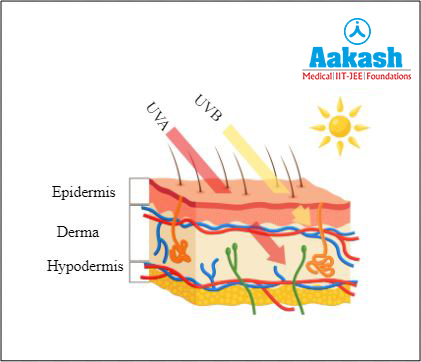
Fig: UV rays penetrating into the skin
4. What is photogeochemistry?
Answer: The study of light induced chemical reactions that occur among the natural components on the surface of the Earth is called photogeochemistry. It is the combination of photochemistry and geochemistry.

NEET Related Links
JEE MAIN Related Links
JEE Advanced Related Links
JEE Advanced Eligibility Criteria
JEE Advanced Chemistry Syllabus
JEE Advanced Registration Dates
CUET Related Links
Important Topics
Anemometer : Measurement of Wind Speed
Angular Acceleration Atomic Theory Audible and Inaudible Sound Average Speed and Average Velocity Average Velocity Avogadros Number Avogadros Hypothesis Azimuthal Quantum Number Balanced Force Bar Magnet Biconvex Lens Boyles Law Buoyancy Calorimeter Carnot Engine Celestial Bodies Centripetal And Centrifugal Force Concave and Convex Lenses Concave Convex Mirrors Contact and Non Contact Force Controlled Thermonuclear Fusion Convection Currents Convex Lens Convex Mirror Destructive Interference Difference Between Conduction Convection and Radiation Difference Between Electric Field and Magnetic Field Difference Between Heat And Temperature Difference Between Series And Parallel Circuits Differences Between Acceleration And Velocity Distance and Displacement Distance Time Graph Electrical Force : Electric Forces and Their Types Electromagnetic Waves : Definition, Equation and Properties of Electromagnetic Waves Electromagnetism Electron Spin Fluid Flow : Bernoullis Equation Derivation and Fluid Mechanics Fluid Friction : Types and Factors of Fluid Friction Frames of Reference : Inertial and Non- Inertial Frame of Reference Frequency and Wavelength Frictional Force Importance of Hydrosphere Instantaneous Speed and Velocity Introduction to Motion Kinetic and Potential Energy Difference Law Of Conservation of Energy Layers of the Earth Light Energy Light Sources List of physics scientists and Their inventionsLoudness of Sound
Magnetic Dipole Moment Magnetic Field Non - Contact Force Non - Renewable Energy Ohms Law Optics P Wave Physics Symbols Plane Mirrors Poissons Ratio Projectile Motion Properties of Water : Anomalous Expansion of Water Radius of Gyration Reflection of Light Reflection of Waves Relative Density Resonance Reverberation Rolling Friction Rotation and Revolution Screw Gauge Semiconductors and Insulators Sliding Friction Speed Time Graphs Static Friction Stefan Boltzmann Law Stress Tension Tension Force Thermometer: Clinical Laboratory Thermometer Types of Rocks Types of Waves Uniform Motion and Non Uniform Motion Unit of Voltage Uses of Convex Lens Uses Of Convex Mirror Uses of Electromagnet Uses of Optical Fibre Wave Wavelength of Light What is Scattering of Light Working of Electric Bell Conventional and Non-conventional Sources of Energy Buoyant Force Bulk Modulus of Elasticity Bernoulli’s Principle Angular Momentum Difference Between Speed And Velocity ForceUnit of Heat
Difference between Distance and Displacement Simple Microscope Derivation Of Equation Of Motion Thermometer: Clinical & Laboratory Thermometer Difference between Concave and Convex LensDerivation Of Lens Maker Formula
Unit Of Pressure Velocity Uses of Plane Mirror
Wave Theory of Light
Unit of Density Unit of Light Unit of Force Unit of Magnetic Field Unit of wavelength Unit of Viscosity Uses of Electroplating Young's Modulus
What is the Scattering of Light
Lenz Law Space Wave Propagation Schrodinger Wave Equation Relation between Fahrenheit and Celsius Refractive Index Potentiometer Working Pascal Law Oscillatory Motion Optical Instruments Newton's Laws of Motion - First Law Modulation and Demodulation Magnetic Flux Lens Formula and Magnification Kaleidoscope Faradays Law Epsilon Naught Value Energy Bands Electrostatics Electroscope AC Generator Unit of Current Lithosphere Bending Equation Derivation Difference Between Pound and Kilogram Semiconductor Devices OTEC - Ocean Thermal Energy Conversion Hall Effect Rectilinear Propagation of Light Difference Between Ammeter and Voltmeter Coefficient of Linear Expansion Ampere’s Law Cyclone and Thunderstorm Save The Environment From Pollution Particle Nature of Light Types of DC Motor Uses Of Transistor Derivation of Phase Rule Unit of Humidity

 Call Now
 Let's Chat
 Share
Share