-
Call Now
1800-102-2727


Ovaries: Layers, Neurovascular Supply, Functions, and Disorders, Practice Problems and FAQs

We all know how reproduction occurs in human beings. Sexual reproduction is the process by which human beings are able to produce its young ones. How amazing is it that females are capable of giving birth? The organ system that allows females to give birth is known as the female reproductive system.
Fig: Motherhood
But do you know the exact process involved in sexual reproduction in human beings or which all structures take part in this process of sexual reproduction? Yes, we all know that when sperm and ova fuse together by fertilisation, they form a zygote which will develop into an embryo in the womb of the female. So for sexual reproduction to takes place, first we need sperms and ova. But where will they come?
The sperms are male gametes which are produced in the testes of the male reproductive system and reach the female reproductive system through the act of sexual intercourse. On the other hand, the ova is the female gamete that is produced and released into the fallopian tubes by the ovaries. Let’s understand the structure and functions of the ovaries in detail in this article.
Table of contents
- Female reproductive system
- Ovaries
- Layers of ovary
- Neurovascular supply
- Functions of the ovary
- Disorders of ovary
- Practice Problems
- FAQs
Female reproductive system
The female reproductive system consists of a pair of ovaries along with oviducts, uterus, cervix, vagina, accessory glands (lesser vestibular glands and greater vestibular glands) and external genitalia. It is located in the pelvic region of the female. It consists of a pair of mammary glands located in the chest regions also. This system carries out several functions such as production of eggs that are necessary for reproduction, providing a site for fertilisation, and also production of sex hormones.
Sex organs
The female reproductive system possess two types of organs as follows:
Primary sex organs
These produce gametes and sex organs. Ovaries are the primary sex organs in females.
Secondary sex organs
The neither produce gametes nor sex hormones. They help in the transportation of gametes and play a role in reproduction. It includes fallopian tubes, uterus, vagina, lesser vestibular glands, greater vestibular glands and mammary glands.
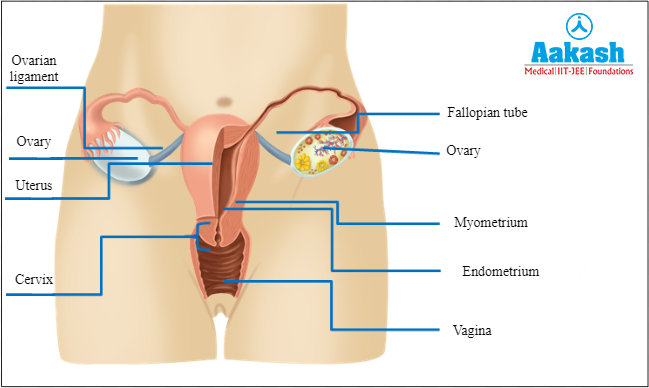
Fig: The female reproductive system
Ovaries
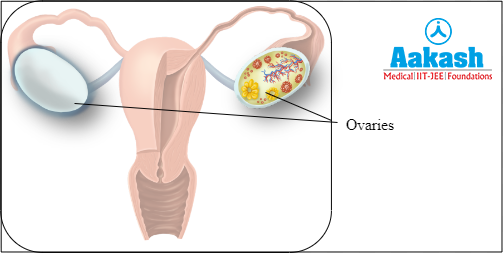
The ovaries are described as small and oval-shaped (looks like an unshelled almond) structures that are situated on either side of the uterus in the pelvic cavity. It is about 2 - 4cm in length. Their primary function is to produce eggs or ova. They also produce sex hormones that regulate the menstrual cycle and pregnancy. During ovulation, one of the ovaries releases an egg per menstrual cycle. Until the female reaches menopause, the ovaries will continue to release an egg in every menstrual cycle. Menopause is a condition during which the ovaries stop releasing eggs. Sometimes, the ovaries release more than one egg in a single menstrual cycle which will result in multiple pregnancies.
Fig: Ovaries
Ligaments
The female reproductive system is held in place within the pelvis by ligaments, which provide support. The following are the ligaments that hold the ovaries in position:
Broad ligament
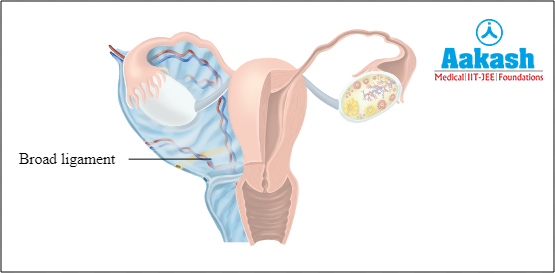
It is a layer of the parietal peritoneum that surrounds the uterus and ovaries. It attaches to the ovary with the uterus by a double-layered fold of the peritoneum called the mesovarium.
Fig: Broad ligament
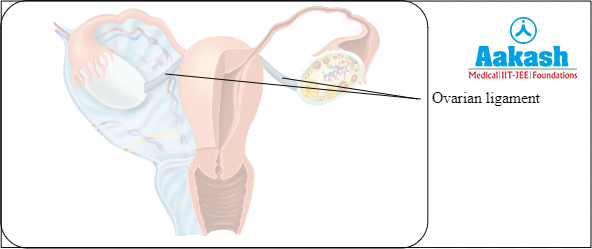
Ovarian ligament
It is mainly associated with the ovaries. These are suspensory ligaments that attach each ovary to the pelvic sidewall. The ovarian ligaments connect each ovary to the lateral side of the uterus. They do not possess any blood vessels. These are also called the utero-ovarian ligaments.
Fig: Ovarian ligament
Hilum
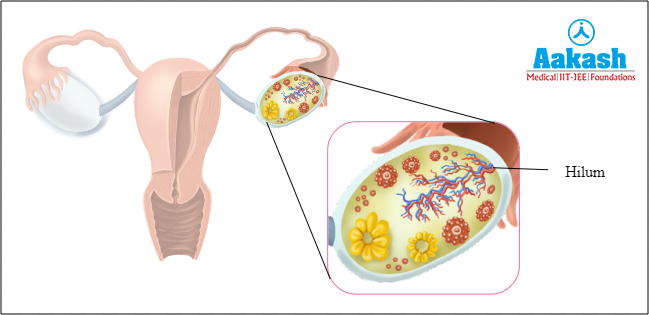
The hilum is known as the base of the ovary. It is a point in each ovary that allows the entrance and exit of the blood vessels and nerves. The ovarian arteries emerge from the abdominal aorta which is located just below the renal arteries.
Fig: Hilum
Layers of ovary
The ovary is composed of three layers as follows:
- Germinal epithelium
- Tunica albuginea
- Ovarian stroma
Germinal epithelium
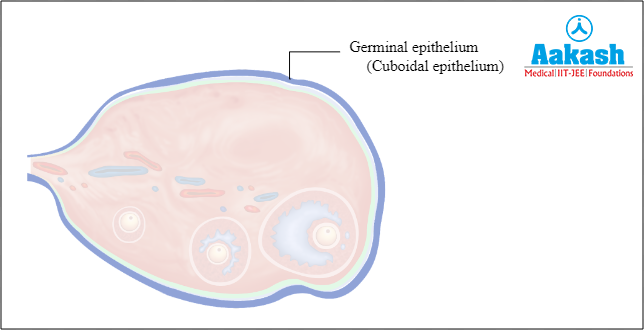
Each ovary is surrounded by cuboidal germinal epithelium and is the outermost layer.
Fig: Germinal epithelium
Tunica albuginea
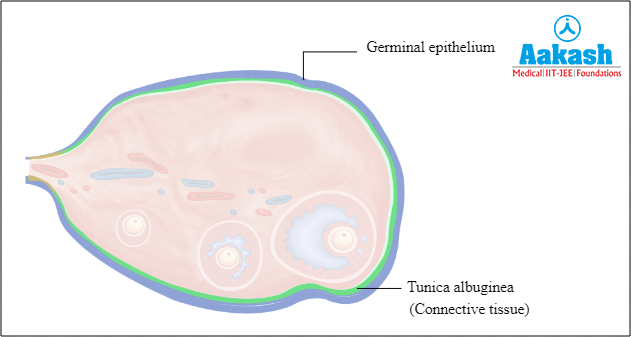
It is a layer of connective tissue that is located underneath the germinal epithelium. It encloses the ovarian stroma.
Fig: Tunica albuginea
Ovarian stroma
Inside tunica albuginea, the ovarian stroma is present that encloses two zones as follows:
- Peripheral cortex
- Inner medulla
Peripheral cortex
It is a region present inner to the tunica albuginea. It is made up of ovarian follicles surrounded by dense irregular connective tissue with collagen fibres and stromal cells, which are fibroblast-like cells. This region appears more dense and granular due to the presence of numerous ovarian follicles which are present in the different stages of development.
Inner medulla
It is an area that is located inside the ovarian cortex. The borderline between the cortex and medulla is indistinct. Lymphatic vessels, nerves, and blood vessels are present in the medulla. It is made up of more loosely structured connective tissue.
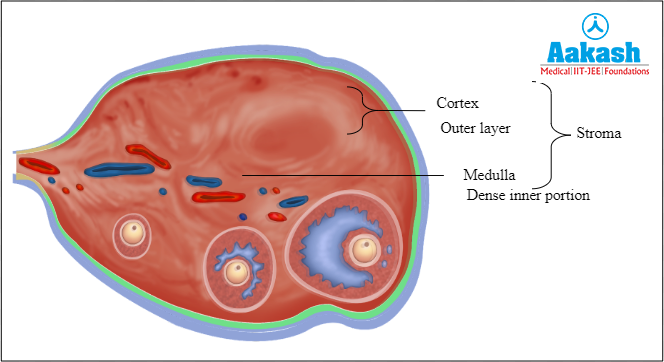
Fig: Ovarian stroma
Neurovascular supply
The pair of ovarian arteries provide the majority of the ovary's arterial blood supply. These arteries directly emerge from the abdominal aorta, which is situated inferior to the renal arteries. The uterine arteries also contribute to the ovarian arteries. Pairs of ovarian veins work together to empty the contents to the major veins. The right ovarian vein empties directly into the inferior vena cava, while the left ovarian vein empties into the left renal vein. The ovarian and uterine (pelvic) plexuses, respectively, supply sympathetic and parasympathetic innervation to the ovaries. The nerves enter the ovary through a point called the hilum with the help of suspensory ligaments.
Functions of the ovary
Ovaries are the primary sex organs in human females and therefore perform two major types of functions as follows:
- Gametogenic functions
- Endocrine functions
Gametogenic functions
Ovaries are primarily involved in gamete production. They produce female gametes or ova for fertilisation. In ovaries, oogonia or gamete mother cells are present during the embryonic stage itself. No more oogonia are formed and added after birth.
Follicular development in ovaries
During follicular development, primordial follicles experience a number of significant hormonal and histological changes. The oogonia divide by mitosis to form primary oocytes. Each primary oocyte gets surrounded by a layer of granulosa cells and then called the primary follicle. A large number of these primary follicles degenerate during the phase from birth to puberty. This degenerative process of primary follicles is called follicular atresia and the follicles that are degenerated are called atretic follicles. At puberty only 60000 to 80000 primary follicles are left in each ovary. The primary follicles get surrounded by more layers of granulosa cells and called secondary follicles. The secondary follicles then change into tertiary follicles. It is characterised by a fluid filled cavity called antrumn. At this stage of development, they become more dependent on hormones, especially FSH, which significantly accelerates their rate of growth. The tertiary follicles then change into the mature follicle called the Graffian follicle. The Graffian follicles or ovarian follicles burst and release the secondary oocyte. The process of releasing secondary oocytes is known as ovulation and the process of development of different stages of the follicles is known as folliculogenesis.
Fig: A section of a mammalian ovary
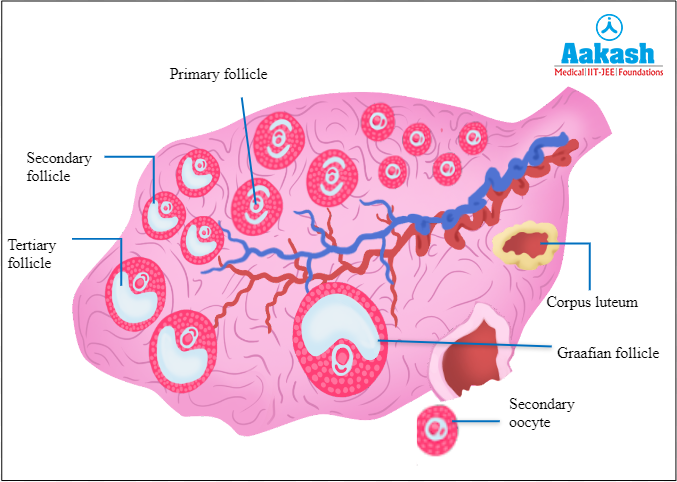
Endocrine function
The ovaries are majorly responsible to produce and release two types of sex hormones and these are the progesterone and estrogen.
Estrogens
The ovary releases three major types of estrogens such as estradiol, estrone, and estriol. All these hormones work together to support the healthy development of female sex characteristics. These features develop during puberty and these hormones are also responsible to ensure fertility. During puberty, estradiol is responsible for secondary sex characteristics, such as breast development, fat distribution in the hips, legs, and breasts, and the development of other reproductive organs. Ovaries also release relaxin hormones to a lesser extent. This hormone is released prior to parturition. Inhibin is another minor hormone released by the ovaries that play a crucial role in instructing the pituitary to stop secreting follicle-stimulating hormones.
Fig: Hormonal control of the female reproductive system
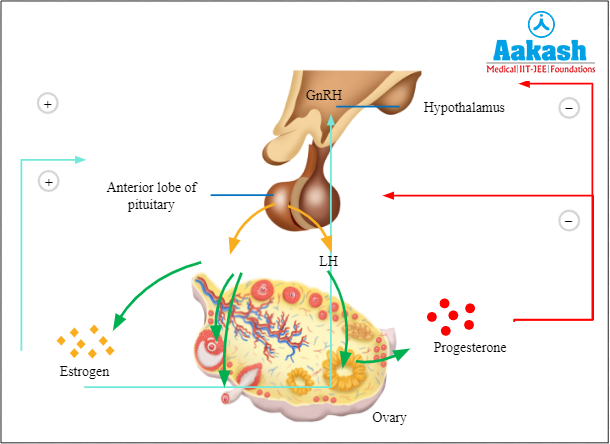
Hormonal control of the female reproductive system
Progesterone and estrogens are two major hormones that are produced by the ovaries when the hypothalamus is triggered. These hormones are necessary to get the uterus ready for menstruation. After puberty, the ovaries started releasing a single egg each month and this process is known as ovulation. The pituitary gland receives a signal (gonadotropin releasing hormone) from the hypothalamus to release gonadotrophic hormones, such as follicle-stimulating hormone (FSH) and luteinizing hormone (LH). These hormones are essential for the normal reproductive function and regulation of the menstrual cycle.
The egg is released by the ovary which then migrates through the fallopian tube to reach the uterus. During this time, progesterone is released by the corpus luteum (remnants of ruptured Graffian follicle). It prepares the inner wall of the uterus for pregnancy. If a woman is not getting pregnant, the corpus luteum degenerates. On the other hand, if a woman gets pregnant, it will trigger high levels of progesterone and estrogens that prevent the oocyte from maturation in the ovary. The estrogens level is increased near the end of the pregnancy. This triggers the pituitary gland to produce oxytocin that is required for uterine contractions. Before parturition, the ovaries release relaxin hormone in lesser amounts that serve in loosening the pelvic ligaments and widens the pelvic region for the preparation of labour.
Disorders of ovary
There are certain diseases and disorders that are associated with ovaries and are discussed below:
- Ovarian cancer
- Ovarian cyst
- Polycystic ovary syndrome
Ovarian cancer
Ovarian cancer in human females is a very deadly but rare disease. The symptoms of ovarian cancer usually do not become apparent in the initial stages. They appear when it reaches the later stages. This occurs when the cells of an ovary start growing uncontrollably. The symptoms of ovarian cancer involve persistent abdominal pain, bloating, indigestion, abnormal bleeding from the uterus, and pain during sexual intercourse. It is treated via chemotherapy or surgery to remove the tumour.
Fig: Ovarian cancer
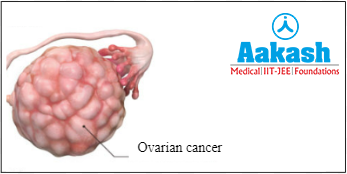
Ovarian cyst
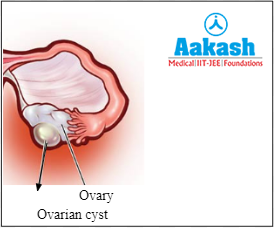
Ovarian cysts are described as fluid-filled sacs that can occur in women of all ages. However, it commonly occurs in those women that are of child-bearing age. Cysts can range in size from pea to grapefruit and are extremely common. The majority of cysts are benign, but larger cysts (those with a diameter of more than 5 cm) may require surgical removal because they can twist the ovary and interfere with its blood supply. The cyst can form because of several reasons. In some cases, they are formed normally as a part of the menstrual cycle. In such cases, the woman does not experience any symptoms and it will go after a few cycles. Functional cysts are the term used to describe these kinds of cysts. The common symptoms of ovarian cysts involve bloating, discomfort in the abdomen, vagina, lower back, and thighs, infertility, weight gain, fatigue, and extreme pain before and after the menstrual cycle.
Fig: An ovarian cyst
Polycystic ovary syndrome
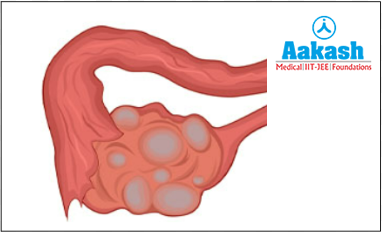
Polycystic ovarian syndrome (PCOS) is a condition of hormonal imbalance in the ovaries. As a result, excess male hormones called androgens are released. Due to this, the levels of reproductive hormones in the body of the female become imbalanced. Therefore, irregular menstrual cycles, missed periods, and uncertain ovulation are common in women with PCOS. Due to a lack of ovulation, small cysts (fluid-filled sacs) may form in the ovaries. One of the most prevalent factors of female infertility is PCOS. It may also raise the risk of developing additional medical problems. The symptoms of PCOS involve infertility, irregular menstruation, acne, and increased hair growth on the face and body. These women usually have high levels of testosterone in their body.
Fig: PCOS (Polycystic ovarian syndrome)
Practice Problems
Q 1. Estrogen and progesterone are two hormones that are secreted by the ovary. Which type of hormones are they?
a. Proteinaceous
b. Amino-acid derived
c. Steroid
d. Polypeptide
Answer: The primary sex organs that produce ova and hormones are the ovaries in the females. Estrogen and progesterone are the main hormones released by the ovary. These hormones are steroids and are derived from cholesterol. Hence, the correct option is c.
Q 2. Identify the correct statements with respect to ovaries from the options given below.
Statement I: Ovaries produce the female gametes.
Statement II: The hormone that controls the growth of secondary sexual characteristics is produced by the ovaries.
Statement III: FSH is produced by the ovary.
a. I and II
b. I and III
c. II and III
d. I, II, and III
Answer: The gonadotropin-releasing hormone (GnRH) is released by the hypothalamus at puberty when the ovary and uterus are ready for hormone stimulation. The anterior lobe of the pituitary gland is stimulated to secrete luteinizing hormone (LH) and follicle-stimulating hormone (FSH) by gonadotropin-releasing hormone (GnRH). FSH affects the ovary, stimulating the development of ovarian follicles and the production of estrogen hormones. In females, estrogen promotes the growth of secondary sexual traits such as the development of mammary glands, a high-pitched voice, widening of pelvis etc. Under the influence of hormones, the female gamete is produced within the ovarian follicles. Hence, the correct option is a.
Q 3. Identify the correct statement regarding the human ovary.
a. germinal epithelium is absent
b. tunica albuginea is present beneath germinal epithelium
c. tunica albuginea is absent
d. germinal epithelium is present beneath tunica albuginea
Answer: Each ovary is surrounded by cuboidal germinal epithelium and is the outermost layer.
Tunica albuginea is a layer of connective tissue that is located underneath the germinal epithelium. It encloses the ovarian stroma. Hence, the correct option is b.
Q 4. Identify the changes that occur in females during the onset of puberty.
a. enlargement of breasts
b. beginning of the menstrual cycle
c. development of high-pitched voice
d. all of the above
Answer: During the onset of puberty, several secondary sexual characteristics develop under the influence of various sex hormones. These secondary sexual characteristics include enlargement of breasts, growth of pubic and armpit hair, development of high-pitched voice, and beginning of menstrual cycles. Hence, the correct option is d.
FAQs
Q 1. What is the size of a normal ovary on a sonogram?
Answer: Under a sonogram, the size of a normal ovary is 2.5 - 5 cm long, 1.5 - 3 cm wide, and 0.6 - 1.5 cm thick.
Q 2. On which day of the menstrual cycle, the secondary oocyte is released from the ovary?
Answer: The secondary oocyte is released on the 14th day of the 28 - day menstrual cycle and this process is known as ovulation.
Q 3. What is the weight of an ovary in a normal female?
Answer: In normal and healthy females, the weight of an ovary is 4 - 8 grams.
Q 4. Do ovaries shrink or not?
Answer: The ovaries do shrink after menopause. The size of an ovary in pre-menopause is 3 - 4 cm but after menopause, the size becomes 0.5 - 1.0 cm.
Youtube VIDEO:
Related Topics
|
Pregnancy, Embryonic development, Placenta, Parturition, Lactation, Practice Problems and FAQs |
|
Mammary Glands: Structure, Types, Diagram, Function & Breast Cancer, Practice Problems and FAQs |
|
Oogenesis, Hormonal control of oogenesis, comparison between oogenesis and spermatogenesis, Practice Problems and FAQs |

 Call Now
 Let's Chat
 Share
Share