-
Call Now
1800-102-2727


Origin and Rvolution of Man (Dryopithecus, Ramapithecus, Australopithecus, Homo Habilis, Homo Erectus, Homo Neanderthalensis, Cro-Magnon Man, Modern Man, Aegyptopithecus), Practice Problems, FAQs

Do you know the scientific name of man? Yes, you are correct. It is Homo sapiens. We are the superior species in the animal kingdom. Everywhere, we see human beings, be it railways stations, metro stations, bus stops, malls or streets.
Have you ever thought about how the origin of man began? In previous classes, we have studied that early man had tails. Where did the tail disappear now?
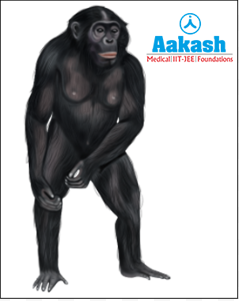
Fig: Early man
This is related to the evolution of man. As man evolved in many years, he has gained or lost various characteristics. Do you know how man evolved? How many years ago did the first man or man-like organism originate? Ancestors of man are primates such as chimpanzees and apes. Let’s take a deep dive into the details of this interesting topic.
Table of contents
- Dryopithecus
- Ramapithecus
- Australopithecus
- Homo habilis
- Homo erectus
- Homo neanderthalensis
- Cro-Magnon Man
- Modern Man
- Aegyptopithecus
- Practice problems
- FAQs
Origin of man
The fossil evidence strongly suggests that man originated in Central Asia, China, Java, and India (Shivalik Hills). Dryopithecus has been identified as one of the oldest fossils that evolved into apes and humans.
Dryopithecus
Dryopithecus africanus fossils have been discovered in Miocene strata from Africa and Europe.
It is thought to be the common ancestor of humans and apes. Dryopithecus and Ramapithecus were monkeys who lived around 15 million years ago. They had a shaggy appearance and walked like chimpanzees and gorillas. Thus, they are called knuckle walkers. Although they possessed huge canines, they ate mostly fruits and foliage. They lived on the tops of trees and were arboreal or tree dwellers. This animal is thought to have produced two animals, one of which gave origin to all apes and the other one is considered as the ancestor of our own species.

Fig: Dryopithecus africanus
Ramapithecus
They lived roughly 14 - 15 million years ago. It lasted from the late Miocene to the Pliocene.
Edward Lewis discovered a Ramapithecus fossil in the Pliocene strata of India's Shivalik Hills. Their canines were smaller and their molars were larger. Larger molars aided in the consumption of nuts and seeds. They still had hair on their bodies and lived in treetops. They were ape-like. They walk erect on their hind feet. They became extinct about 7 - 8 mya.

Fig: Ramapithecus
Australopithecus
The Australopithecus africanus (African Ape Man) fossil was discovered in Pliocene rocks near Tuang, Africa, by Raymond Dart. Dart discovered the skull of a 5 – 6 year old kid, hence the name ‘Taung child’. They served as a bridge or intermediary between apes and humans. East African grasslands were most likely home to Australopithecines. They are known as the ‘first ape man.’ They had large brow ridges, or protrusions over the eyes. They walked bipedally and had erect posture, on their two hind legs. These strong forehead ridges were thought to be a symbol of power. They had something that distinguished them from the rest of the animal kingdom. They had human-like teeth as well. They were cave dwellers.

Fig: Australopithecus africanus
Despite hunting with whatever stone instruments they could find, they ate largely fruits. As a result, they are thought to be omnivores. Donald Johanson discovered a 3.2 million - year-old female human ancestor's skeleton in 1981. Lucy was his nickname for it. Australopithecus afarensis is Lucy's scientific name. They have six different species. A. africanus (African Ape man, Southern Ape, or Tuang baby), A. afarensis (Lucy), A. ramidus, A. aethiopicus, A. robustus, and A. boisei are the species.
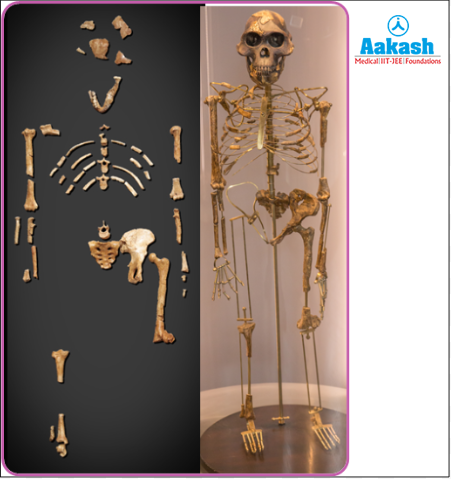
Fig: Lucy
Homo habilis
They were the first hominid (human-like). They showed bipedal locomotion. Their cranial capacity was ~ 650 - 800 cc. The first tool manufacturers were Homo habilis. Chipped stones were used to make tools. As a result, they are also known as able, skillful man, toolmaker or handyman. For various activities, several shaped tools were employed. They lived in Africa about 2 mya. They were 1.2 to 1.5 metres tall. They didn’t eat meat. They led a community life in caves. They took care of their young ones.
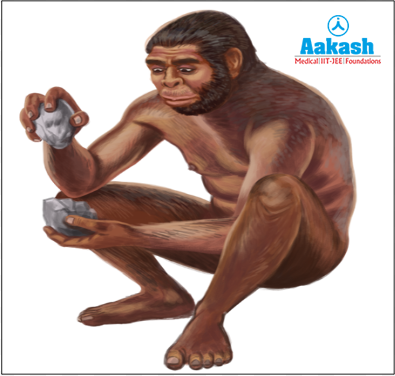
Fig: Homo habilis
Homo erectus
Fossils of Homo erectus were discovered from the island of Java in 1891. They were known as erect men because of their upright posture. They ate meat and moved around on two legs. The Homo erectus, like humans, had a flattened cranium and teeth. The brow ridges are also noticeable. Even though their teeth were little, they had projecting jaws that allowed them to chew meat with more vigour. They had a 900-cc cranial capacity. They created and utilised fire. They made better and sharper tools. Their stone tools had a tapering tip at one end and a sharp edge on either side, and were of a size that fit comfortably in the hand. The employment of tools transformed them to hunters in the food chain. They include three fossils as follows: Peking Man, Java Ape Man, Heidelberg Man.
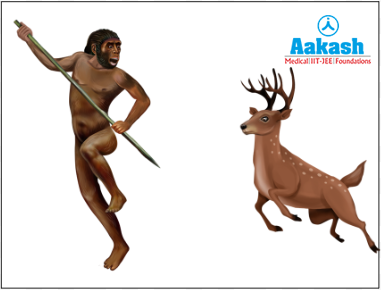
Fig: Homo erectus
Java Ape Man
Dubois discovered a fossil of Java Ape Man from Pleistocene rocks in Central Java in 1891. He named it Pithecanthropus erectus. Mayer in 1950 named it as Homo erectus erectus. It was 1.65 - 1.75 m tall. It had a cranial capacity of 800 - 1000 cc. It was omnivorous. They used fire for defence, hunting and cooking.
Peking Man
W.C. Pai in 1924 discovered the fossils of Peking Man from the limestone caves near Peking. Davisson Black named it Sinanthropus pekinensis. Mayer renamed it as Homo erectus pekinensis. It was slightly shorter and a little weaker than Java Man. It had a cranial capacity ranging from 850 - 1100 cc. It lived in small groups. They used fire.
Heidelberg Man
Otto Schoetensack in 1908 discovered the fossil jaws of Heidelberg Man from the middle Pleistocene, near Heidelberg, Germany. It was named Homo erectus heidelbergensis. It had a cranial capacity of 1300 cc. They used tools and fire.
Homo neanderthalensis
The Neanderthal man's fossils were discovered in Germany's Neander Valley. Around 100,000 – 400,000 years ago, they lived in East and Central Asia. They had a more upright posture and larger physique. They were omnivores, meaning that they ate both meat and plants. However, they were most likely meat eaters. Neanderthals had a cranial capacity of roughly 1400cc. This was extremely close to the current human’s cerebral capacity. During this time, the Earth's surface was also altering. The Earth was becoming encased in ice, indicating that the temperature was dropping. Animals were hairy to keep warm in the winter. They lived in caves and used fire to keep their surroundings warm. To protect their bodies, they wore hides and skin. They were skilled hunters and hunted in packs. They even used fire to scare the animals. It was during this time that they became predators as they would consume the animals they hunted. They also buried their dead. Then the Earth became colder. It was during the ice age.

Fig: Homo neanderthalensis
Cro-Magnon Man
It emerged around 34000 years ago. It was about 1.8 metres tall. It had a well built body. They were more intelligent and cultured than modern man. They had a cranial capacity of 1650cc. They lived along with their families in caves. They made tools and ornaments. They are believed to be the direct ancestor of modern man.
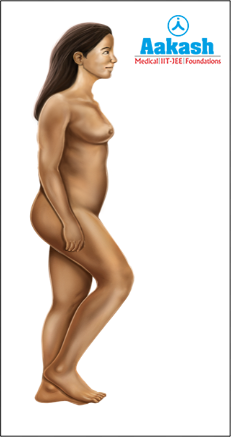
Fig: Homo sapiens
Modern Man
Modern man or Homo sapiens appeared between 75,000 and 10,000 years ago. They are the people of today. In humans, the skull cap is lifted to accommodate the enormous brain. They don't need to eat raw meat, so their teeth are little and their jaws aren't projecting. Homo Sapiens have extremely huge brains, earning them the title of most intelligent mammal. They made fantastic tools. They even carved elephant tusks and made ornaments. This demonstrates human creativity.

Fig: Ornaments from elephant tusks
They lived in caverns and painted cave drawings that date back 25,000 years. Humans and chimps are believed to share 99 percent of their DNA. Humans and chimps have nearly identical banding patterns.
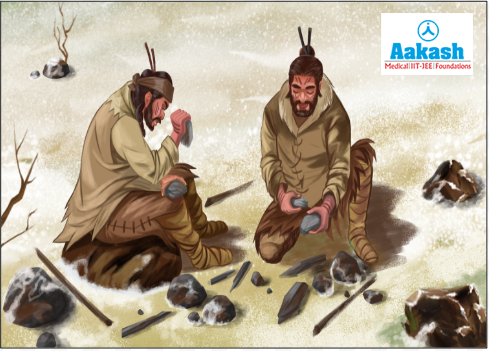
Fig: Homo sapiens sapiens (Modern Man)
Formation of races of Modern Man
The members of the modern man migrated westwards, eastwards and southwards. They changed into Caucasoid (white), Mongoloid and Negroid (black) races. Agriculture came around 10,000 years ago and human settlements started from then.
Mongoloid
It is a racial grouping of various people. They are seen indigenous to large parts of Asia,and some regions in Europe and the Americas. They have yellowish or brown skin. They possess straight black hair and dark eyes with epicanthic folds. They have prominent cheekbones also.

Fig: Mongoloid
Negroid
It is a racial grouping of various people. They are mainly indigenous to Africa, the area which stretched from the southern Sahara desert in the west to the African Great Lakes in the southeast. They have characteristic woolly black hair on head and body hair is sparse.
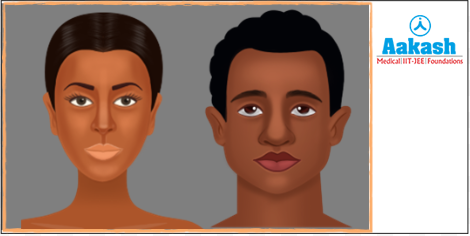
Fig: Negroid
Caucasoid
They are the people from Europe, West Asia, South Asia, the Horn of Africa, Central Asia or North Africa. Their skin colour is pale reddish white to olive brown. They are medium to tall.
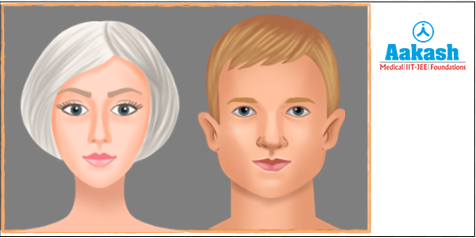
Fig: Caucasoid
Aegyptopithecus
In 1966, Aegyptopithecus was discovered by Elwyn Simons. He discovered it from the Faiyum Governorate of central Egypt. Analysis by Erik Seiffert proved that the age of the Gabal Qatrani Formation occurred between 30.2 and 29.5 mya. Aegyptopithecus is an ancestral lineage of humans. It also closes the gap of missing information between Eocene and Miocene fossil hominoids. It was large, slow moving and arboreal. It had binocular vision. It had fully enclosed, forward facing eyes. It was about 56 to 92 cm long
Practice Problems
1. Match the following.
|
Column I |
Column II |
||
|
i |
Homo habilis |
1 |
900 cc |
|
ii |
Neanderthal |
2 |
1400 cc |
|
iii |
Homo erectus |
3 |
700 cc |
- i - 1, ii - 2, iii - 3
- i - 2, ii - 1, iii - 3
- i - 3, ii - 2, iii - 1
- i - 1, ii - 3, iii - 2
Solution: Homo habilis were the first hominid (human-like). They showed bipedal locomotion. Their cranial capacity was ~ 650 - 800 cc. The correct answer is option c. The Neanderthal man's fossils were discovered in Germany's Neander Valley. Around 100,000 – 400,000 years ago, they lived in East and Central Asia. Neanderthals had a cranial capacity of roughly 1400cc. Fossils of Homo erectus were discovered from the island of Java in 1891. They were known as erect men because of their upright posture. They had a 900-cc cranial capacity. The correct match is as follows:
|
Column I |
Column II |
||
|
i |
Homo habilis |
3 |
700 cc |
|
ii |
Neanderthal |
2 |
1400 cc |
|
iii |
Homo erectus |
1 |
900 cc |
2. Select the correct chronological order of human evolution:
- Ramapithecus → Australopithecus → Homo habilis → Homo erectus
- Ramapithecus → Homo habilis → Australopithecus → Homo erectus
- Australopithecus → Ramapithecus → Homo habilis → Homo erectus
- Australopithecus → Homo habilis → Ramapithecus → Homo erectus
Solution: The order from early to the recent in which human evolution occur is as follows:
- Ramapithecus existed 14 - 15 mya between the middle and late Miocene and walked erect.
- Australopithecus existed 2.4 mya during the Late Pliocene and Early Pleistocene.
- Homo habilis existed 2 million years ago (mya).
- Homo erectus existed 1.5 - 2.4 mya by the end of the Pliocene epoch to the later Pleistocene. Hence, the correct option is a.
3. Write a short note on Neanderthal man?
Answer: Neanderthal Man was discovered from Neander valley for the first time. They lived in Central Asia and East Asia around 40,000 - 1,00000 years ago. They built hut-like dwellings and caves. They started the culture of hiding and protecting their body using leaves or skin of dead animals. They started burying the dead man.
FAQs
- Name the most primitive ancestor of man?
Answer: Ramapithecus was the earliest man-like primate who probably walked on their legs. They lived in Africa, Hungary and Greece about 8 - 15 million years ago. They are primitive human ancestors.
- Name the continent where the maximum number of the most prehistoric human fossils have been discovered?
Answer: Fossils of Ramapithecus, Australopithecus, Modern man, Homo erectus, Homo habilis were found in Africa.Thus the continent where maximum fossils of prehistoric man have been found is Africa.
- Enlist the characteristic changes in modern man evolved during the course of time?
Answer: Advanced features in human during the evolution of human are enlisted below:
- Perfect bipedal locomotion with straightening of knees and shortening of toes.
- There is a reduction in the size of jaws.
- They have smaller teeth.
- Higher cranial capacity.
- Loss of hair from many body parts.
- Which extinct human ancestor hunted with stone weapons and ate mainly fruits?
Answer: Australopithecus lived 2 million years ago in Africa. They ate only fruits. Some evidence demonstrates that they used stone weapons for hunting.
Related Topics
|
Theory of evolution: Darwinism, Its Criticism and Neo-Darwinism, difference between Darwinism and Lamarckism, Practice Problems and FAQs |
|
A brief account of evolution, Geological Time Scale, Practice Problems and FAQs |

 Call Now
 Let's Chat
 Share
Share