-
Call Now
1800-102-2727


Neural Tissue: Neuron - its Parts and Functions, Neuroglial Cells, Practice Problems and FAQs

We read books, learn new things in our daily life and expand our knowledge. We are constantly improving in our life as we learn from past experiences. How is this possible? Which tissue is responsible to memorise and analyse all these things in our life?
Yes, you know the answer is neurons or nerve cells. These neurons form a group of cells called neural tissue. In a complex organism, there is one major organ system that controls and regulates the activities of all other systems.
GIF: Magic of brain

In humans, this is the nervous system that regulates the entire body activities. The nerve cell or neuron is the basic functional unit of the nervous system. It is responsible for the conduction of signals and coordination of activities. Let’s understand more about the neurons and their supporting cells in this article.
Table of contents:
- Neural tissue
- Neuron
- Neuroglial cells
- Functions of nervous system
- Practice Problems
- Frequently Asked Questions
Neural tissue
Neural system is the most complex network that controls the body's responses. Neural tissue consists of excitable and specialised cells called neurons. The rest of the neural system is made up of neuroglial cells.
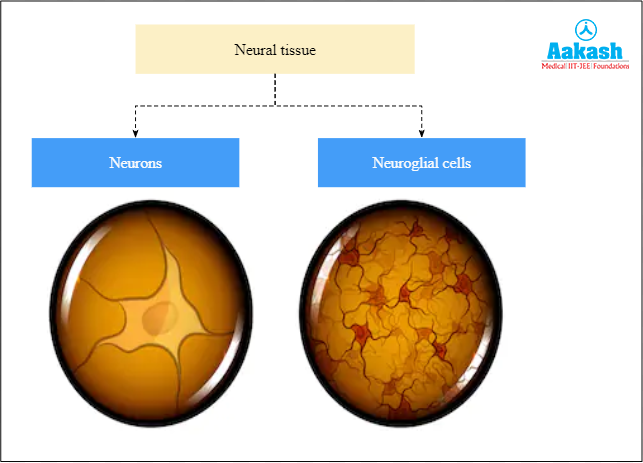
Fig: Neural tissue
Neuron
Neuron is the structural and functional unit of neural tissue. It detects and receives information from different sense organs in the form of stimuli and transmits these stimuli to the CNS or central nervous system.
Properties of neuron
It shows the following properties:
- Excitability
- Conductivity
Excitability
It is the ability of a neuron to generate electrical impulses in response to the stimuli. Neurons respond to stimulations by the rapid changes in the membrane potential. This excitation occurs in response to various stimuli like light, pressure, temperature or chemicals.
Conductivity
It is the ability of neurons or nerve cells to rapidly transmit the electrical impulse as a wave from one neuron to other neurons, muscles or glands. That means from the site of origin to the site of response along their length in a particular direction.
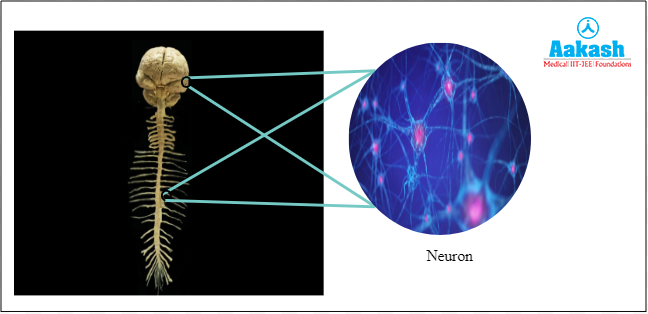
Fig: Nervous tissue
Parts of the neuron
Neuron possesses two parts mainly as follows:
- Cyton
- Cytoplasmic processes
The cytoplasmic processes include dendrites and axon.
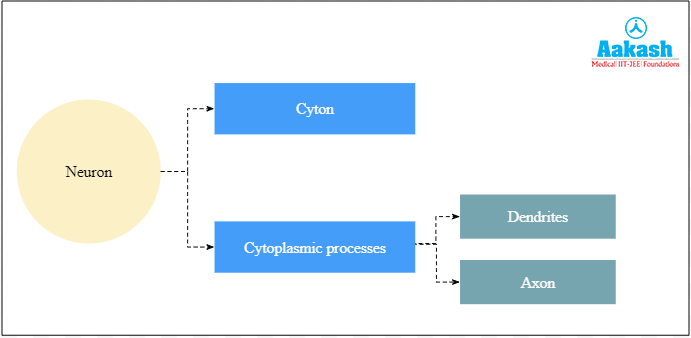
Fig: Parts of neuron
Cyton
The cell body of a neuron is known as cyton or perikaryon or soma. It is rounded, oval, star shaped or pyramidal. The cytoplasm of a neuron is known as neuroplasm. It possesses a central nucleus, Nissl’s granules, neurofibrils, mitochondria, golgi bodies, Endoplasmic reticulum, and lysosomes.
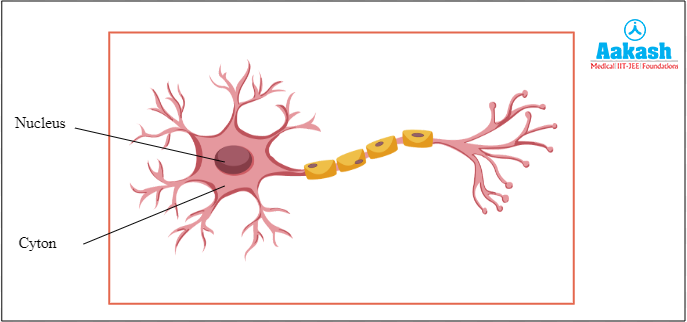
Fig: Cyton of a neuron
Nissl’s granules
Nissl’s granules or tigroid bodies are present in the cytoplasm of a neuron and occur as a deeply stained particle. These are categorised as irregular masses of rough endoplasmic reticulum and ribosomes. It is named after Franz Nissl who discovered them. Basic dyes can be used to stain them. It plays a role in the transmission of impulses.
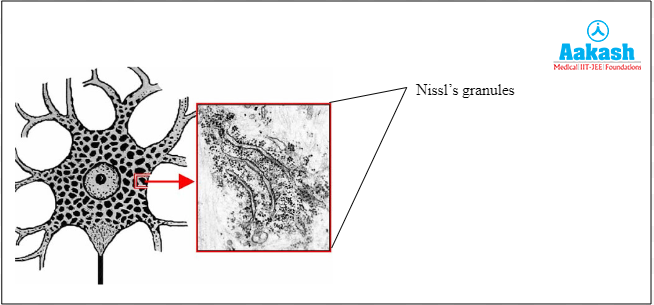
Fig: Nissl’s granules
Cytoplasmic processes
Cytoplasmic processes help in the conduction of nerve impulses. They are of two types as follows:
- Dendrite
- Axon
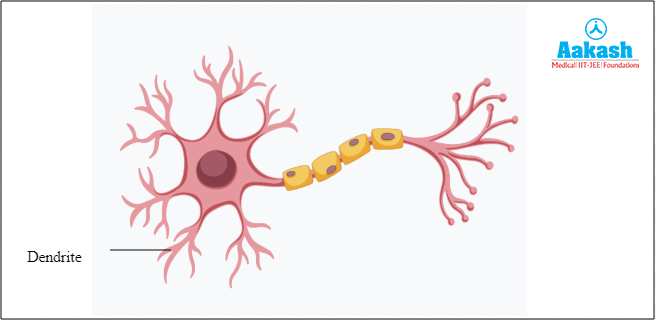
Dendrite
|
Characteristics |
They are short and branched with tapering ends. |
|
Function |
Dendrites receive nerve impulse from adjacent neurons and transfer it to the cyton of next neurons. GIF: Transmission of nerve impulse |
|
Image |
Fig: Dendrite |

Axon
|
Characteristics |
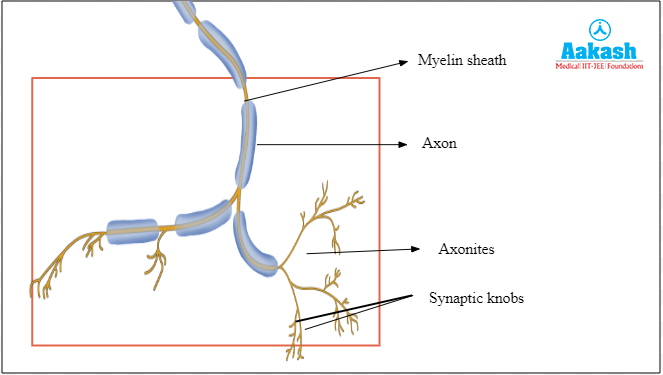
It is a single, long projection arising from the part of the cyton called axon hillock. It is the most sensitive part of the neuron. Axon ends in a number of branches known as axonites. The end of each branch swells at the tip to form a synaptic knob or end plate. It possesses synaptic vesicles with neurotransmitters, mitochondria and vesicles. The cytoplasm present here is called axoplasm and the plasma membrane is called axolemma. |
|
Function |
Axon conducts impulse from cyton to the dendrites of adjacent neurons. GIF: Conduction of impulse by axon |
|
Image |
Fig: Axon |

Differences between axon and dendrite
|
Axon |
Dendrite |
|
It arises from the cell body and branched at the distal end |
It arises from the cell body and branched all along their length |
|
It is very long |
They are very short |
|
Branches terminates in synaptic knobs |
Branches do not terminate in synaptic knobs |
|
Vesicles with neurotransmitters present in the synaptic knob |
Vesicles with neurotransmitters are absent |
|
Neuroplasm lack Nissl’s granules |
Neuroplasm possess neurofibrils and Nissl’s granules |
|
It conduct impulses away from the cell body |
It conduct impulses towards the cell body |
Neuroglial cells
These are supporting cells. They provide support to the brain, spinal cord and ganglions. Here Glia means glue. They are of different types. They have different shapes. They separate and insulate the adjacent neurons. It allows the passage of impulses from one neuron to the next only over the synapse. Glial cells are of four types as follows:
- Astrocytes
- Schwann cells
- Oligodendrocytes
- Microglia
Astrocytes
These cells possess a characteristic star shape. They form the blood-brain barrier. They help in defence and repair of neural tissues. They provide mechanical support to the neurons. They are of two types as follows:
Fibrous astrocytes
They possess thin and asymmetrical processes. They are normally present in the white matter of the central nervous system.
Protoplasmic astrocytes
They possess thick and symmetrical processes. They are present in the grey matter of the central nervous system.
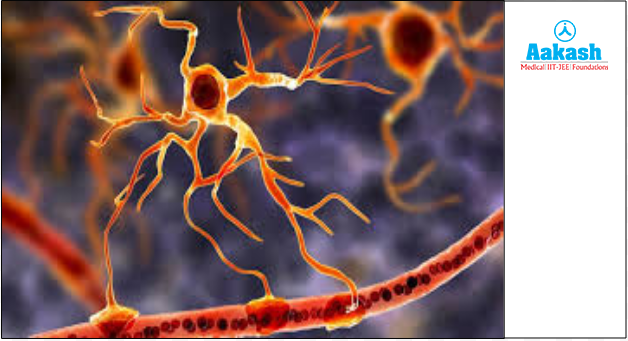
Fig: Astrocytes
Schwann cells
They help to form an insulating layer around the neurons, called myelin sheath. The myelin sheath is rich in lipids. It covers the nerve cells.
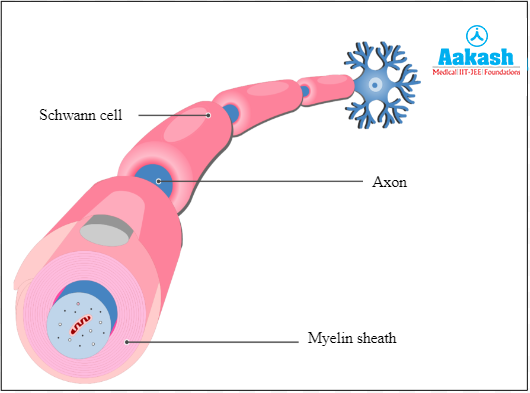
Fig: Schwann cell
Oligodendrocytes
They have rounded a nucleus with cytoplasm. The cytoplasm is rich in mitochondria, glycogen and microtubules. They have fewer and shorter cell processes. Oligodendrocytes have numerous projections that extend to many neurons. These cells also help in the formation of myelin sheath around the axons that lie in the brain and spinal cord.
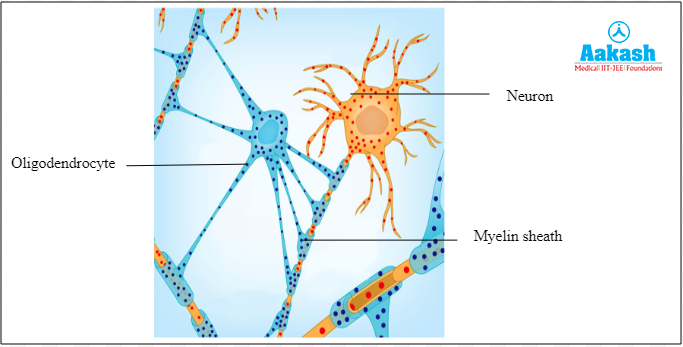
Fig: Oligodendrocyte
\Microglia
These are considered as the smallest neuroglial cells. They are formed from the mesoderm of the embryo. They are thought to be derived from the monocytes that invade the brain during the foetal life. They are more numerous in grey matter normally. They have short and fine processes. They engulf and destroy microbes, that means they help in phagocytosis. They are considered as scavengers as they remove cellular debris.

Fig: Microglia
Functions of neurons
- Helps in maintaining homeostasis.
- It generates reflex actions.
- It helps in memory and learning.
- It helps in control and coordination of all activities.
- It helps in control of movements.
Practice problems
- Recognise the figure and identify the correct labelling:

Answer: In the given figure, ‘a’ represents dendrites, ‘b’ represents cyton or cell body and ‘c’ represents axon.
- In the human body, the longest cell is _____________.
- nerve cell
- skeletal muscle cell
- bone cell
- cell of alimentary canal
Solution: Nerve cell or neuron is the longest cell in the human body. It is considered the longest cell because of the presence of a long axon. Hence, the correct option is a.
3. What does the given GIF represent?
Answer: The given GIF represents the impulse conduction via axon. The impulse is transferred from the cyton to the dendrites of the next neuron through the axon.
4. Identify the cell which is star-shaped?
- Astrocytes
- Schwann cells
- Oligodendrocytes
- Microglia
Solution: Astrocytes have a distinctive star form. They are responsible for forming the blood-brain barrier. They aid in brain tissue defence and repair. They also give mechanical support to the neurons. Hence, the correct option is a.
5. The end of the axon forms a __________.
Answer: The end of the axon forms a synaptic knob. It has synaptic vesicles with neurotransmitters like acetylcholine.
6. What is the function of Schwann cells?
Answer: Schwann cells contribute to the formation of the myelin sheath, an insulating coating that surrounds neurons. The myelin sheath has abundant lipid content.
FAQs
- Why can't neurons regenerate?
Answer: Neurons have a special architecture that is post-mitotic. A post mitotic cell does not have the ability to divide anymore after its differentiation. There are a few restricted areas in the brain and CNS where new nerve cells are born in an adult brain.
- How big will a neuron be?
Answer: There are different types of neurons. They can vary in size. It normally ranges from 4 microns to 100 microns in diameter.
- Neurons are said to be fast in conducting impulses. How fast are they?
Answer: Neurons transmit electrochemical signals in the form of the action potentials. These signals travel through the axon to dendrites of other nerve cells. Neurons can send signals at about 50 metres per second, which is more than 100 miles an hour.
- How many neurons are present in the brain?
Answer: An average of 86 billion neurons present in the brain. It possesses 85 billion nonneuronal cells also.
YOUTUBE LINK: Need to be created
Related Topics:
|
Human neural system: Overview (CNS and PNS), Practice Problems and FAQs |
|
Synapse and Transmission of impulses, Practice Problems and FAQs |
|
Reflex action and reflex arc, Practice Problems and FAQs |

NEET Related Links
JEE MAIN Related Links
JEE Advanced Related Links
JEE Advanced Eligibility Criteria
JEE Advanced Chemistry Syllabus
JEE Advanced Registration Dates
CUET Related Links
Important Topics
Anemometer : Measurement of Wind Speed
Angular Acceleration Atomic Theory Audible and Inaudible Sound Average Speed and Average Velocity Average Velocity Avogadros Number Avogadros Hypothesis Azimuthal Quantum Number Balanced Force Bar Magnet Biconvex Lens Boyles Law Buoyancy Calorimeter Carnot Engine Celestial Bodies Centripetal And Centrifugal Force Concave and Convex Lenses Concave Convex Mirrors Contact and Non Contact Force Controlled Thermonuclear Fusion Convection Currents Convex Lens Convex Mirror Destructive Interference Difference Between Conduction Convection and Radiation Difference Between Electric Field and Magnetic Field Difference Between Heat And Temperature Difference Between Series And Parallel Circuits Differences Between Acceleration And Velocity Distance and Displacement Distance Time Graph Electrical Force : Electric Forces and Their Types Electromagnetic Waves : Definition, Equation and Properties of Electromagnetic Waves Electromagnetism Electron Spin Fluid Flow : Bernoullis Equation Derivation and Fluid Mechanics Fluid Friction : Types and Factors of Fluid Friction Frames of Reference : Inertial and Non- Inertial Frame of Reference Frequency and Wavelength Frictional Force Importance of Hydrosphere Instantaneous Speed and Velocity Introduction to Motion Kinetic and Potential Energy Difference Law Of Conservation of Energy Layers of the Earth Light Energy Light Sources List of physics scientists and Their inventionsLoudness of Sound
Magnetic Dipole Moment Magnetic Field Non - Contact Force Non - Renewable Energy Ohms Law Optics P Wave Physics Symbols Plane Mirrors Poissons Ratio Projectile Motion Properties of Water : Anomalous Expansion of Water Radius of Gyration Reflection of Light Reflection of Waves Relative Density Resonance Reverberation Rolling Friction Rotation and Revolution Screw Gauge Semiconductors and Insulators Sliding Friction Speed Time Graphs Static Friction Stefan Boltzmann Law Stress Tension Tension Force Thermometer: Clinical Laboratory Thermometer Types of Rocks Types of Waves Uniform Motion and Non Uniform Motion Unit of Voltage Uses of Convex Lens Uses Of Convex Mirror Uses of Electromagnet Uses of Optical Fibre Wave Wavelength of Light What is Scattering of Light Working of Electric Bell Conventional and Non-conventional Sources of Energy Buoyant Force Bulk Modulus of Elasticity Bernoulli’s Principle Angular Momentum Difference Between Speed And Velocity ForceUnit of Heat
Difference between Distance and Displacement Simple Microscope Derivation Of Equation Of Motion Thermometer: Clinical & Laboratory Thermometer Difference between Concave and Convex LensDerivation Of Lens Maker Formula
Unit Of Pressure Velocity Uses of Plane Mirror
Wave Theory of Light
Unit of Density Unit of Light Unit of Force Unit of Magnetic Field Unit of wavelength Unit of Viscosity Uses of Electroplating Young's Modulus
What is the Scattering of Light
Lenz Law Space Wave Propagation Schrodinger Wave Equation Relation between Fahrenheit and Celsius Refractive Index Potentiometer Working Pascal Law Oscillatory Motion Optical Instruments Newton's Laws of Motion - First Law Modulation and Demodulation Magnetic Flux Lens Formula and Magnification Kaleidoscope Faradays Law Epsilon Naught Value Energy Bands Electrostatics Electroscope AC Generator Unit of Current Lithosphere Bending Equation Derivation Difference Between Pound and Kilogram Semiconductor Devices OTEC - Ocean Thermal Energy Conversion Hall Effect Rectilinear Propagation of Light Difference Between Ammeter and Voltmeter Coefficient of Linear Expansion Ampere’s Law Cyclone and Thunderstorm Save The Environment From Pollution Particle Nature of Light Types of DC Motor Uses Of Transistor Derivation of Phase Rule Unit of Humidity

 Call Now
 Let's Chat
 Share
Share