-
Call Now
1800-102-2727


The Root: Functions and Modifications, Practice Problems and FAQs

You all like sabudana. We all enjoy the different dishes made from this. Have you ever thought, from which part of the plant it is made? Yes, they are produced from the tapioca roots and they are also called the tapioca pearls. Then why is the root of tapioca plant swollen and tasty? Now you understand that in some plants the roots are swollen and tasty. Roots also serve as places to store food. That’s why some roots are so tasty.

Fig: Sabudana
You all know that roots are important for plants. The plants grow well if this root system works properly. The roots can be called the receiving rooms of the plant factory, as one of their chief functions is to draw water and minerals from the soil.
As rainwater filters down into the ground, it dissolves the minerals in the soil. The plant uses this nutrient solution for its work in making food and growth. The word morphology is derived from two words, ‘morph’ meaning ‘shape or form’ and ‘logos’ meaning ‘study of’. Morphology is the science which deals with the study of external features and structure. It involves the study of size, forms, colours, structures, relative positions of the constituent parts of an organism. The study of the form and structure of plants is known as phytomorphology.
The plant possesses a shoot system and root system. The part of the plant consisting of the roots and associated structures that grows under the soil surface is termed as the root system.
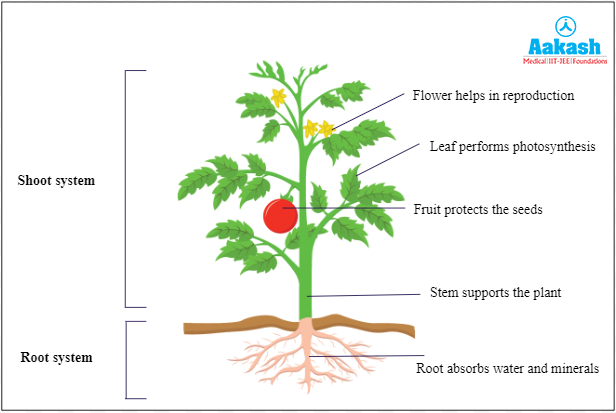
Fig: Morphology of plant
Root system develops from the radicle of the seed. Radicles grow downward into the soil and help in anchoring the seedling.
GIF: Development of root from the radicle of the seed

Table of contents:
- Functions of roots
- Modifications of roots
- Practice Problems
- FAQs
Functions of roots
Root perform two types of functions as follows:
- Primary functions
- Secondary functions
Primary or main functions of roots
Primary functions of the roots are as follows:
- It helps in absorption of water and minerals from the soil.
- Roots provide anchorage to plants and help support the aerial shoot system.
- The soil particles are held by the root network that prevents soil erosion.
- It also helps in synthesis of plant growth regulators (PGRs).
Secondary or accessory functions of roots
The secondary functions of the root are as follows:
- Some of the plant roots get modified to store the reserve food materials. Examples include carrots and tapioca.
- It provides extra mechanical support to the shoot system of plants. Examples include prop roots and stilt roots.
- Roots are involved in perennation in some plants. Examples include jasmine.
- Roots of certain plants such as leguminous plants are associated symbiotically with nitrogen-fixing bacteria which facilitate nitrogen fixation in the root nodules.
- The roots of aquatic plants have air-storing root structure to maintain the buoyancy of the plant and allow it to float. Examples include lotus.
- Roots of certain plants get modified to perform photosynthesis. Examples include the velamen roots of orchids.
- Parasitic plants have roots that derive nutrients from the hosts. Examples include Loranthus.
- Roots of plants growing in marshy areas have their roots modified to help in respiration. Examples include Rhizophora.
- Roots of certain plants support the plants in climbing by clinging to the fissures and cracks. Examples include Betel.
Modifications of roots
Roots are modified to perform certain specialised functions. These modifications are present in both tap roots and adventitious roots.
Tap root modifications
Tap roots are modified for the following purposes:
- For storage
- For respiration
- For nitrogen fixation
For storage
For storage purposes tap roots are modified. They become swollen and fleshy in that case. Normally the primary root becomes fleshy and the secondary and tertiary roots remain thin and fibrous. It include the following:
- Conical
- Fusiform
- Napiform
- Tuberous
Conical
These are fleshy taproots that resemble a cone. They are broad normally at the base and gradually taper towards the apex. Secondary roots are found throughout the conical root. Examples include carrots.
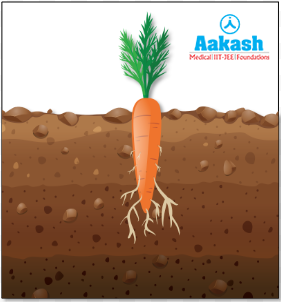
Fig: Conical roots in carrot
Fusiform
They are spindle-shaped roots. They are thicker and rough in the middle and narrow towards both the apex and the base. This root possesses a discoid stem and radical leaves. Examples include radish.
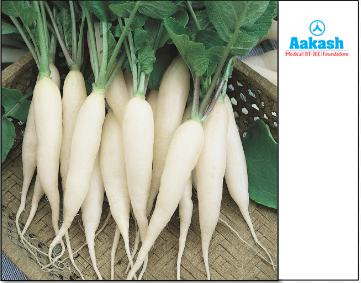
Fig: Fusiform root in radish
Napiform
They are almost spherical-shaped and wider at the top, and narrow at the tip. In other words, they are very thick at the base and become thin towards the apex. Examples include turnips.
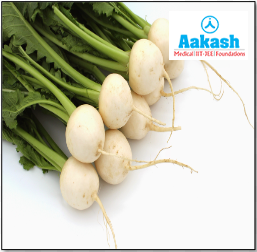
Fig: Napiform roots in turnip
Tuberous
They are thickened tap roots that do not have any definite form. They are irregularly shaped roots. Examples include roots of four o’clock plants (Mirabilis jalapa).
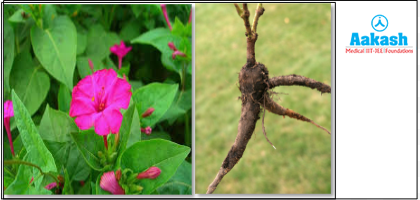
Fig: Tuberous root in four O’clock plant
For respiration
Roots are modified for the purpose of respiration. Examples include pneumatophores.
Pneumatophores
These roots can be observed in plants which grow in the marshes, swamps, and salt lakes. The common feature of these areas is that all of them are deficient in oxygen. These plants are known as halophytes. They possess horizontal cable roots that give rise to vertically upward (negatively geotropic) aerial roots at short intervals. Negatively geotropic roots known as pneumatophores (respiratory roots) bear pores that are known as pneumathodes (lenticels) which help in exchange of gases.
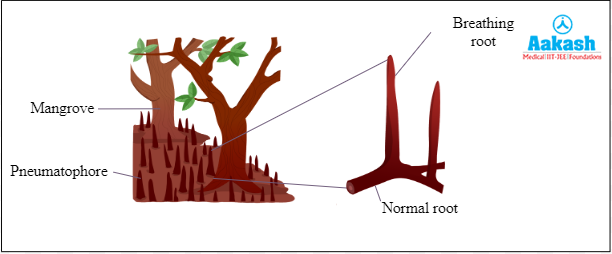
Fig: Respiratory root (Pneumatophores) in mangrove trees
Examples include Rhizophora.

Fig: Respiratory root (pneumatophores) in Rhizophora
For nitrogen fixation
The tap root is modified to fix nitrogen here. Examples include roots of leguminous plants. They are called the nodulated tap roots.
Nodulated tap root
In certain plants the primary, secondary and tertiary roots possess irregular swellings called root nodules or tubercles. These root nodules possess millions of minute nitrogen fixing bacteria belonging to the genus Rhizobium. They help in nitrogen fixation. A part of this fixed nitrogen is used by the leguminous plants and remaining nitrogen compounds are added to the soil. The roots provide food and shelter to the bacteria.
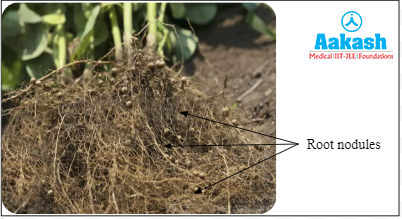
Fig: Root nodules
Adventitious roots modifications
Adventitious roots are modified to perform the following functions:
- Storage
- Anchorage and support
- Vital functions
For storage
In some plants the adventitious roots are modified to store food. They are swollen and thick. They are of the following types:
- Tuberous root
- Fasciculated root
- Palmate root
- Nodulus root
- Beaded root
- Annulated root
Tuberous roots
The roots are swollen and don’t assume a perfect shape. They arise singly at the nodes. They are also called reproductive roots, when new plants develop from them. Examples include roots of sweet potato.
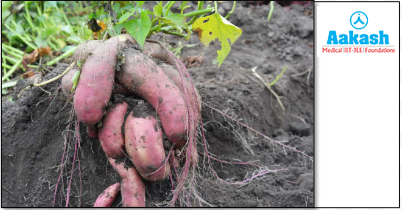
Fig: Tuberous roots of sweet potato
Fasciculated fleshy roots
These swollen roots occur in clusters either at the base of the stem or at intervals on the normal roots. Examples include roots of Asparagus.
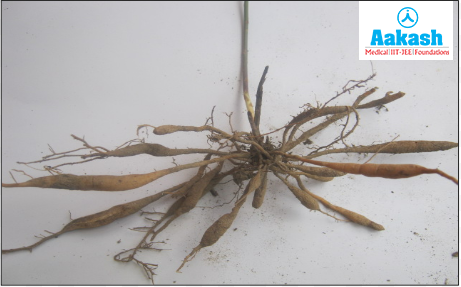
Fig: Roots of Asparagus
Palmate roots
They are fleshy adventitious roots. The arrangement of rlook like the palm of a human hand. Examples include Orchis.
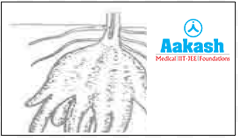
Fig: Palmate root
Nodulus roots
They are adventitious roots with the swellings only near tips. Examples include arrow root.
Beaded roots
These are adventitious roots which have swellings at regular intervals like beads of necklace. Examples include bitter gourd.
Annulated roots
These roots are adventitious roots which bear a series of rings on the roots. Examples include ipecac plant root.
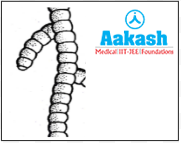
Fig: Annulated roots
For anchorage and support
Roots are modified here in such a way to provide additional support to the plant. It include the following types of roots:
- Stilt root
- Prop root
- Climbing roots
Stilt roots
Roots arise obliquely from lower or basal nodes of the stem and penetrate into the soil. They are thick, short and supportive in nature. Examples include sugarcane, maize, Sorghum etc.
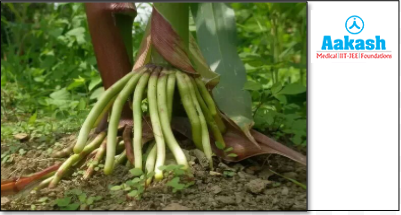
Fig: Stilt roots in maize
Prop roots
They are thick, pillar-like roots. The roots arise from heavy horizontal branches of the plant and grow downward towards soil. They function as a supporting stem for the plant. These roots are aerial. They attain the pillar-like shape as they reach the ground and appear nearly indistinguishable from the main stem. Examples include banyan trees.

Fig: Prop roots in banyan tree
Climbing roots
These are non absorptive adventitious roots. They are normally found in the climbers. They may arise from nodes, internodes or both. They enter into the crevices and cracks and support the plant by secreting some cementing substances. They help the plant in climbing. Examples include betel.
For vital functions
The roots are modified to perform certain vital functions. It include the following types of roots:
- Epiphytic roots
- Parasitic roots
- Photosynthetic roots
- Reproductive roots
- Contractile roots
- Floating roots
- Root spines
- Root thorns
Epiphytic roots
These are hygroscopic roots. They are present in epiphytes like orchids. These are aerial roots which hang freely in the air. They are normally white in colour and possess the specialised spongy tissue called velamen. These roots help in absorption of atmospheric moisture. Examples include Taeniophyllum which is an epiphyte with roots growing on the surface of other plants.
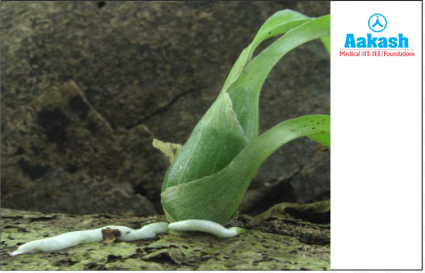
Fig: Velamen root of orchids
Parasitic roots
They are present in parasitic plants like doddar (Cuscuta), Loranthus etc. They help in absorption of nourishment from the host plant. They are also called suckers. They develop from the stem of the parasite and develop a connection with the vascular tissues of the host plant.
GIF: Parasitic roots of Cuscuta

Photosynthetic roots
These are green coloured roots that help in photosynthesis. In certain cases they develop small flowering shoots and help in reproduction. Examples include Trapa, Podostemon etc.
Reproductive roots
They are adventitious roots which possess adventitious buds. These buds will develop into new plants under favourable conditions. Examples include sweet potato and Dahlia.
Contractile roots
These roots are able to contract. They shrink to more than half of their length. Examples include Crocus.
Floating roots
These are inflated roots for buoyancy. They arise from the nodes of the aquatic plants. They are spongy due to the presence of aerenchyma. They help the plant in floating. Examples include Jussiaea.
Root thorns
In certain plants the roots are replaced by hard, thick pointed structures called thorns. Examples include Acanthorhiza.
Root spines
In certain plants the roots are modified into hard structures called spines. Examples include Iriartea.
Practice Problems
Q1. When will a root be called adventitious ?
A. Swollen form
B. Grows in marshy places
C. Formed from plumule
D. Modified for storage
Solution: Roots which arise from any plant part like plumule (stem nodes, internodes, branches or leaves) and do not from the radicle or its branches are termed as adventitious roots. Hence option c is correct.
Q2. Which of the given areas of root is responsible for the growth in length?
A. Region of elongation
B. Region of meristematic activity
C. Region of maturation
D. Root cap
Solution: The region of elongation or enlargement is located proximally to the region of meristematic activity. This region is responsible for increasing the length of roots as the constituent cells increase in size and length. Hence option a is correct.
Q3. Fill in the blanks:
The _____1____ roots of turnip and ______2_____ roots of Asparagus get swollen and store food.
A. 1 - tap, 2 - adventitious
B. 1 - tap, 2 - fibrous
C. 1 - adventitious, 2 - tap
D. 1 - fibrous, 2 - adventitious
Solution: Turnips store food in the napiform roots, which are modifications of taproots. In Asparagus, many tubular roots get clumped up on the base of the stem forming a fasciculated structure, a modification of adventitious roots for storage. Hence option a is correct.
Q4. Stilt roots are present in ____________.
A. Sugarcane, maize
B. Ficus, sugarcane
C. Sweet potato, Dahlia
D. Ficus, sweet potato
Solution: Stilt roots arise obliquely from lower or basal nodes of the stem. Examples include sugarcane, maize etc. Hence option a is correct.
Q5. Out of the given options, which roots grow against the gravitational force?
a) Prop roots
b) Stilt roots
c) Buttress roots
d) Pneumatophores
Solutions: The feature of plant roots growing towards the soil or directional growth of an organism towards gravity is known as geotropism. Hence, roots are positively geotropic. Pneumatophores grow against gravity. They are present in mangrove plants. Hence option d is correct.
Q6. Sweet potato is a modification of ____________.
A. stem
B. adventitious root
C. tap root
D. rhizome
Solution: Sweet potato is an example of a modified root. The edible part of sweet potato is a modified adventitious root that stores food. Hence option b is correct.
Q7. Velamen is a tissue found in
a) parasites
b) all epiphytes
c) aerial roots of some orchids or Vanda
d) halophytes
Solution: Orchids have a multiple-layered epidermis called a velamen, which consists of non living compact cells with lignified strips of secondary walls. Hence option c is correct.
FAQs
Q1. Can we consider garlic as a modified root?
Answer: Garlic is a modified stem called bulb. It is present underground.
Q2. What is the speciality of cactus roots?
Answer: Cactus roots are covered normally with a cork-like layer. This helps in preventing water loss. In some cacti tuberous roots which are thick and fleshy, act as storage organs. Cacti normally have fibrous root systems.
Q3. Why do carrots appear in different colours?
Answer: Carrots have different colours due to the presence of different pigments. The orange colour is due to the presence of carotenoids and yellow or pink colour is due to the presence of anthocyanins.
Q4. Why do different storage roots have different tastes?
Answer: All storage roots store starch and different proportions of sugars like glucose, fructose, sucrose, maltose etc. In addition to this the organic chemicals like flavonoids or terpenoids also differ in them which give their characteristic aroma.
Related Topics
|
Root and Its Parts, Practice Problems and FAQs |
|
The Stem : Shoot modifications, Practice Problems, FAQs |
|
The Leaf: Origin, Functions, Parts, Veins and Venation, and Practice Problems, and FAQs |
|
The Flower: Pedicle, Parts of flower, General classifications, Practice Problems and FAQs |

 Call Now
 Let's Chat
 Share
Share