-
Call Now
1800-102-2727



Diffusion: Definition, Types, Significance, Practice Problems and FAQs
Holi is the celebration of colours. Everyone will be celebrating the Holi by playing with colour powders and colourful waters. You might have played with ‘pichkaris’ filled with colured water. It is fun to celebrate the holi with friends and family, right? So now let’s focus on the colourful water in the ‘pichkari’. Ever observed the water while adding colour? If we add colour in the transparent water, it will turn into whatever colour we need. How is this happening? It is due to a process called diffusion.
To understand more about diffusion, let’s do an experiment. Let’s take a beaker filled with water. Now see what happens if we drop some ink to it. You can see the spreading of the ink in the water. Why is that happening? The ink molecules are basically spreading out from its area of high concentration to an area of lower concentration. This type of movement of molecules is known as diffusion.

Fig: Diffusion of ink in water
Have you ever observed the smell of perfume in your room, after spraying it on you, this is also due to the same process; diffusion. Diffusion is an important process in the short distance transport of plants. So in this article we are going to discuss more about the diffusion of molecules and their significance in the plants.
Table of contents
- Definition of diffusion
- Diffusion and permeability of membranes
- Facilitated diffusion
- Significance of diffusion
- Differences between simple diffusion and facilitated diffusion
- Practice Problems
- FAQs
Definition of diffusion
Diffusion is the movement of molecules of gases, liquids and dissolved substances from the higher concentration to lower concentration until it attains equilibrium. This process is occurring according to the concentration gradient. It is also called simple diffusion.

Fig: Diffusion
Characteristics of diffusion
The major characteristics of diffusion are as follows:
- It is considered as a slow process.
- It does not depend on the living system.
- It takes place in dissolved substances, gases and liquids.
- Movement of molecules is passive.
- It occurs in short distances (cell to cell, one part of the cell to another and across intercellular spaces).
- No energy is utilised.
- It occurs according to the concentration gradient.
- It does not release heat.
- The absorption of CO2 and O2 in plants takes place through diffusion.
Rate of diffusion
The rate of diffusion is considered as the change in the number of diffusing molecules inside the cell over time. It is represented as dn/dt.
Where
dn = Change in the number of diffusing molecules
dt = Change in time
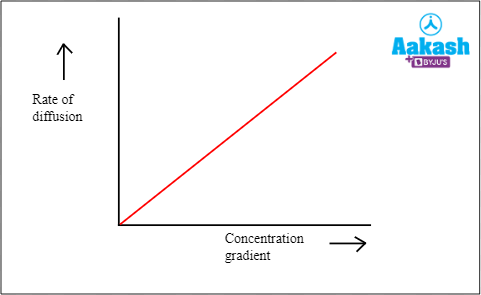
Fig: Rate of diffusion
Factors affecting the rate of diffusion
Many factors can affect the rate of diffusion. The major five factors are as follows:
- Concentration gradient
- Temperature
- Pressure
- Density
- Surface area of the membrane
Concentration gradient
Concentration gradient is a factor which is directly proportional to the rate of diffusion. The molecules will diffuse across the membrane when the concentration gradient is high across the membranes. This will neutralise the difference in concentration. Equilibrium is achieved after diffusion.

Fig: Effect of concentration gradient on diffusion
Temperature
Temperature is also directly proportional to the rate of diffusion. Kinetic energy of molecules is increased when there is a rise in temperature, as a result the molecules get excited and cross the membrane. For example, sugar dissolves quicker in hot water than cold water.

Fig: Effect of temperature on diffusion
Pressure
Pressure and the rate of diffusion are directly proportional to each other. Increase in the pressure can increase the kinetic energy of molecules. When kinetic energy increases, the molecules can easily pass across the membrane.

Fig: Effect of pressure on diffusion
Density
Density is a factor which is inversely proportional to the rate of diffusion.
Density of the diffusing molecules
Graham’s law supports the influence of the factor density. Graham’s law states that the rate of diffusion of a gas is inversely proportional to the square root of its molecular weight. Hence, according to Graham's law, the denser the molecule, the lesser the rate of diffusion.

Fig: Effect of density on diffusion
Density of the medium
The rate of diffusion is slower when the medium is concentrated. For example, gas molecules will diffuse more rapidly in vacuum than in air.
Surface area of the membrane
The surface area of the membrane and rate of diffusion are directly proportional to each other. Hence more molecules can diffuse through the membrane, if the surface area of the membrane is more. For example, the surface area of the plasma membrane.

Fig: Effect of surface area of the membrane on diffusion
Diffusion and permeability of membranes
Permeability is defined as the degree of diffusion of gases, liquids or dissolved substances through a membrane. On the basis of permeability four types of membranes are present as follows:
Freely permeable membrane
These types of membranes allow free passage of solvents and most of the dissolved substances. Examples include the cell walls of plant cells.
Impermeable membranes
These types of membranes possess waxy substances like cutin or suberin and do not allow the entry of water, gases or dissolved substances. Examples include plant cell walls with suberin.
Semi permeable membrane
These types of membranes allow the movement of solvent molecules but prevent the movement of solute molecules. Examples include egg membrane, parchment membrane, bladders of animals etc.
Selectively permeable membrane
These types of membranes allow the selective passage of solutes along with the solvent through them. Examples include plasma membranes. Plasma membrane of a cell is made up of lipid bilayer which is selectively permeable. Hence all molecules are not able to pass through this layer. Only those molecules that are lipid-soluble are allowed to cross the lipid bilayer by simple diffusion. Molecules that are lipid-insoluble can not cross through the membrane. Such molecules are passed through the lipid bilayer by another process called facilitated diffusion.

Fig: Transport of lipid soluble and lipid insoluble materials
Facilitated diffusion
The movement of lipid insoluble molecules across the membranes with the help of specialised proteins are called facilitated diffusion. Energy is not needed for this process to happen. The specialised proteins can only transport few and specific molecules across the membrane. Hence bulk transport molecules do not happen through the facilitated diffusion. In the presence of inhibitors, the process of facilitated diffusion gets interrupted.

GIF: Facilitated diffusion
Specialised proteins involved in facilitated diffusion
There are major three types of specialised proteins involved in the facilitated diffusion and they are as follows:
- Channel proteins
- Gated channel proteins
- Carrier proteins

Fig: Types of specialised proteins
Channel proteins
The pore-like proteins present in the cell membrane that allows the passage of molecules are called channel proteins. There are two types of channel proteins and are as follows:
- Porins
- Aquaporins
Porins
The large proteins that are present in the outer membrane of plastids, mitochondria, and bacteria are called porins. Small lipid insoluble proteins can easily pass through the porins.

GIF: Porins
Aquaporins
The specialised channel proteins that can transport water molecules and selected small solutes are called aquaporins. They are also called water channels as these are mainly involved in the transport of water. The structure of aquaporins possess a bundle of six transmembrane alpha helices that are embedded in the cell membrane. Eight different types of aquaporins are present.

GIF: Aquaporins
Gated channel proteins
The specialised proteins on the cell membrane with a structure of gate are called gated channel proteins. These proteins have specific binding sites for each protein that has to be transported. So molecules bond to the gated proteins and while it opens, the molecules diffuse to the next side of the membrane.

Fig: Gated channel proteins
Examples
NMDA (N-methyl-D-aspartate) receptor is an example of gated channel proteins. It is a glutamate ion channel. It gets activated when glycine and glutamate bind to it. Gated channel proteins like AMPA (α-amino-3-hydroxy-5-methyl-4-isoxazolepropionic acid) receptors have been opened by some inducers. Simulations like temperature, chemicals and electrical signals can open these gated channel proteins.

GIF: NMDA receptor
Carrier proteins
The specialised proteins which can undergo structural changes according to the molecules that to be transported are called carrier proteins. When the molecules bind to the carrier proteins, it will undergo structural configuration changes and transport the molecules.

GIF: Carrier proteins
Types of facilitated diffusion
On the basis of the number and type of molecules passing through the cell membrane there are three types of facilitated diffusion. These are as follows:
- Uniport
- Symport
- Antiport

Fig: Types of facilitated diffusion
Uniport
The movement of single types of molecules across the membrane is called uniport. The movement of molecules through the proteins are unidirectional.


Fig: Uniport GIF: Uniport
Symport
The movement of molecules across the membrane in the same direction is called symport. Movement of different types of molecules occurs through symport.


Fig: Symport GIF: Symport
Antiport
The movement of two types of molecules in the opposite direction is called antiport. This can also happen as coupled movements of molecules.


Fig: Antiport GIF: Antiport
Diffusion pressure (DP)
The pressure generated by the number and concentration of molecules in the diffusion process is called diffusion pressure. It is the pressure exerted by the tendency of molecules of gases and liquids to diffuse from the area of their higher concentration to the area of lower concentration. It is directly proportional to the concentration of molecules. The diffusion pressure will be high, if the number and concentration of the diffusing molecules are high.
The highest diffusion pressure is shown by the pure solvent. When a solute is added to it slowly and continuously its DP progressively decreases. This difference in the diffusion pressure is called diffusion pressure deficit or DPD.
Diffusion pressure is zero for a supersaturated solution. Thus, the diffusion pressure of water molecules is highest in pure water, low is shown in hypotonic solution, lowest is shown in hypertonic solution.
DPD is always in positive magnitude. When the concentration of the solute increases in the solution, the water potential of a solution decreases. At this time, the cell can take more water and this increases the osmotic pressure or OP. The cells will take up more water until it gets turgid. DPD is dependent on the osmotic pressure and turgor pressure, hence the equation to calculate the DPD is:
DPD = Osmotic pressure (OP) - Turgor pressure (TP)
Significance of diffusion in plants
The major significances of diffusion in plants are as follows:
- Diffusion is essential for the exchange of CO2 and O2 during photosynthesis and respiration.
- Diffusion is important in transpiration.
- Ions are absorbed by simple diffusion during passive salt uptake.
- Diffusion is an effective means of transport of substances and it helps the translocation of food materials over a very short distance.
- The odour of flowers to attract the pollinators spread through the air by diffusion.
Differences between simple diffusion and facilitated diffusion
The major differences between simple and facilitated diffusion are as follows:
Simple diffusion |
Facilitated diffusion |
|
Her the movement of particles from the higher to lower concentration occurs without any assistance |
Here the movement of particles from the higher to lower concentration occurs with the help of carrier proteins |
|
Movement of substances occurs through phospholipid bilayer |
Movement of substances occurs through transmembrane protein |
|
Small and non-polar molecules are transported |
Large and polar molecules are transported |
|
Movement of molecules occurs directly through membrane |
Facilitator molecules are needed for the movement |
|
Rate of diffusion is directly proportional to the concentration gradient and permeability of the membrane |
Rate of diffusion depends on the kinetics of carrier mediated proteins |
|
Examples include diffusion of gases through respiratory membranes |
Examples include Co transport of sodium along with sugars like glucose, galactose etc. |
|
Fig: Simple diffusion |
GIF: Facilitated diffusion |
Practice Problems
Q1. Which of the following are not the characteristics of diffusion?
I) It is a fast process.
II) It takes place for gases, liquids and solids.
III) Movement of molecules is passive.
IV) It occurs in short distances.
V) Energy is utilised in the process.
a. I and II
b. I, II and III
c. I only
d. I, II and V
Solution: Diffusion is the movement of molecules from the higher concentration to lower concentration until it attains equilibrium. This process is occurring according to the concentration gradient. It is also called simple diffusion. Diffusion is a slow process and it does not depend on the living system. It takes place for gases, dissolved substances and liquids. Movement of molecules is passive while diffusing. It occurs in short distances (cell to cell, one part of the cell to another and across intercellular spaces). No energy is utilised for diffusion. The absorption of CO2 and O2 in plants takes place through diffusion. Hence the correct option is d.
Q2. Which of the following factors that affect the rate of diffusion is related inversely to it?
A. Concentration gradient
B. Temperature
C. Density
D. Pressure
Solution: Many factors can affect the rate of diffusion. The major five factors are concentration gradient, temperature, pressure, density and surface area of the membrane. Concentration gradient is a factor which is directly proportional to the rate of diffusion. The molecules will diffuse across the membrane when the concentration gradient is high across the membranes. This will neutralise the difference in concentration. Temperature is also directly proportional to the rate of diffusion. Kinetic energy of molecules is increased when there is a rise in temperature, as a result the molecules get excited and cross the membrane. Pressure and the rate of diffusion are directly proportional to each other. Increase in the pressure can increase the kinetic energy of molecules. When kinetic energy increases, the molecules can easily pass across the membrane. Density is a factor which is inversely proportional to the rate of diffusion. Graham’s law supports the influence of this factor. Graham’s law states that the rate of diffusion of a gas is inversely proportional to the square root of its molecular weight. Hence, according to Graham's law, the denser the molecule, the lesser the rate of diffusion. The rate of diffusion is slower when the medium is concentrated. For example, gas molecules will diffuse more rapidly in vacuum than in air. Hence the correct option is c.
Q3. Assertion: Facilitated diffusion has specialised proteins for the transport of the molecules.
Reason: The specialised channel proteins that can transport only water molecules are called porins.
A. Both the assertion and the reason are correct and the reason is the correct explanation of the assertion
B. Both the assertion and the reason are correct, but the reason is not the correct explanation of the assertion
C. Assertion is correct, but the reason is not correct
D. Both the assertion and the reason are incorrect
Solution: The movement of lipid insoluble molecules across the membranes with the help of specialised proteins are called facilitated diffusion. Energy is not needed for this process to happen. The specialised proteins can only transport few and specific molecules across the membrane. Hence bulk transport molecules do not happen through the facilitated diffusion. There are major three types of specialised proteins involved in the facilitated diffusion and they are channel proteins, gated channel proteins and carrier proteins. The pore-like proteins present in the cell membrane that allows the passage of molecules are called channel proteins. There are two types of channel proteins and they are porins and aquaporins. The large proteins that are present in the outer membrane of plastids, mitochondria, and bacteria are called porins. Small lipid insoluble proteins can easily pass through the porins. The specialised channel proteins that can transport water molecules and few selected solutes are called aquaporins. These are also called water channels as are mainly involved in the transport of water molecules. The structure of aquaporins possess a bundle of six transmembrane alpha helices that are embedded in the cell membrane. Here the assertion is correct and the reason is false. So the correct option is c.
Q4. Find out the incorrectly matched pair.
|
Movement of molecules in one direction |
|
Movement of different molecules in one direction |
|
The movement of two types of molecules in the opposite direction |
A. A only
B. A and B
C. A and C
D. B only
Solution: On the basis of the number and type of molecules passing through the cell membrane there are three types of facilitated diffusion. They are uniport, symport and antiport. The movement of single types of molecules across the membrane is called uniport. The movement of molecules through the proteins are unidirectional. The movement of molecules across the membrane in the same direction is called symport. Movement of different types of molecules occurs through symport. The movement of two types of molecules in the opposite direction is called antiport. This can also happen as coupled movements of molecules. Hence the correct option is a.
FAQs
Q1. Find out the differences between diffusion and osmosis?
nswer: Even though the two terms diffusion and osmosis hold the same idea of the transport of molecules across the cell membrane, there are some differences too. These are as follows:
|
Diffusion |
Osmosis |
|
Observed in mediums like liquid and gas |
Only observed in liquid medium |
|
Semipermeable membrane is not needed for the molecules to pass through |
Semipermeable membrane is needed for the molecules to pass through |
|
Water is not required for the movement of molecules |
Water is required for the movement of molecules |
|
Both solutes and solvents can pass through the membrane |
Only solvents can pass through the membrane |
|
Flow of molecules in every direction |
Flow of molecules only in one direction |
|
If pressure is applied the process cannot be stopped |
If additional pressure is applied on the solution, the process can be stopped or reversed (reverse osmosis) |
|
Molecules can move between similar and dissimilar types of solutions |
Molecules move across similar types of solutions |
|
Helps in the uptake of nutrients and minerals |
Does not help in the uptake of minerals and nutrients |
|
Does not depend on pressure potential, solute potential and water potential |
Depends on solute potential, water potential and pressure potential |
Q2. What is dialysis?
Answer: The process by which the solutes diffuse over a selective porous membrane is called dialysis. This selectively permeable membrane permits the flow of some molecules and ions through it and prevents the other molecules.
Q3. What is Fick’s laws?
Answer: Diffusion can be also described through Fick’s laws of diffusion and it was derived by Adolf Fick in 1855. Diffusion coefficient can be solved through the law. Fician diffusion is the diffusion process which obeys the Fick’s law. If a diffusion is not obeying the Fick’s law, then it is called anomalous diffusion or non-Fickian diffusion.
Fick's law states that the rate of diffusion of a substance across a unit area like a surface or membrane is proportional to the concentration gradient.
Q4. How can diffusion be useful in daily life?
Answer: The smell of perfume in the air after it gets sprayed is due to the diffusion. The making of tea using a tea bag is also a scenario of diffusion. Usage of food colours in liquids is another example.
YOUTUBE LINK: Need to be created
Related Topics
|
Differences between diffusion and osmosis, Practice Problems and FAQs |
|
Means of transport, Practice Problems and FAQs |
|
Definition of osmosis, Practice Problems and FAQs |
|
Difference between diffusion and osmosis, difference between active and passive transport, difference between endosmosis and exosmosis |

 Call Now
 Let's Chat
 Share
Share