-
Call Now
1800-102-2727


Decomposition, Process of decomposition, Factors Affecting Decomposition, Practice Problems and FAQs

We breathe in oxygen but do we give it back to the atmosphere? Plants take in minerals from the soil but do they give it back? When we eat plants or animals which feed on plants, we too consume the minerals that the plants borrow from the soil, but do we give it back to the soil? All living organisms are made up of complex compounds which are in turn made up of simple elements that are either directly or indirectly taken from the air, water or soil around them. But if we just continue to take from the environment, and not return these resources back, then there will come a time when the environment runs out of these elements. Thus, a balance has to be struck between what we take from the environment, and what we return back to it. Let us see how this balance is achieved.
Have you ever had to take out garbage? You must have noticed that we segregate our wastes and put all the wastes derived from organic sources into a green bin. Do you know why? It is because the complex components of such organic wastes can easily be broken down in nature by various agents and the simpler byproducts of degradation can easily be released into the environment. This process is known as decomposition.
Organic matter such as food wastes, animal faeces, dead leaves that drop to the ground, dead animals, etc. are broken down by various microbes as they feed on the organic matter to obtain nutrition and energy. In the process of breakdown, they release simple elements back to the environment and restore the balance. Thus, the process of decomposition also helps to keep the environment clean. In this article we will learn more about the process of decomposition.
Table of contents
- Introduction to Decomposition
- Process of decomposition
- Factors affecting the decomposition
- Practice problems
- FAQs
Introduction to Decomposition
Decomposition is the process by which complex organic remains of organisms are physically and chemically broken down to form simple inorganic substances such as carbon dioxide, water, minerals such that they can be recycled back into the environment.
Decomposition is mainly aided by saprotrophic microorganisms such as bacteria, fungi, some protists and small invertebrates such as earthworms, ants, mites, termites, slugs, snails, millipedes, woodlice, etc.
The major site of decomposition is the upper layer of soil in terrestrial ecosystems and the bottom of the water body in aquatic ecosystems.
Detritus
The raw material for decomposition is freshly deposited organic matter above or below the ground and is known as detritus. Detritus consists of dead remains of plants, animals and animal wastes or faeces.
Above the ground detritus includes dried plant parts or litter, excreta and dead remains of animals. Below the ground detritus mainly consists of plant roots and the dead remains and faecal matter of underground organisms.
Process of decomposition
The process of decomposition is carried out with the help of three different processes, fragmentation, leaching and catabolism, which occur simultaneously.
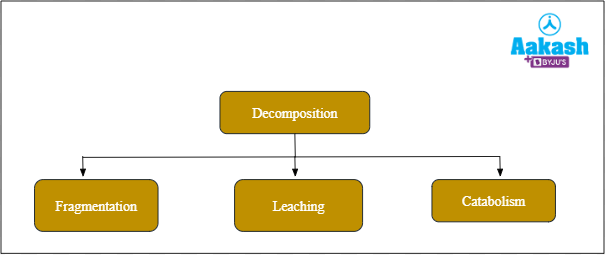
Fig: Process of decomposition
Fragmentation
Decomposition occurs in a stepwise manner starting from fragmentation. The detritivores like earthworms, small insects etc., feed on the detritus (dry leaves) and break them down into smaller particles. This process is known as fragmentation. As the detritivores feed on the detritus, a part of it comes out in their faeces in a highly pulverised state. Due to fragmentation during eating as well as pulverisation in the digestive tracts, the detritus is broken into finer particles. This increases the surface area of the detritus for better action by microbes.
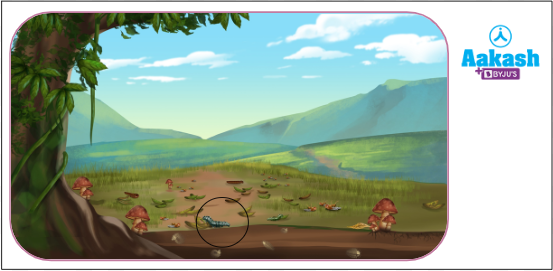
Fig: Fragmentation by smaller invertebrates
Leaching
Water-soluble inorganic nutrients present in the fragmented or decomposed detritus percolate along with water down into the upper layers of soil and get precipitated there as unavailable salts. This process is known as leaching.
Catabolism
Catabolism refers to the enzymatic breakdown or decomposition of the organic matter of the detritus into simple or soluble organic or inorganic compounds, by the actions of saprotrophic microbes or decomposers such as bacteria, fungi, etc.
During catabolism, the process of decomposition results in the release of both organic and inorganic compounds with the help of two processes, humification and mineralisation, respectively.
Humification
Humification is the process of decomposition of detritus to form a highly colloidal, partially decomposed, amorphous organic matter known as humus which is rich in cellulose, lignin, tannins, resin, etc. Humus is acidic and highly resistant to microbial degradation. Thus it is degraded very slowly and gradually releases nutrients into the soil, acting as a nutrient reservoir. It helps in maintaining soil aeration and moisturisation.
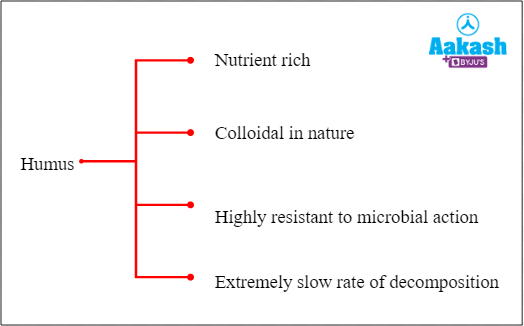
Fig: Humus
Mineralisation
Mineralisation is the process of breaking down organic matter in the detritus and humus in order to release simple inorganic substances. Mineralisation occurs as a result of the action of digestive enzymes, released by bacteria and fungi, on the organic matter. The released minerals such as Ca2+, Mg2+, K+, etc are easily absorbed by plants and utilised for their growth and development.

Fig: Mineralisation
Thus the decomposition cycle in a terrestrial ecosystem can be represented as -

Fig: Decomposition cycle
Nutrient immobilisation
As the decomposers and detritivores feed on detritus and break it down, they absorb some of the digested or broken down substances for nutrition. Thus, a part of the nutrients present in detritus remain trapped within the biomass of detritivores and decomposers and are not released into the environment during the decomposition process. This phenomenon is known as nutrient immobilisation and it prevents the nutrients from mein washed away or lost from the ecosystem. Once the decomposers and detritivores die, the immobilised nutrients within them are again available for solubilisation and release into the environment.
Factors affecting the decomposition:-
Environmental temperature
Rate of decomposition is faster in warm and moist conditions. Under proper conditions of moisture and aeration, growth and activity of decomposers is maximum at an optimum temperature of 25oC. A temperature below 10oC slows down the rate of decomposition, even when proper moisture and aeration is available, due to reduced activity of the microbial enzymes.
Moisture content
Moist conditions promote the growth of microorganisms and hence, under proper conditions of temperature and aeration, rate of decomposition is higher in moist soil compared to dry soil.
Soil pH
Microbes are unable to survive under highly acidic conditions. Thus, an acidic pH slows down the decomposition process. Decomposers are generally abundantly present in alkaline or neutral soils.
Soil aeration
Rate of decomposition is faster in the presence of oxygen because decomposition is an oxygen-requiring process, except for rare scenarios in which the decomposers are anaerobic.
Chemical composition of detritus
If large complex polymers such as chitin and lignin are present in the detritus, the rate of decomposition is slow. If water-soluble substances like sugars, nitrogen, etc, are present in the detritus, the rate of decomposition is quicker.
Practice problems
Q1. The process of release of inorganic nutrients by the degradation of detritus or humus is called
A. mineralisation
B. leaching
C. catabolism
D. Humification
Solution: Mineralisation is the process of breaking down organic matter in the detritus and humus in order to release simple inorganic substances. Mineralisation occurs as a result of the action of digestive enzymes, released by bacteria and fungi, on the organic matter. The released minerals such as Ca2+, Mg2+ K+, etc are easily absorbed by plants and utilised for their growth and development.
So the correct option is a.
Q2. Assertion: Decomposition of detritus helps in biogeochemical cycling.
Reason: Humus formed during decomposition slowly releases the minerals in the process of mineralisation
a. Both Assertion and Reason are correct and Reason is the correct explanation for Assertion
b. Both Assertion and Reason are correct but Reason is not the correct explanation for Assertion
c. Assertion is correct but Reason is incorrect
d. Both Assertion and Reason are incorrect
Solution: Biogeochemical cycling is the repeated circulation of nutrients and minerals between the biotic and abiotic components of the ecosystem. Decomposition of detritus (dead remains of plants, animals and animal wastes) helps in biogeochemical cycling. This is because decomposition of detritus results in the formation of a colloidal, dark organic matter called humus which is highly resistant to microbial action and decomposes very slowly. As it gradually decomposes, humus is further broken down to release simple inorganic minerals into the environment, thereby cycling them back to the environment.
So, the correct answer is option a.
Q3. Which of the following factors does not affect the rate of decomposition of organic matter?
A. Chemical composition of detritus
B. Ability of producers to perform photosynthesis
C. Soil pH
D. Aeration in soil
Solution: Photosynthetic ability of a plant majorly affects productivity of an ecosystem, i.e, the rate of production of organic matter by the process of photosynthesis. It does not affect the rate of decomposition.
Rate of decomposition is affected by the chemical composition of detritus, soil pH and soil aeration. Presence of large complex polymers like cellulose and lignin will slow down the decomposition process. Low soil pH retards the rate of decomposition. Anaerobic conditions in the soil will also reduce the rate of decomposition.
Thus, the correct option is b.
Q4. Which of the following statements is not true about humus?
A. It is highly susceptible to microbial action
B. It is dark and amorphous in nature
C. It is rich in cellulose and lignin
D. It decomposes very slowly
Solution: Humus is a highly colloidal, partially decomposed, amorphous organic matter which is rich in cellulose, lignin, tannins, resin, etc. Humus is acidic and highly resistant to microbial degradation and is thus degraded very slowly.
Thus, the correct option is a.
FAQs
Question 1. What would happen if decomposition did not occur?
Answer: If the process of decomposition would not occur in the ecosystem, then the nutrients that we obtain from the ecosystem would not be recycled back and the biogeochemical cycles will not function. If the nitrogen present in living systems is not returned back to the soil then plants growth will stop eventually and this would collapse the ecosystem.
Question 2. Does decomposition release oxygen?
Answer: Most decomposition reactions that occur in nature are aerobic reactions and the decomposers utilise oxygen to break down the complex organic matter to simple inorganic substances and release energy. Thus, oxygen is utilised during decomposition and not released. Oxygen is released into the atmosphere when plants photosynthesise.
Question 3. Does anaerobic decomposition occur?
Answer: Anaerobic decomposition is carried out by anaerobic microbes such as methanogenic bacteria. They breakdown organic matter in the absence of oxygen and produce methane in the process. These organisms are widely used for sewage treatment processes and biogas production.
Question 4. When does a dead human body start decomposing?
Answer: The human body is believed to start decomposing roughly 4 minutes after death. As soon as the body stops respiring, accumulation of carbon dioxide in the body creates an acidic environment which causes the cellular lysosomes to rupture. The released enzymes start digesting the cells and autolysis in the body starts. Within 24-72 hours after death, the decomposition of internal organs occurs and the body starts to bloat and leak after 3-5 days of death. The nails and teeth start falling out several weeks after death and around a month after death, the body starts to liquefy.
Related Topics
|
The Ecosystem - Components, Structure and Functions |
|
Biomass, Primary Productivity, Secondary Productivity |
|
Nutrient cycling: Carbon cycle and Phosphorus cycle |

 Call Now
 Let's Chat
 Share
Share