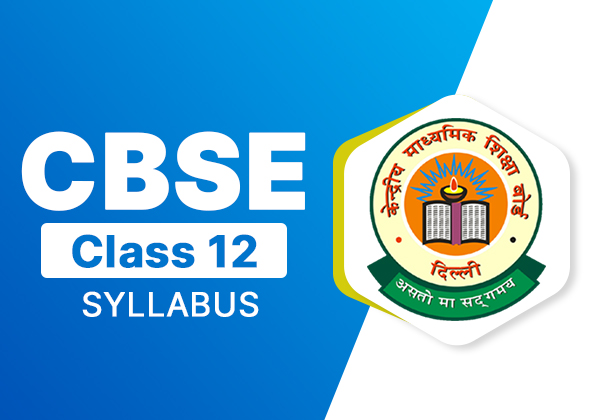

CBSE Class 12 Syllabus 2025: The Central Board of Secondary Education (CBSE) released the CBSE 12th Syllabus 2025 on its official website at cbseacademic.nic.in. Students preparing for the CBSE class 12 exams 2025 can check the updated CBSE Syllabus 2025. The CBSE Class 12 exams are conducted covering the entire CBSE Class 12 Syllabus 2025. The CBSE 12 exams 2025 will be conducted between February and April 2025.
Students must go through the entire CBSE Syllabus 2025 and strategize their study schedule accordingly. Students must also refer the CBSE Class 12 Exam pattern to know the marking scheme and the type of questions asked. The CBSE 12 Datesheet 2025 will be released in December 2024 in online mode on the official website – cbse.nic.in. Students can also go through the CBSE preparation tips for Class 12 to know how to approach the board examinations 2025.
How to Download the CBSE Class 12 Syllabus 2025?
Follow the below mentioned steps to download CBSE Syllabus for Class 12:
- Visit the official website – cbse.nic.in
- Click on the subject-wise class 12 syllabus
- The syllabus will open up on the screen
- Download and save for future use
CBSE Class 12 Physics Syllabus 2025
Students can check below the Chapter and units covered in the CBSE Class 12 Physics syllabus 2025.
| Unit | Chapter |
| Unit – 1: Electrostatics | Ch 1: Electric charges, Conservation of charge, Coulomb’s law-force between two- point charges, forces between multiple charges; superposition principle and continuous charge distribution. Electric field, electric field due to a point charge, electric field lines, electric dipole, electric field due to a dipole, torque on a dipole in uniform electric field. Electric flux, statement of Gauss’s theorem and its applications to find field due to infinitely long straight wire, uniformly charged infinite plane sheet and uniformly charged thin spherical shell (field inside and outside).NCERT Solutions for Electric Charges and FieldsCh 2: Electric potential, potential difference, electric potential due to a point charge, a dipole and system of charges; equipotential surfaces, electrical potential energy of a system of two-point charges and of electric dipole in an electrostatic field. Conductors and insulators, free charges and bound charges inside a conductor. Dielectrics and electric polarization, capacitors and capacitance, combination of capacitors in series and in parallel, capacitance of a parallel plate capacitor with and without dielectric medium between the plates, energy stored in a capacitor (no derivation, formulae only).NCERT Solutions for Electrostatic Potential and Capacitance |
| Unit – 2: Current Electricity | Ch 3: Electric current, flow of electric charges in a metallic conductor, drift velocity, mobility and their relation with electric current; Ohm’s law, V-I characteristics (linear and non-linear), electrical energy and power, electrical resistivity and conductivity, temperature dependence of resistance, Internal resistance of a cell, potential difference and emf of a cell, combination of cells in series and in parallel, Kirchhoff’s rules, Wheatstone bridge.
NCERT Solutions for Current Electricity |
| Unit – 3: Magnetic Effects of Current and Magnetism | Ch 4: Concept of magnetic field, Oersted’s experiment. Biot – Savart law and its application to current carrying circular loop. Ampere’s law and its applications to infinitely long straight wire. Straight solenoid (only qualitative treatment), force on a moving charge in uniform magnetic and electric fields. Force on a current-carrying conductor in a uniform magnetic field, force between two parallel current-carrying conductors-definition of ampere, torque experienced by a current loop in uniform magnetic field; Current loop as a magnetic dipole and its magnetic dipole moment, moving coil galvanometer- its current sensitivity and conversion to ammeter and voltmeter. NCERT Solutions for Moving Charges and MagnetismCh 5: Bar magnet, bar magnet as an equivalent solenoid (qualitative treatment only), magnetic field intensity due to a magnetic dipole (bar magnet) along its axis and perpendicular to its axis (qualitative treatment only), torque on a magnetic dipole (bar magnet) in a uniform magnetic field (qualitative treatment only), magnetic field lines. Magnetic properties of materials- Para-, dia- and ferro – magnetic substances with examples, Magnetization of materials, effect of temperature on magnetic properties. NCERT Solutions for Magnetism and Matter |
| Unit – 4: Electromagnetic Induction and Alternating Currents | Ch 6: Electromagnetic induction; Faraday’s laws, induced EMF and current; Lenz’s Law, Self and mutual induction.
NCERT Solutions for Electromagnetic Induction Ch 7: Alternating currents, peak and RMS value of alternating current/voltage; reactance and impedance; LCR series circuit (phasors only), resonance, power in AC circuits, power factor, wattless current. AC generator, Transformer. NCERT Solutions for Alternating Current |
| Unit – 5: Electromagnetic Waves | Ch 8: Basic idea of displacement current, Electromagnetic waves, their characteristics, their transverse nature (qualitative idea only). Electromagnetic spectrum (radio waves, microwaves, infrared, visible, ultraviolet, X-rays, gamma rays) including elementary facts about their uses.
NCERT Solutions for Electromagnetic Waves |
| Unit – 6: Optics | Ch 9: Ray Optics: Reflection of light, spherical mirrors, mirror formula, refraction of light, total internal reflection and optical fibers, refraction at spherical surfaces, lenses, thin lens formula, lens maker’s formula, magnification, power of a lens, combination of thin lenses in contact, refraction of light through a prism. Optical instruments: Microscopes and astronomical telescopes (reflecting and refracting) and their magnifying powers. NCERT Solutions for Ray Optics and Optical InstrumentsCh 10: Wave optics: Wave front and Huygen’s principle, reflection and refraction of plane wave at a plane surface using wave fronts. Proof of laws of reflection and refraction using Huygen’s principle. Interference, Young’s double slit experiment and expression for fringe width (No derivation final expression only), coherent sources and sustained interference of light, diffraction due to a single slit, width of central maxima (qualitative treatment only) NCERT Solutions for Wave Optics |
| Unit – 7: Dual Nature of Radiation and Matter | Ch 11: Dual nature of radiation, Photoelectric effect, Hertz and Lenard’s observations; Einstein’s photoelectric equation-particle nature of light. Experimental study of photoelectric effect Matter waves-wave nature of particles, de-Broglie relation
NCERT Solutions for Dual Nature of Radiation and Matter |
| Unit – 8: Atoms and Nuclei | Ch 12: Alpha-particle scattering experiment; Rutherford’s model of atom; Bohr model of hydrogen atom, Expression for radius of nth possible orbit, velocity and energy of electron in nth orbit, hydrogen line spectra (qualitative treatment only).
NCERT Solutions for Atoms Ch 13: Composition and size of nucleus, nuclear force Mass-energy relation, mass defect; binding energy per nucleon and its variation with mass number; nuclear fission, nuclear fusion. NCERT Solutions for Nuclei |
| Unit – 9: Electronic Devices | Ch 14: Energy bands in conductors, semiconductors and insulators (qualitative ideas only) Intrinsic and extrinsic semiconductors- p and n type, p-n junction Semiconductor diode – I-V characteristics in forward and reverse bias, application of junction diode -diode as a rectifier
NCERT Solutions for Semiconductor Electronics: Materials, Devices and Simple Circuits |
CBSE Class 12 Chemistry Syllabus 2025
Students can check below the Chapter and units covered in the CBSE Class 12 Chemistry syllabus 2025.
Also read: NCERT Solutions Chemistry Class 11 Preparation
| Units | Chapters/Topics |
| Unit 2: Solutions | Types of solutions, expression of concentration of solutions of solids in liquids, solubility of gases in liquids, solid solutions, Raoult’s law, colligative properties – relative lowering of vapour pressure, elevation of boiling point, depression of freezing point, osmotic pressure, determination of molecular masses using colligative properties, abnormal molecular mass, Van’t Hoff factor. NCERT Solutions for Solid State NCERT Solutions for Solutions |
| Unit 3: Electrochemistry | Redox reactions, EMF of a cell, standard electrode potential, Nernst equation and its application to chemical cells, Relation between Gibbs energy change and EMF of a cell, conductance in electrolytic solutions, specific and molar conductivity, variations of conductivity with concentration, Kohlrausch’s Law, electrolysis and law of electrolysis (elementary idea), dry cell-electrolytic cells and Galvanic cells, lead accumulator, fuel cells, corrosion. NCERT Solutions for Electrochemistry |
| Unit 4: Chemical Kinetics | Rate of a reaction (Average and instantaneous), factors affecting rate of reaction: concentration, temperature, catalyst; order and molecularity of a reaction, rate law and specific rate constant, integrated rate equations and half-life (only for zero and first order reactions), concept of collision theory (elementary idea, no mathematical treatment), activation energy, Arrhenius equation. NCERT Solutions for Chemical Kinetics |
| Unit 5: d -and f -Block Elements | General introduction, electronic configuration, occurrence and characteristics of transition metals, general trends in properties of the first row transition metals – metallic character, ionization enthalpy, oxidation states, ionic radii, colour, catalytic property, magnetic properties, interstitial compounds, alloy formation, preparation and properties of K2Cr2O7 and KMnO4. Lanthanoids – Electronic configuration, oxidation states, chemical reactivity and lanthanoid contraction and its consequences. Actinoids – Electronic configuration, oxidation states and comparison with lanthanoids. NCERT Solutions for d -and f -Block Elements |
| Unit 6: Coordination Compounds | Coordination compounds – Introduction, ligands, coordination number, colour, magnetic properties and shapes, IUPAC nomenclature of mononuclear coordination compounds. Bonding, Werner’s theory, VBT, and CFT; structure and stereoisomerism, importance of coordination compounds (in qualitative analysis, extraction of metals and biological system). NCERT Solutions for Coordination Compounds |
| Unit 7: Haloalkanes and Haloarenes | Haloalkanes: Nomenclature, nature of C–X bond, physical and chemical properties, optical rotation mechanism of substitution reactions. Haloarenes: Nature of C–X bond, substitution reactions (Directive influence of halogen in monosubstituted compounds only). Uses and environmental effects of – dichloromethane, trichloromethane, tetrachloromethane, iodoform, freons, DDT. NCERT Solutions for Haloalkanes and Haloarenes |
| Unit 8: Alcohols, Phenols and Ethers | Alcohols: Nomenclature, methods of preparation, physical and chemical properties (of primary alcohols only), identification of primary, secondary and tertiary alcohols, mechanism of dehydration, uses with special reference to methanol and ethanol. Phenols: Nomenclature, methods of preparation, physical and chemical properties, acidic nature of phenol, electrophillic substitution reactions, uses of phenols. Ethers: Nomenclature, methods of preparation, physical and chemical properties, uses. NCERT Solutions for Alcohols, Phenols and Ethers |
| Unit 9: Aldehydes, Ketones and Carboxylic Acids | Aldehydes and Ketones: Nomenclature, nature of carbonyl group, methods of preparation, physical and chemical properties, mechanism of nucleophilic addition, reactivity of alpha hydrogen in aldehydes, uses. Carboxylic Acids: Nomenclature, acidic nature, methods of preparation, physical and chemical properties; uses. NCERT Solutions for Aldehydes, Ketones and Carboxylic Acids |
| Unit 10: Amines | Amines: Nomenclature, classification, structure, methods of preparation, physical and chemical properties, uses, identification of primary, secondary and tertiary amines. Diazonium salts: Preparation, chemical reactions and importance in synthetic organic chemistry. NCERT Solutions for Amines |
| Unit 11: Biomolecules | Carbohydrates – Classification (aldoses and ketoses), monosaccahrides (glucose and fructose), D-L configuration oligosaccharides (sucrose, lactose, maltose), polysaccharides (starch, cellulose, glycogen); Importance of carbohydrates. Proteins -Elementary idea of – amino acids, peptide bond, polypeptides, proteins, structure of proteins – primary, secondary, tertiary structure and quaternary structures (qualitative idea only), denaturation of proteins; enzymes. Hormones – Elementary idea excluding structure. Vitamins – Classification and functions. Nucleic Acids: DNA and RNA. NCERT Solutions for Biomolecules |
CBSE Class 12 Mathematics Syllabus 2025
Students must go through the CBSE Class 12 Mathematics Syllabus 2025 carefully and cover it on time. The topics and the marks have been mentioned below:
Also Read: NCERT Solutions Maths Class 11 Preparation
| Units | Part | Topics |
| Unit-I: Sets and Functions
|
Sets | Sets and their representations, Empty set, Finite and Infinite sets, Equal sets, Subsets, Subsets of a set of real numbers especially intervals (with notations). Universal set. Venn diagrams. Union and Intersection of sets. Difference of sets. Complement of a set. Properties of Complement.
NCERT Solutions for Sets |
| Relations & Functions | Ordered pairs. Cartesian product of sets. Number of elements in the Cartesian product of two finite sets. Cartesian product of the set of reals with itself (upto R x R x R).Definition of relation, pictorial diagrams, domain, co-domain and range of a relation. Function as a special type of relation. Pictorial representation of a function, domain, co-domain and range of a function. Real valued functions, domain and range of these functions, constant, identity, polynomial, rational, modulus, signum, exponential, logarithmic and greatest integer functions, with their graphs. Sum, difference, product and quotients of functions.
NCERT Solution for Relations & Functions |
|
| Trigonometric Functions | Positive and negative angles. Measuring angles in radians and in degrees and conversion from one measure to another. Definition of trigonometric functions with the help of unit circle. Truth of the identity sin2x + cos2x = 1, for all x. Signs of trigonometric functions. Domain and range of trigonometric functions and their graphs. Expressing sin (x±y) and cos (x±y) in terms of sinx, siny, cosx & cosy and their simple applications.
NCERT Solutions for Trigonometric Functions |
|
| Unit-II: Algebra
|
Complex Numbers and Quadratic Equations | Need for complex numbers, especially√−1, to be motivated by inability to solve some of the quadratic equations. Algebraic properties of complex numbers. Argand plane. NCERT Solutions for Complex Numbers and Quadratic Equations |
| Linear Inequalities | Linear inequalities. Algebraic solutions of linear inequalities in one variable and their representation on the number line.
NCERT Solutions for Linear Inequalities |
|
| Permutations and Combinations | Fundamental principle of counting. Factorial n. (n!) Permutations and combinations, derivation of Formulae for nPr and nCr and their connections, simple applications.
NCERT Solutions for Permutations and Combinations |
|
| Binomial Theorem | Historical perspective, statement and proof of the binomial theorem for positive integral indices. Pascal’s triangle, simple applications. NCERT Solutions for Binomial Theorem | |
| Sequence and Series | Sequence and Series. Arithmetic Mean (A.M.) Geometric Progression (G.P.), general term of a G.P., sum of n terms of a G.P., infinite G.P. and its sum, geometric mean (G.M.), relation between A.M. and G.M.
NCERT Solutions for Sequence and Series |
|
| Unit-III: Coordinate Geometry
|
Straight Lines | Brief recall of two dimensional geometry from earlier classes. Slope of a line and angle between two lines. Various forms of equations of a line: parallel to axis, point -slope form, slope-intercept form, two-point form, intercept form, Distance of a point from a line.
NCERT Solutions for Straight Lines |
| Conic Sections | Sections of a cone: circles, ellipse, parabola, hyperbola, a point, a straight line and a pair of intersecting lines as a degenerated case of a conic section. Standard equations and simple properties of parabola, ellipse and hyperbola. Standard equation of a circle.
NCERT Solutions for Conic Sections |
|
| Introduction to Three-dimensional Geometry | Coordinate axes and coordinate planes in three dimensions. Coordinates of a point. Distance between two points.
NCERT Solutions for Introduction to Three-dimensional Geometry |
|
| Unit-IV: Calculus | Calculus | Derivative introduced as rate of change both as that of distance function and geometrically. Intuitive idea of limit. Limits of polynomials and rational functions trigonometric, exponential and logarithmic functions. Definition of derivative relate it to scope of tangent of the curve, derivative of sum, difference, product and quotient of functions. Derivatives of polynomial and trigonometric functions.
NCERT Solutions for Limits and Derivatives |
| Unit-V: Statistics and Probability | Statistics | Measures of Dispersion: Range, Mean deviation, variance and standard deviation of ungrouped/grouped data. NCERT Solutions for Statistics |
| Probability | Events; occurrence of events, ‘not’, ‘and’ and ‘or’ events, exhaustive events, mutually exclusive events, Axiomatic (set theoretic) probability, connections with other theories of earlier classes. Probability of an event, probability of ‘not’, ‘and’ and ‘or’ events.
NCERT Solutions for Probability |
CBSE Class 12 Maths Syllabus 2025
The CBSE Class 12 Maths Syllabus Maths is essential for developing a strategic exam preparation strategy. Additionally, it familiarises class 12 students with all the chapters covered in Maths subject. This way, they can list out all the topics and concepts they must cover during the academic year.
| CBSE Syllabus Class 12 Maths |
| Chapter 1: Relations and Functions |
| Chapter 2: Inverse Trigonometric Functions |
| Chapter 3: Matrices |
| Chapter 4: Determinants |
| Chapter 5: Continuity and Differentiability |
| Chapter 6: Application of Derivatives |
| Chapter 7: Integrals |
| Chapter 8: Application of Integrals |
| Chapter 9: Differential Equations |
| Chapter 10: Vector Algebra |
| Chapter 11: Three-Dimensional Geometry |
| Chapter 12: Linear Programming |
| Chapter 13: Probability |
CBSE Class 12 Physics Syllabus 2025
CBSE Class 212 Physics syllabus is crucial for every student as it assists them in effectively utilizing their time during the preparation. There are a total of 15 chapters in Physics that students of class 12 must complete before appearing for the final board exam.
| CBSE Syllabus Class 12 Physics |
| Chapter 1: Electric Charges and Fields |
| Chapter 2: Electrostatic Potential and Capacitance |
| Chapter 3: Current Electricity |
| Chapter 4: Moving Charges and Magnetism |
| Chapter 5: Magnetism And Matter |
| Chapter 6: Electromagnetic Induction |
| Chapter 7: Alternating Current |
| Chapter 8: Electromagnetic Waves |
| Chapter 9: Ray Optics and Optical Instruments |
| Chapter 10: Wave Optics |
| Chapter 11: Dual Nature of Radiation and Matter |
| Chapter 12: Atoms |
| Chapter 13: Nuclei |
| Chapter 14: Semiconductor Electronic: Material, Devices And Simple Circuits |
| Chapter 15: Communication Systems |
CBSE Class 12 Chemistry Syllabus 2025
CBSE Class 12 Chemistry Syllabus consists of all the fundamental concepts that students have to cover before taking the final board exam. At the beginning of the academic year 2023-2024, students should be familiar with the chapters included in the CBSE syllabus for class 12 Chemistry.
| CBSE Syllabus Class 12 Chemistry |
| Chapter 1: The Solid State |
| Chapter 2: Solutions |
| Chapter 3: Electrochemistry |
| Chapter 4: Chemical Kinetics |
| Chapter 5: Surface Chemistry |
| Chapter 6: General Principles and Processes of Isolation of Elements |
| Chapter 7: The p-Block Elements |
| Chapter 8: The d and f Block Elements |
| Chapter 9: Coordination Compounds |
| Chapter 10: Haloalkanes and Haloarenes |
| Chapter 11: Alcohols, Phenols and Ethers |
| Chapter 12: Aldehydes, Ketones and Carboxylic Acids |
| Chapter 13: Amines |
| Chapter 14: Biomolecules |
| Chapter 15: Polymers |
| Chapter 16: Chemistry in Everyday Life |
CBSE Class 12 Biology Syllabus 2025
The revised CBSE Class 12 Biology Syllabus is a crucial study material that helps students secure excellent scores in board exams.
| CBSE Syllabus Class 12 Biology |
| Chapter 1: Reproduction in Organism |
| Chapter 2: Sexual Reproduction in Flowering Plants |
| Chapter 3: Human Reproduction |
| Chapter 4: Reproductive Health |
| Chapter 5: Principles of Inheritance and Variation |
| Chapter 6: Molecular Basis of Inheritance |
| Chapter 7: Evolution |
| Chapter 8: Human Health and Disease |
| Chapter 9: Strategies for Enhancement in Food Production |
| Chapter 10: Microbes in Human Welfare |
| Chapter 11: Biotechnology: Principles and Processes |
| Chapter 12: Biotechnology and its Applications |
| Chapter 13: Organisms and Populations |
| Chapter 14: Ecosystem |
| Chapter 15: Biodiversity and Conservation |
| Chapter 16: Environmental Issues |
CBSE Class 12 English Core Syllabus 2025
The CBSE Class 12 English Syllabus is essential for all the students of class 12. Irrespective of the stream, students must learn the chapters of English Core as it is a compulsory subject.
| CBSE Syllabus Class 12 English Core | |
| Flamingo (Prose) |
|
| Flamingo (Poem) |
|
| Vistas |
|
| Cutting of My Long Hair | |
| We Too Are Humans | |
CBSE Class 12 English Elective Syllabus 2025
The CBSE Class 12 English Elective Syllabus is effectively designed by the board to help students understand the advanced English language. Students who thoroughly cover the chapters of the CBSE syllabus for the class 12 English Elective can develop to improve their reading, grammar, and creative writing.
| CBSE Syllabus Class 12 English Elective – Kaleidoscope | |
| Short Stories |
|
| Poetry |
|
| Non-Fiction |
|
| Drama | Chandalika- Rabindranath Tagore |
Importance of CBSE Class 12 Syllabus 2025
The CBSE Class 12 syllabus is of paramount importance in the academic journey of students. Here are several reasons that highlight its significance:
1. Guidance and Structure
The syllabus acts as a roadmap for students, offering a structured outline of the entire course. It guides students on what to study throughout the academic year, ensuring a systematic approach to learning.
2. Exam Preparation
Serving as the foundation for exam preparation, the syllabus outlines the topics, chapters, and subjects that students need to focus on. This helps in organizing study schedules efficiently and prioritizing key areas.
3. Board Exams
The CBSE Class 12 syllabus is crucial for board examinations. It defines the scope of what will be assessed in the final exams, allowing students to align their preparation with the exam pattern and marking scheme.
4. Uniformity
Ensuring uniformity in education across schools affiliated with the CBSE board, the syllabus guarantees that students receive a standardized education and are evaluated based on similar criteria.
5. Higher Education and Career Paths
Understanding the Class 12 syllabus is essential for students planning to pursue higher education. Many competitive exams and college admissions are based on the CBSE curriculum, making it vital for future academic and career endeavors.
6. Conceptual Clarity
The syllabus is designed to ensure that students grasp fundamental concepts and principles in various subjects. This foundational knowledge is crucial for further studies and practical application in real-life scenarios.
7. Skill Development
Beyond academic knowledge, the syllabus often includes activities, projects, and practical assessments that contribute to the development of skills such as research, critical thinking, problem-solving, and communication.
8. Curriculum Updates
The syllabus undergoes periodic updates to align with changes in educational policies, advancements in knowledge, and the evolving needs of the industry. Staying updated with the latest syllabus ensures students are learning relevant and contemporary content.
9. Teacher Guidance
Teachers use the syllabus as a teaching guide. It helps them plan lessons, select appropriate teaching materials, and assess students’ progress effectively.
10. Parental Awareness
Parents can use the Class 12 syllabus as a tool to monitor their child’s academic progress. It enables them to be actively involved in their child’s education, providing necessary support and guidance.
CBSE Class 12 Syllabus FAQs
1. What is the CBSE Class 12 Syllabus 2024?
Answer: The CBSE Class 12 Syllabus 2024 is a detailed outline provided by the Central Board of Secondary Education (CBSE) that includes the topics, chapters, and subjects to be covered during the academic year. It serves as a guide for both students and teachers for the entire course of study.
2. Where can I find the CBSE Class 12 Syllabus 2024?
Answer: The CBSE Class 12 Syllabus 2024 can be found on the official CBSE website (www.cbse.nic.in). Schools affiliated with CBSE also provide the syllabus to students at the beginning of the academic year.
3. Has the CBSE Class 12 Syllabus 2024 been changed from the previous year?
Answer: The CBSE periodically updates the syllabus to keep it relevant with the latest educational policies and industry needs. For specific changes in the 2024 syllabus, refer to the official CBSE notifications or check with your school.
4. Why is the CBSE Class 12 Syllabus 2024 important for board exams?
Answer: The CBSE Class 12 Syllabus 2024 defines the scope of the topics that will be covered in the board exams. It helps students focus their preparation on the relevant subjects and ensures they are well-prepared for the assessments.
5. How does the CBSE Class 12 Syllabus 2024 help in competitive exam preparation?
Answer: Many competitive exams and college entrance tests are based on the CBSE curriculum. Understanding and mastering the CBSE Class 12 Syllabus 2024 ensures that students are well-prepared for these exams, as they cover similar topics and concepts.
6. Are there any practical components in the CBSE Class 12 Syllabus 2024?
Answer: Yes, the CBSE Class 12 Syllabus 2024 includes practical components, particularly for science subjects. These practicals are designed to provide hands-on experience and enhance understanding of theoretical concepts.