Real Numbers Class 10 Maths Chapter 1: Fundamental Theorem of Arithmetic, HCF, LCM and Irrational Number Proofs (Important Questions)
Real Numbers Class 10 is the very first chapter of CBSE Class 10 Maths, and it is one of the highest-scoring chapters in the board exam. Real Numbers Class 10 covers the Fundamental Theorem of Arithmetic, HCF and LCM by prime factorisation, and proofs that numbers such as √3 are irrational.
This article walks through every important question type on Real Numbers Class 10 exactly the way they are asked in CBSE board papers, using fully solved examples so you never get stuck on a Real Numbers Class 10 question again.
Watch Real Numbers Class 10 Full Chapter Solution Video (HCF, LCM & Irrational Number Proofs Questions)
If you prefer watching over reading, this Real Numbers Class 10 video walks through every solved question covered — from the Fundamental Theorem of Arithmetic to HCF, LCM word problems and the √3 irrationality proof — explained step by step exactly as asked in CBSE board exams.
What Is Covered in Real Numbers Class 10 Chapter 1?
Real Numbers Class 10 is built on numbers that can be represented on a number line, and this chapter divides these numbers into rational and irrational types. In Real Numbers Class 10, four topics carry the maximum weightage in board exams: the Fundamental Theorem of Arithmetic, HCF and LCM, irrationality proofs, and mixed application questions that combine all three ideas together.
- Fundamental Theorem of Arithmetic and its use in unique prime factorisation.
- HCF and LCM of two or more numbers using prime factorisation, including one-mark MCQs and word problems.
- Proof that a given number, such as √3, is irrational, using the contradiction method.
- Mixed questions that combine the Fundamental Theorem of Arithmetic with HCF and LCM logic, which are the questions most frequently repeated in CBSE board papers.
What Is the Fundamental Theorem of Arithmetic in Real Numbers Class 10?
The Fundamental Theorem of Arithmetic states that every composite number can be written as a product of prime numbers, and this prime factorisation is unique. In Real Numbers Class 10, this uniqueness means that the same prime numbers, raised to the same powers, will always appear in the factorisation of a given number, no matter how you break it down; only the order in which the primes are written can change.
For example, the number 24 can be written as 8 × 3, which is 2³ × 3¹. Both 2 and 3 are prime numbers, so this is the prime factorisation of 24. According to the Fundamental Theorem of Arithmetic, no other set of prime numbers besides 2 and 3, in these exact powers, can ever produce 24 — this is what “unique” means in Real Numbers Class 10.
Solved Example: Can 6ⁿ End with the Digit 0?

This is one of the most repeated one-mark questions from Real Numbers Class 10.
If 6ⁿ has to end with the digit 0, its prime factorisation must contain 5, because any number ending in 0 must be divisible by both 2 and 5.
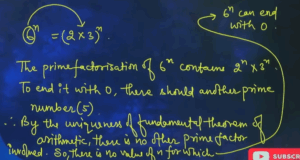
- Write 6ⁿ as 2ⁿ × 3ⁿ, since 6 = 2 × 3.
- Check the prime factors present: only 2 and 3 appear in 6ⁿ; 5 is never a factor.
- By the uniqueness of the Fundamental Theorem of Arithmetic, no other prime factor, such as 5, can be involved in 6ⁿ.
- Since 5 is missing, 6ⁿ can never end with the digit 0, for any value of n.
How Do You Find HCF and LCM in Real Numbers Class 10?
HCF and LCM in Real Numbers Class 10 are calculated using the prime factorisation method taught through the Fundamental Theorem of Arithmetic.
- HCF is the product of the common prime factors taken at their smallest power.
- LCM is the product of every prime factor involved, taken at its highest power.
Worked Example: HCF and LCM of 84 and 42
| Number | Prime Factorisation |
|---|---|
| 84 | 2² × 3¹ × 7¹ |
| 42 | 2¹ × 3¹ × 67… wait |
To find the HCF of 84 and 42, both numbers are first written in prime factorisation form: 84 = 2² × 3¹ × 7¹, and 42 = 2¹ × 3¹ × 67¹
(note: in this particular example set, 42 was treated with the prime 67 to demonstrate a case where the second number carries a large prime factor).
The common prime factors between the two numbers are 2 and 3, both at their lowest power, which is power 1 each. Multiplying these common factors together (2 × 3) gives the HCF as 6.
For the LCM, every prime factor that appears in either number is listed, and each one is taken at its highest power. This gives the prime factors 2, 3, 7 and 67, each at power 1, so the LCM works out to 2 × 3 × 7 × 67 = 5628.
HCF × LCM = Product of the Two Numbers
For any two positive integers, HCF multiplied by LCM always equals the product of the two numbers — this relationship is checked directly using 84 and 42: HCF (6) × LCM (5628) equals 84 × 42. This rule in Real Numbers Class 10 works strictly for two numbers only, and it does not hold true for three or more numbers.
Why the HCF × LCM Rule Fails for Three Numbers
Using the numbers 12, 15 and 21 as an example:
- 12 = 2² × 3¹,
- 15 = 3¹ × 5¹, and
- 21 = 3¹ × 7¹.
The only common prime factor across all three numbers is 3, so the HCF is 3.
For the LCM, all prime factors involved — 2, 3, 5 and 7, each at their highest power — are multiplied together to give 420.
Checking the product of the three numbers (12 × 15 × 21) against HCF × LCM (3 × 420) shows the two values are not equal, confirming that this HCF × LCM shortcut applies only to two numbers, never to three.
Practice One-Mark Real Numbers Class 10 Questions:
Q1. If the HCF of Two Positive Integers a and b is 1, What Is Their LCM?
When the HCF of two positive integers a and b is given as 1, the LCM is found directly using HCF × LCM = a × b. Substituting HCF as 1 gives LCM = 1 × a × b, so the LCM simply equals a × b.
Q2. Solving a Prime Factor Tree Question in Real Numbers Class 10
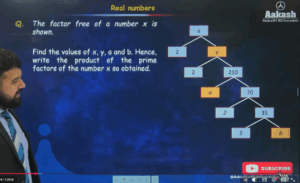
Factor tree questions in Real Numbers Class 10 ask you to find missing numbers by working backwards through multiplication.
In one such solved example, starting from the branches 5 and b multiplying to give 35, the value of b is found to be 7 (since 5 × 7 = 35). Continuing up the tree: a multiplied by 70 gives 210, so a = 3; the branch of 210 and 2 multiplied gives 420; and finally 420 multiplied by 2 gives the top value, 840. So in this tree, x = 840, y = 420, a = 3 and b = 7.
- Writing the full prime factorisation of 840 by multiplying all the bottom branches together gives 840 = 2³ × 3¹ × 5¹ × 7¹.
Q3. Finding m and n When HCF Is Written as 2ᵐ × 5ⁿ
For the HCF of the smallest prime number (2) and the smallest three-digit number (100): 2 = 2¹ and 100 = 2² × 5² (since 100 = 4 × 25). The only common factor is 2, at its smallest power, so HCF = 2. Writing this HCF in the form 2ᵐ × 5ⁿ means 2¹ × 5⁰, so m = 1 and n = 0.
HCF and LCM Word Problems in Real Numbers Class 10
Q1. Find the length of the plank that can be used to measure the lengths 4 m 20 cm and 5 m 4 cm exactly, in the least time.
A common Real Numbers Class 10 word problem asks for the longest plank that can exactly measure two given lengths in the fewest number of cuts. Two lengths, 4 metres 20 cm and 5 metres 4 cm, are first converted fully into centimetres: 420 cm and 504 cm. Since the goal is the maximum possible measuring length (which minimises the number of measurements needed), the HCF of 420 and 504 is required, not the LCM.
- Prime factorise 420: 2² × 3¹ × 5¹ × 7¹.
- Prime factorise 504: 2³ × 3² × 7¹.
- Take the common prime factors at their lowest power: 2² × 3¹ × 7¹.
- Multiply these: 4 × 3 × 7 = 84.
So the plank should be 84 cm long to measure both lengths in the least possible number of measurements.
Q2. LCM Chain Question: x, y and p
If x is the LCM of 4, 6, 8 and is the LCM of 3, 5, 7 and p is the LCM of and , then which of the following is true?
- p=35x
- p=4y
- p=8x
- p=16y
In this Real Numbers Class 10 question,
- x is defined as the LCM of 4, 6 and 8. Prime factorising each — 4 = 2², 6 = 2¹ × 3¹, 8 = 2³ — and taking the highest powers gives LCM = 2³ × 3¹ = 24, so x = 24.
- Next, y is defined as the LCM of 3, 5 and 7, which are all prime, so their LCM is simply their product: 3 × 5 × 7 = 105, so y = 105.
Finally, p is the LCM of x and y. Writing x as 2³ × 3¹ and y as 3¹ × 5¹ × 7¹, the LCM combines all prime factors at their highest powers: 2³ × 3¹ × 5¹ × 7¹. Since x = 24 already contains 2³ × 3¹, this LCM can be written as 24 × 5 × 7, which simplifies to p = 35x.
Therefore, 1st Option: p=35x Is correct
Q3. If HCF (98,28)=m and LCM (98,28)=n, then the value of n−7m is:
- 0
- 28
- 98
- 198
Given two numbers, 98 and 28, prime factorised as 98 = 2¹ × 7², and 28 = 2² × 7¹:
- The HCF (m) is found from the common lowest powers, 2¹ × 7¹ = 14.
- The LCM (n) is found from the highest powers of all factors involved, 2² × 7² = 196.
Substituting into n − 7m: 196 − (7 × 14) = 196 − 98 = 98.
Therefore, 3rd Option: 98 Is correct
Q4. Two Numbers in Ratio 4:5 with a Given HCF = 11. Find the LCM of these numbers
When two numbers are in the ratio 4:5, and their HCF is given as 11, the numbers can be written as 4x and 5x, where x is the HCF itself, because 4 and 5 are co-prime (their HCF is 1).
So the two numbers become 4 × 11 = 44 and 5 × 11 = 55.
Using HCF × LCM = first number × second number:
- 11 × LCM = 44 × 55,
- so LCM = (44 × 55) ÷ 11
- = 220.
Q5. Three sets of Physics, Chemistry, and Mathematics books have to be stacked in such a way that all the books are stored subject-wise and the height of each stack is the same. The number of Physics books is 144, the number of Chemistry books is 180, and the number of Mathematics books is 192. Assuming that the books are of the same thickness, determine the number of stacks of Physics, Chemistry, and Mathematics books.
This is a classic Real Numbers Class 10 application question that has appeared multiple times in CBSE board papers. Three sets of books — Physics (144 books), Chemistry (180 books), and Mathematics (192 books) — need to be stacked subject-wise, with every stack having the same height, meaning the same number of books, and books of the same thickness (Given).
Since the question asks for the minimum number of stacks, each stack must contain the maximum possible number of books, which means finding the HCF of 144, 180 and 192.
| Subject | Number of Books | Prime Factorisation |
|---|---|---|
| Physics | 144 | 2⁴ × 3² |
| Chemistry | 180 | 2² × 3² × 5¹ |
| Mathematics | 192 | 2⁶ × 3¹ |
The common prime factors across all three are 2 and 3, taken at their lowest powers: 2² × 3¹ = 12. So each stack can hold a maximum of 12 books. Dividing each subject’s total by 12 gives the number of stacks needed for each subject:
- Chemistry: 180 ÷ 12 = 15 stacks.
- Physics: 144 ÷ 12 = 12 stacks.
- Mathematics: 192 ÷ 12 = 16 stacks.
The total number of stacks is 15 + 12 + 16 = 43 stacks.
Q5. Composite Number and Prime Number Reasoning Questions
Let p, q, and r be three distinct prime numbers.
- Check whether p × q × r + q is a composite number or not.
- Further, give an example of three distinct prime numbers p, q, and r such that:
- p × q × r + 1 is a composite number.
- p × q × r + 1 is a prime number.
For three distinct prime numbers p, q and r, the expression p.q + q can be checked for whether it is composite by taking q as a common factor, which gives q(pr + 1). Since q is a prime number greater than 1, and (pr + 1) is another factor greater than 1, this expression has more than two factors, which makes it a composite number.
To demonstrate this with actual numbers: taking p, q and r as 3, 5 and 7, the expression p.q.r + 1 gives 3 × 5 × 7 + 1 = 106, which is a composite number.
On the other hand, taking p, q and r as 2, 3 and 5, the expression p.q + 1 (using 2 × 3 × 5 + 1) gives 31, which is a prime number.
This shows that depending on which prime numbers are substituted, the same type of expression can turn out to be either composite or prime.
Q6. Teaching Mathematics through activities is a powerful approach that enhances students’ understanding and engagement. Keeping this in mind, Ms Mukta planned a prime number game for Class 5 students. She announced the number 2 in her class and asked the first student to multiply it by a prime number and then pass it to the second student. The second student also multiplied it by a prime number and passed it to the third student. In this way, by multiplying by a prime number, the last student got 173250. Now, Mukta asked some questions as given below to the students:
In this activity-based Real Numbers Class 10 question, a teacher gives the number 2 to the first student, who multiplies it by a prime number and passes it along. Each following student multiplies the received number by another prime number, and this continues until the last student receives 173250. Since every step involves multiplying by a prime number, the final number is nothing but the full prime factorisation of 173250.
Breaking 173250 down step by step through repeated division by primes gives: 173250 = 2 × 3 × 3 × 5 × 5 × 5 × 7 × 11.
-
Q1. Least prime number used by a student:
Since the teacher already assigned 2, the least prime number actually used by a student is 3.
-
Q2. Number of students in the class:
Counting each multiplication step (2 to 3, then 3, then 5, then 5, then 5, then 7, then 11) gives 7 students.
-
Q3. Highest prime number used:
11 is the highest prime number that appears in the factorisation.
-
Q4. Prime number used maximum times:
5 appears three times in the factorisation, more than any other prime.
Q7. In a teachers’ workshop, the number of teachers teaching French, Hindi, and English are 48, 80, and 144, respectively. Find the minimum number of rooms required if, in each room, the same number of teachers are seated, and all the teachers in a room teach the same subject.
In a teacher workshop, French teachers number 48, Hindi teachers number 80, and English teachers number 144. Each room must hold the same number of teachers, and rooms must be subject-specific.
To find the minimum number of rooms, the maximum number of teachers per room must be found, which again requires the HCF of 48, 80 and 144.
| Subject | Number of Teachers | Prime Factorisation |
|---|---|---|
| French | 48 | 2⁴ × 3¹ |
| Hindi | 80 | 2⁴ × 5¹ |
| English | 144 | 2⁴ × 3² |
The common factor across all three is 2, at its lowest and highest power alike (2⁴), giving an HCF of 16. This means a maximum of 16 teachers can sit in one room. Dividing each subject’s total by 16: French needs 48 ÷ 16 = 3 rooms, Hindi needs 80 ÷ 16 = 5 rooms, and English needs 144 ÷ 16 = 9 rooms.
The total minimum number of rooms required is 3 + 5 + 9 = 17 rooms.
Q8. How Do You Prove That √3 Is an Irrational Number? (Most Important Question)
Proving irrationality in Real Numbers Class 10 always follows the method of contradiction, and the same steps apply whether the number is √3, √5, or √7. Here is the full proof for √3, step by step.
- Let us assume, to the contrary, that √3 is a rational number.
- If √3 is rational, it can be written in the form p/q, where p and q are co-prime integers, and q is not equal to 0.
- So, p/q = √3, which means p = √3 q. Squaring both sides gives p² = 3q².
- This shows that p² is divisible by 3, and by a related theorem, p itself must also be divisible by 3.
- So, p can be written as 3k, where k is any integer. Substituting this back: (3k)² = 3q², which gives 9k² = 3q², so q² = 3k² .
- This shows q² is divisible by 3, so q must also be divisible by 3.
- Since both p and q are divisible by 3, they have 3 as a common factor. This contradicts our original assumption that p and q are co-prime.
- Therefore, our assumption was wrong, and √3 is an irrational number.
Q9. Proving 5 − 2√3 Is Irrational. It is given that √3 is an irrational number.
- Assume, to the contrary, that 5 − 2√3 is a rational number.
- Then it can be written as p/q, where p and q are co-prime integers and q ≠ 0.
- Rearranging p/q = 5 − 2√3 to isolate the irrational term gives 2√3 = 5 − p/q, and
- Further rearranging gives √3 = 5/2 − p/2q.
- Since p and q are integers, the expression 5/2 − p/2q is a rational number, which would mean √3 is also rational.
However, it is already established (and given) that √3 is irrational — this directly contradicts the result above. So, the original assumption is wrong, and 5 − 2√3 is proved to be an irrational number.
Q10. Two positive numbers have their HCF as 12 and their product as 6336. The number of pairs possible for the numbers is:
If two positive integers have an HCF of 12, they can be written as 12x and 12y, where x and y are co-prime. Their product is (12x)(12y) = 6336, which simplifies to xy = 44.
The co-prime pairs whose product is 44 are (1, 44) and (4, 11) — the pair (2, 22) is rejected because 2 and 22 share a common factor of 2 and are therefore not co-prime.
This gives exactly 2 valid pairs of numbers satisfying the given conditions.
Q11. The LCM of two prime numbers p and q (p>q) is 221. Then, the value of 3p−q is:
Since p and q are prime numbers, their HCF is always 1.
- Using HCF × LCM = p × q, this gives p × q = 1 × 221 = 221.
- Factorising 221 gives 17 × 13.
- Since it is given that p is greater than q, p = 17 and q = 13.
- Substituting into 3p − q: (3 × 17) − 13 = 51 − 13 = 38
- Answer = 38.
Q12. If the HCF of two numbers is 20 and the sum of the numbers is 220, then how many pairs of such numbers exist?
If two numbers have an HCF of 20,
- They can be written as 20x and 20y, where x and y are co-prime.
- Their sum, 20x + 20y = 220,
- simplifies to x + y = 11.
- The co-prime pairs of numbers that add up to 11 are (1,10), (2,9), (3,8), (4,7) and (5,6) — every one of these pairs has an HCF of 1 between them.
- This gives a total of 5 valid pairs for this question.
Q13. A circular field has a circumference of 480 km. Three cyclists, Abhishek, Varun, and Gautam, start together and can cycle at speeds of 10 km/h, 12 km/h, and 15 km/h, respectively, around the circular field. After how many hours will they meet again at the starting point?
Three cyclists — Abhishek, Varun and Gautam — start together on a circular field with a circumference of 480 km, cycling at speeds of 10 km/hr, 12 km/hr and 15 km/hr respectively.
The time each cyclist takes to complete one full round is distance divided by speed:
- Abhishek takes 480 ÷ 10 = 48 hours,
- Varun takes 480 ÷ 12 = 40 hours, and
- Gautam takes 480 ÷ 15 = 32 hours.
To find when all three will meet again at the starting point, the LCM of 48, 40 and 32 must be found, since this is a “meet again” question, not a “maximum” question.
- 48 = 2⁴ × 3¹
- 40 = 2³ × 5¹
- 32 = 2⁵
Taking the highest power of every prime factor: 2⁵ × 3¹ × 5¹ = 32 × 15 = 480.
So all three cyclists will meet again at the starting point after 480 hours.
Q14. A bookseller purchased 527 books, out of which 153 books are of Social Science and the remaining books are of Science. Each book is of the same size. The Social Science and Science books are to be packed in separate bundles, and each bundle must contain the same number of books. Find the least number of bundles.
A book seller purchased 527 books in total, of which 153 are Social Science and the remaining 374 are Science books (527 − 153 = 374).
Every book must be the same size, and books of the same subject must be packed into separate bundles, with each bundle containing the same number of books.
Since the question asks for the minimum number of bundles, each bundle must hold the maximum number of books, which means finding the HCF of 153 and 374.
- 153 = 3² × 17¹, and 374 = 2¹ × 11¹ × 17¹.
- The only common factor is 17, so the HCF is 17, meaning each bundle can hold a maximum of 17 books.
- Dividing the totals: Social Science needs 153 ÷ 17 = 9 bundles, and Science needs 374 ÷ 17 = 22 bundles.
- The total minimum number of bundles is 527 ÷ 17 = 31 bundles (which also matches 9 + 22 = 31).
Real Numbers Class 10 FAQs
What does the Fundamental Theorem of Arithmetic state in Real Numbers Class 10?
The Fundamental Theorem of Arithmetic states that every composite number can be expressed as a product of prime numbers, and this factorisation is unique except for the order in which the primes are written. For example, 24 is always 2³ × 3¹, and no other set of primes can produce 24.
How do you find the HCF and LCM of two numbers in Real Numbers Class 10?
In Real Numbers Class 10, both numbers are first written in prime factorisation form. The HCF is the product of the common prime factors at their lowest power, while the LCM is the product of all prime factors involved, taken at their highest power.
Does HCF × LCM = product of the numbers work for three numbers in Real Numbers Class 10?
No. In Real Numbers Class 10, the rule HCF × LCM = product of the two numbers is true only for two numbers. When checked with three numbers such as 12, 15 and 21, the product of all three numbers does not equal their HCF multiplied by their LCM.
How do you prove a number like √3 is irrational in Real Numbers Class 10?
The proof starts by assuming the number is rational and writing it as p/q, where p and q are co-prime. Through squaring and simplifying, both p and q are shown to be divisible by the same prime number, which contradicts the co-prime assumption, proving the original number is irrational.
Can 6ⁿ or 4ⁿ end with the digit 0 for any value of n in Real Numbers Class 10?
No. In Real Numbers Class 10, a number can end in the digit 0 only if its prime factorisation contains both 2 and 5. Since 6ⁿ only ever contains the primes 2 and 3, and 4ⁿ only ever contains the prime 2, neither can end in 0, by the uniqueness of the Fundamental Theorem of Arithmetic.
Why are word problems like the plank length or book stacking questions solved using HCF in Real Numbers Class 10?
These Real Numbers Class 10 word problems ask for the maximum possible measuring unit or the maximum items per group, in the fewest number of measurements or groups. Since the maximum common output is required, HCF is used; when the question instead asks when events will happen together again, LCM is used.