
Life Processes Class 10: Complete Nutrition and Respiration Notes
Life processes class 10 refers to the basic functions living organisms perform to stay alive — mainly nutrition and respiration in this chapter. Nutrition covers autotrophic nutrition (photosynthesis), heterotrophic nutrition (saprophytic, parasitic, symbiotic, holozoic), and the human digestive system. Respiration covers breathing vs respiration, aerobic and anaerobic pathways, and the human respiratory system.
What Are Life Processes in Class 10 Biology?
Life processes class 10 are defined as “the basic functions performed by living organisms to keep themselves alive on Earth”.
Every organism, whether single-celled or multicellular, constantly carries out these life processes without stopping, even while resting or sleeping. A closely linked idea in life processes class 10 is metabolism, which means all the chemical reactions happening inside a living organism.
When someone says their metabolism has slowed down, it means fewer chemical reactions are occurring inside their body, which can lead to weight gain; a faster metabolism, such as during exercise, means more reactions are happening and leads to weight loss.
Understanding life processes class 10 begins with these two foundational terms — life processes and metabolism — before moving into the five specific processes studied in NCERT biology.
What Are the 5 Life Processes Studied in Class 10?
Life processes class 10 uses a simple NCERT-based mnemonic trick to remember all five life processes covered across two chapters of the syllabus.
| Letter | Life Process | What It Means |
|---|---|---|
| N | Nutrition | Taking in food and using it inside the body |
| C | Control and Coordination | Covered as a separate chapter in the syllabus |
| E | Excretion | Removing nitrogenous waste from the body |
| R | Respiration | Making energy from the food eaten and the air breathed |
| T | Transportation | Moving substances like oxygen to every single cell |
This life processes class 10 article focuses on Nutrition and Respiration, since Transportation and Excretion are covered separately as Part 2 of the chapter.
What Is Nutrition and What Are Its Two Modes in Life Processes Class 10?
In life processes class 10, nutrition is defined as the intake and utilisation of food — it is not just about eating, but about the body actually putting that food to use.
Protein’s job is to build muscles, fat’s job is to store energy, and carbohydrates give energy; when all these nutrients are taken in and used, that combination is called nutrition.
There are two modes of nutrition studied in Life Processes Class 10: autotrophic nutrition, where organisms make their own food, and heterotrophic nutrition, where organisms depend on other organisms for food.
How Does Photosynthesis Work in Life Processes Class 10?
Photosynthesis is the process by which green plants make their own food using inorganic substances, sunlight, and chlorophyll — this is the core autotrophic nutrition topic in Life Processes Class 10.
In this process, carbon dioxide is taken from the air and water is taken from the soil; with the help of chlorophyll (naturally present in the plant) and sunlight, glucose is produced, and oxygen is released into the atmosphere along with some water.
Equation of Photosynthesis

Light Energy→
C6H12O6 + 6O2+6H2O
Mechanism of photosynthesis: Life Processes Class 10
The mechanism of photosynthesis, an important part of the Life Processes class 10, happens in three clear steps:
- Light energy is absorbed by chlorophyll present in the plant cells.
- This light energy is converted into chemical energy, and at the same time water molecules split into hydrogen and oxygen.
- The hydrogen produced reduces carbon dioxide to form carbohydrates (glucose), while the leftover oxygen is released into the atmosphere.
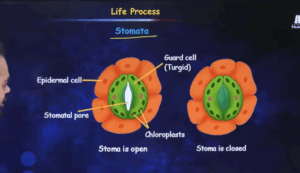
Gas exchange during photosynthesis happens through stomata, tiny pores present on the leaf surface, surrounded by guard cells. When water moves from the surrounding epidermal cells into the guard cells, the guard cells become turgid (swollen), and the stomatal pore opens, letting oxygen and water vapour escape.
When water moves out of the guard cells, they become flaccid, and the pore closes. A leaf’s internal structure, also part of life processes class 10, is layered as follows: the cuticle (a thin transparent layer that locks in moisture and protects the leaf), the upper epidermis (protective outer layer), the palisade parenchyma (closely packed living cells containing chloroplast), the spongy parenchyma (cells with gaps between them, like a sponge), and finally the lower epidermis, where the stoma is located.
Life Processes Class 10: photosynthesis in desert plants
A special case discussed in Life Processes Class 10 is photosynthesis in desert plants. Since desert conditions are hot with very little water, these plants keep their stomatal pores closed during the daytime to avoid losing water through evaporation. At night, the stomatal pores open, allowing carbon dioxide to enter and be stored as malic acid, since there is no sunlight at night to cause water loss. During the day, this stored malic acid converts back into carbon dioxide with the help of sunlight, allowing normal photosynthesis and glucose formation to continue without needing to open the stomatal pores in daylight.
What Are the 4 Types of Heterotrophic Nutrition in Life Processes Class 10?
Heterotrophic nutrition, the second major mode discussed in life processes class 10, is divided into four types based on how organisms obtain food from others.
- Saprophytic nutrition — organisms such as bread mould, yeast, and mushrooms (all fungi) feed on rotten or decayed food. They secrete digestive chemicals onto the spoiled food, breaking it into tiny particles, which are then absorbed rather than eaten and digested internally.
- Parasitic nutrition — organisms that live on or inside another organism (the host) and take nutrients from it. Examples include intestinal worms that take nutrients from blood, leeches and ticks, and the plant Cuscuta (called Amarbel in Hindi), a rope-like yellowish plant that hangs on host trees and absorbs nutrients from them.
- Symbiotic nutrition — seen in lichen, which is actually two organisms living together for mutual benefit: algae, which perform photosynthesis to make food, and fungus, which provides protection and nutrients in return.
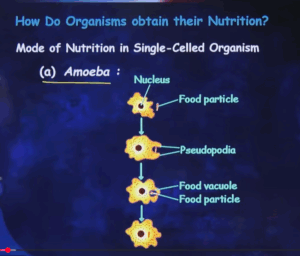
Diagram of Amoeba Life process class 10
- Holozoic nutrition — organisms take whole food into the body and break it down inside. Humans, amoeba, and paramecium follow this mode. An amoeba uses two arm-like projections called pseudopodia (meaning “false feet”) to pull a food particle into its body. A paramecium has an oral groove for taking in food and an anal groove for waste removal, with a food vacuole that moves around the body digesting food along the way.
Life processes class 10 also outlines five steps that make up holozoic nutrition: ingestion (taking in food), digestion (breaking down food), absorption (small intestine absorbing nutrients), assimilation (nutrients reaching cells and being put to use), and egestion (removal of undigested food from the body).
How Does the Human Digestive System Work in Life Processes Class 10?
The human digestive system, a major practical section of Life Processes Class 10, begins in the mouth and ends at the anus, with each organ performing a specific digestive function.
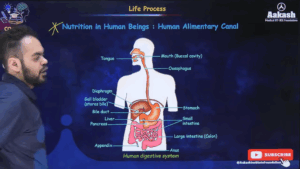
| Organ | Secretion | Enzyme / Component | Function |
|---|---|---|---|
| Mouth (teeth and tongue) | Saliva | Salivary amylase (also called ptyalin) |
|
| Oesophagus | — | Peristaltic movement |
|
| Stomach | Gastric juice from gastric glands | Pepsin, hydrochloric acid (HCl), mucus |
|
| Small intestine (liver) | Bile juice | — |
|
| Small intestine (pancreas) | Pancreatic juice | Pancreatic amylase, trypsin, lipase |
|
| Small intestine (intestinal glands) | Intestinal juice | — |
|
| Large intestine | — | — |
|
| Rectum and anus | — | — |
|
Life processes class 10 also notes that the small intestine is the longest part of the digestive tract, and its length differs across animals depending on their diet — herbivores like cows have a longer small intestine, while carnivores like tigers have a shorter one.
Life processes class 10 difference between pepsin and trypsin: protein does not break down in one step; pepsin partially breaks the large protein down, and trypsin later breaks it down further into smaller usable pieces.
What Is the Difference Between Breathing and Respiration in Life Processes Class 10?
A very common doubt in life processes class 10 is assuming breathing and respiration are the same thing — they are not. Respiration is defined as a process that provides energy required for every activity of the organism, occurring in all living beings through enzyme-controlled breakdown of organic substances; breathing is only a part of respiration, not the whole of it.
| Aspect | Respiration | Breathing |
|---|---|---|
| Type of process | Complex biochemical process | Physical process |
| What happens | Transport of gases and oxidation of food material | Only exchange of gases (oxygen in, carbon dioxide out) |
| Enzymes required | Several enzymes are required | No enzymes are required |
| Energy | Energy is released and also utilised | Energy is only utilised to move certain muscles |
| Scope | Connected to the whole body; every cell respires | Only certain organs of the respiratory system take part |
| Location | Both extracellular and intracellular | Extracellular phenomenon |
In Life Processes class 10, ATP (adenosine triphosphate) is described as the “energy currency” of the body — just as money or a UPI payment represents value being transferred, ATP represents energy being stored and delivered to wherever it is needed in the body, such as the lungs. Life processes class 10 also connects photosynthesis and respiration in a cycle: photosynthesis happens in the chloroplast, producing organic molecules and releasing oxygen; these organic molecules are eaten and travel to the mitochondria (the “powerhouse” of the cell), where respiration takes place, releasing carbon dioxide and water that are reused for photosynthesis — this is why both plants and humans depend on each other to survive.
How Does Glucose Break Down in Respiration — Aerobic vs Anaerobic (Life Processes Class 10)?
One of the most exam-important tables in Life Processes Class 10 explains how glucose, a six-carbon molecule, breaks down through different pathways depending on oxygen availability.
| Step / Pathway | Where It Happens | Oxygen Level | Products | Energy (ATP) |
|---|---|---|---|---|
| Step 1: Glycolysis | Cytoplasm (occurs even without mitochondria, e.g., in bacteria) | Not required for this step | Glucose (6-carbon) breaks into pyruvate (3-carbon) | A small amount of energy |
| Aerobic respiration | Mitochondria | Oxygen present | Complete oxidation; pyruvate converts into carbon dioxide and water | 38 ATP released |
| Anaerobic respiration (muscle cells) | Cytoplasm | Oxygen low | Pyruvate converts into lactic acid (3-carbon) | 2 ATP released |
| Anaerobic respiration (yeast) | Cytoplasm | Oxygen absent | Pyruvate converts into ethanol (2-carbon) and carbon dioxide | 2 ATP released |
Life processes class 10 explains that when a person runs very fast for a long time, the muscles don’t get enough oxygen quickly enough, so the body produces lactic acid instead, which causes the painful cramps felt in the legs during intense running; resting or getting a massage helps break the lactic acid down again. Life processes class 10 further distinguishes aerobic respiration (occurs in the presence of oxygen, complete oxidation of food, releases more energy — 38 ATP, end products are carbon dioxide and water) from anaerobic respiration (occurs without oxygen, incomplete oxidation, releases far less energy — only 2 ATP, end products are lactic acid or ethyl alcohol depending on the organism).
How Do Plants Carry Out Respiration in Life Processes Class 10?
Life processes class 10 explains that plants also need to respire because, like all living organisms, they require energy — photosynthesis only makes food, while respiration breaks that food down to release usable energy. Gas exchange in plants occurs through the stomata present on leaves, and also through root hairs and lenticels. Root hairs are unicellular extensions arising from the epidermal cells of roots; through these, oxygen goes in, and carbon dioxide comes out so that roots can respire.
Lenticels are small pores present in the bark of old stems, where the outer covering has hardened into dead sclerenchyma cells (cork cambium); gas exchange still happens through the living parenchymatous cells located between these dead cells, allowing older, hard-barked stems to continue respiring.
How Does Respiration Happen in Fish (Life Processes Class 10)?
Life processes class 10 describes fish respiration as taking place through gills. Fish take in water through the mouth, and since oxygen is dissolved in this water, the body uses that dissolved oxygen; the used water, now carrying carbon dioxide, is released through flaps on the sides of the fish’s body. This process of the mouth opening and closing followed by the flaps opening allows continuous gas exchange in fish.
Life processes class 10 also highlights an important exam fact: the rate of breathing in aquatic animals is much faster than in terrestrial animals, because the amount of oxygen dissolved in water is far lower than the amount of oxygen present in air, forcing aquatic animals to breathe more quickly to get enough oxygen.
What Is the Human Respiratory System in Life Processes Class 10?
The human respiratory system, a detailed structural topic in Life Processes Class 10, consists of the following parts in sequence:
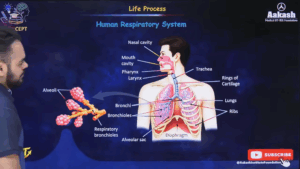
- Nostrils (external nares) — paired oval openings at the lower end of the nose used for inhaling air.
- Nasal chamber — a pair of chambers enclosed in the nasal cavity, present above the palate and separated from each other by the nasal septum; the palate separates the nasal cavity from the mouth.
- Pharynx — the common passage used both for the air we inhale and the food we eat.
- Larynx — the sound-producing organ, also called the voice box; food does not pass through the larynx. It contains vocal cords — shorter and thinner in women and children, producing a high-pitched voice, and longer and thicker in men, producing a low-pitched voice; the visible bulge that develops in males during the teenage years, known as the Adam’s apple, is the larynx developing due to the hormone testosterone.
- Trachea (windpipe) — supported by C-shaped incomplete rings of cartilage, which prevent the windpipe from collapsing when air is drawn through it, similar to how a pipe would get compressed if not supported.
- Bronchi and bronchioles — the trachea bifurcates into a pair of primary bronchi entering the left and right lungs; these branch further into secondary bronchi, then tertiary bronchi, and finally end in bronchioles.
- Ribs, intercostal muscles, and diaphragm — humans have 12 pairs of ribs forming a protective rib cage around the lungs and heart; intercostal muscles (connected to the ribs) and the diaphragm (a dome-shaped muscle) work together to help with breathing.
- Lungs and pleural membranes — each lung is enclosed in two pleural membranes that provide protection.
- Alveoli — balloon-like structures at the end of the bronchioles, surrounded by blood vessels; this is where the actual exchange of gases happens — oxygen goes into the blood and carbon dioxide comes out of it.
Life processes class 10 also lists the characteristics a respiratory surface must have: it must be thin (to allow diffusion), permeable to respiratory gases (so oxygen and carbon dioxide can pass through), moist (with water or mucus, since a dry surface prevents proper gas exchange), highly vascular (surrounded by blood vessels so gases can be transported), and in direct or indirect contact with the source of oxygen. In humans this surface is the alveoli, in fish it is the gills, and in earthworms it is the skin.
How Does the Mechanism of Breathing Work in Life Processes Class 10?
Life processes class 10 explains the mechanism of breathing using a simple pressure-volume relationship: Pressure equals Force divided by Area.
- Inhalation: The chest (thoracic) cavity expands as the ribs move outward and the diaphragm bends downward into a flatter shape. This increases the chest cavity’s area, which lowers the internal pressure. Since the pressure outside is now higher than inside, air rushes in from the atmosphere into the lungs.
- Exhalation: The ribs move inward and the diaphragm returns to its dome shape, decreasing the chest cavity’s volume and area. This raises the internal pressure above the outside pressure, pushing air back out of the lungs.
Life processes class 10 confirms that intercostal muscles and the diaphragm work together throughout this process, expanding the chest cavity during inhalation and contracting it during exhalation, allowing continuous, rhythmic breathing.
Life processes class 10 ultimately ties nutrition and respiration together as two connected systems — nutrition brings fuel into the body in the form of food, and respiration converts that fuel into usable energy through carefully controlled biochemical steps. A strong grip over life processes class 10 nutrition and respiration builds the foundation needed for the remaining parts of the biology syllabus, including transportation and excretion.
Frequently Asked Questions on Life Processes Class 10
What are life processes in class 10 biology?
Life processes class 10 refers to the basic functions performed by living organisms to keep themselves alive on Earth. Five such life processes are studied — Nutrition, Control and Coordination, Excretion, Respiration, and Transportation — with this portion of life processes class 10 focusing specifically on nutrition and respiration.
What is metabolism in life processes class 10?
Metabolism refers to all the chemical reactions happening inside a living organism. A slower metabolism means fewer chemical reactions occurring in the body, often linked to weight gain, while a faster metabolism, such as during exercise, means more reactions are happening, often linked to weight loss.
What are the four types of heterotrophic nutrition?
The four types covered in life processes class 10 are saprophytic (feeding on decayed matter, e.g., bread mould), parasitic (feeding on a host organism, e.g., leech, Cuscuta), symbiotic (mutual benefit between two organisms, e.g., lichen made of algae and fungus), and holozoic (whole food taken in and digested internally, e.g., amoeba, humans).
What is the difference between breathing and respiration?
Breathing is a physical process involving only the exchange of gases, requiring no enzymes, and involving specific respiratory organs. Respiration is a biochemical process that uses enzymes to oxidise food and release energy, occurring in every single cell of the body, making it far more complex than breathing alone.
Why do muscles cramp during intense running?
When the body cannot supply enough oxygen quickly during fast running, glucose breaks down into lactic acid instead of completing full oxidation in the mitochondria. This lactic acid build-up causes the painful cramps felt in muscles, and resting or getting a massage allows the lactic acid to break down again.
Why do desert plants keep their stomata closed during the day?
Desert plants keep their stomatal pores closed during the day to prevent water loss in the hot, dry conditions of a desert. At night, the pores open to take in carbon dioxide, which is stored as malic acid, and this malic acid converts back into carbon dioxide during the day using sunlight for photosynthesis.
Why do aquatic animals breathe faster than terrestrial animals?
Aquatic animals breathe faster because the amount of oxygen dissolved in water is much lower than the amount of oxygen present in air. To obtain sufficient oxygen for their cells, aquatic animals such as fish must breathe more frequently compared to terrestrial animals.