
Class 9 Science Chapter 1 Exploration: How to Study Physics, Chemistry and Biology the Right Way
Class 9 Science Chapter 1 Exploration, “Entering the World of Secondary Science,” does not teach fixed facts to memorise. It teaches how curiosity, creativity, collaboration and careful questions shape science, and how observation, models, patterns and predictions help Class 9 students study Physics, Chemistry and Biology the right way from day one.
What Is Class 9 Science Chapter 1 Exploration About?
Class 9 Science Chapter 1 Exploration is not built around direct exam questions. Instead, it gives students a “disha,” or direction, on how to approach their Class 9 syllabus. Rather than jumping straight into definitions, the chapter explains how to switch your thinking as you move from Class 8 to Class 9, where Physics, Chemistry and Biology are studied as separate, focused subjects for the first time.
What Chapters Will You Study in Class 9?
Before understanding how to study, it helps to know what Class 9 Science Chapter 1 Exploration leads into. Here is the subject-wise chapter list, divided by term.
| Subject | Chapters |
|---|---|
| Biology | Cell – Building Blocks of Life; Tissues in Action |
| Biology | Reproduction – How Life Continues; Patterns in Life, Diversity and Classification; Chapter 13 (shared with Physics) |
| Physics | Describing Motion Around Us; How Forces Affect Motion; Work, Energy and Simple Machines; Sound Waves: Characteristics and Applications |
| Chemistry | Exploring Mixtures; Journey Inside the Atom; Atomic Foundations of Matter |
How Do Curiosity, Creativity, Collaboration and Careful Questions Shape Science?
Many students believe science only deals with facts, equations and experiments. Class 9 Science Chapter 1 Exploration corrects this by showing science as a human activity shaped by four things.
- Curiosity is the desire to ask why something happens the way it does.
- Creativity means finding new ideas or approaches to solve a scientific problem.
- Collaboration means scientists rarely work alone; they discuss, share results, and build on each other’s work, much like group study.
- Careful, thoughtful questions are what make science evolve and expand further.
How Is Secondary Stage Science Different From Middle Stage Science?
Up to Class 8, science dealt with curiosity, observation, experiments and everyday phenomena, such as electricity making things glow, temperature rising and falling, or magnets attracting objects. Class 9 Science Chapter 1 Exploration shifts the focus to deep exploration, built on four steps.
- Observation leads to careful measurement, which gives reliable results.
- Patterns are written using symbols and equations, such as Distance = Speed × Time, or the chemical equation H2 + O2 giving 2H2O.
- Models explain complex systems by simplifying them, such as reducing a body under multiple forces to a single point.
- Scientific ideas are tested through questions, revised through experiments, and rejected only with evidence.
How Does Science Help Us Understand Nature and Technology?
Science helps us understand natural phenomena such as rain, earthquakes and tsunamis, which can now be predicted, unlike in the past when science had not evolved enough.
It has also helped build technology like mobile phones, computers, satellites and the internet.
Finally, science helps us understand our place in the world, including how to conserve nature and support sustainable development.
Does Food Really Become Harmful During an Eclipse?
Class 9 Science Chapter 1 Exploration uses a common household claim to show scientific thinking in action: that food becomes harmful during an eclipse. A scientific approach asks what actually changes during an eclipse, whether temperature changes greatly, or whether food spoils in shadows.
An eclipse is simply a play of shadows — when the Moon comes between the Earth and Sun, it is a solar eclipse; when the Earth comes between the Moon and Sun, it is a lunar eclipse. Since no physical, chemical or biological change occurs in food during this shadow play, the claim is rejected with the help of science.
How Does a Physicist Think?
Physics is described as the science of understanding how and why things happen in nature, from a falling leaf to a launching rocket. A physical change refers to changes in an object’s physical properties, such as its shape or size.
Physics shows up everywhere: riding a bicycle involves motion and force, switching on a bulb involves electricity, a rainbow deals with light, playing cricket involves motion and energy, and cooking involves heat.
A physicist never accepts things blindly. If a ball falls, a physicist asks why it fell, why it didn’t fall upward, whether the Earth is pulling it, and whether it would still fall on the Moon.
For Example:
- When building a model, only important details are kept. For a cricketer hitting a six, the ball’s mass, velocity and direction matter, while the bat brand, T-shirt colours and air resistance can be ignored for simple calculations.
- A real airplane fuel incident shows why this matters: fuel density was measured in pounds per litre instead of kilograms per litre, so a plane that needed 22,300 kg of fuel was filled with only 15,000 litres. The plane landed safely at a nearby airport, but the incident is a reminder that calculations play an important role in everyday life.
How Does a Chemistry Student Think Differently?
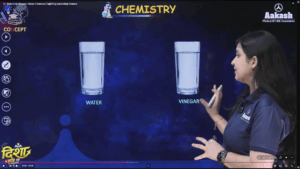
Chemistry does not believe in appearances. Given two glasses, one with water and one with vinegar, you cannot tell them apart just by looking. Adding baking soda reveals the difference: water shows no reaction, while vinegar produces brisk effervescence as carbon dioxide gas is released, since vinegar is an acid. This is how a chemistry student is expected to think, rather than simply tasting the liquids.
Chemistry asks what everything is made up of. Matter is anything around us that occupies space and has mass.
Like Google Maps that shows only the basic route without every tree or shop along the way, chemistry uses simplified models rather than exact pictures, because atoms are far too small to see directly.
A chemistry student looking at burnt paper asks whether heat or smoke was produced, whether a new substance was formed, and whether the paper can be recovered. Because of past experiments and study, chemistry can also predict outcomes, such as knowing in advance that vinegar and baking soda will react before even testing it.
What Are the Four Steps to Study Biology Easily?
Biology connects ideas across the entire world of living things, from microscopic cells to large plants, animals and humans. Four steps make Biology easier to study.
- Make smart models and diagrams: diagrams do not need to be artistically perfect, only neat and properly labelled. A simple pencil-drawn circle can represent a cell, with the outer boundary labelled as the cell membrane.
- Estimation skill: this is the power to find an approximate value rather than an exact one. For example, estimating litres of air breathed in a day starts with counting breaths per minute — about 12 to 15 at rest, measured using a 1-minute timer. Since there are 1,440 minutes in a day, this works out to roughly 20,000 breaths per day. The volume of one breath is estimated using a rubber party balloon, since it takes about 4 to 5 breaths to fill a 2 to 3 litre balloon, giving roughly half a litre per breath. Multiplying the two values gives an estimate of about 10,000 litres of air breathed per day, similar to about 10 home water tanks.
- Connect to real life: Biology, like all of science, should connect to yourself, animals, plants and microorganisms. The COVID-19 pandemic and surgical masks are one example, involving Physics (particle motion and electrostatic attraction), Chemistry (polymer fibre properties) and Biology (virus size and behaviour, including that it cannot survive outside the body for long or replicate without a host), along with Mathematics for modelling airflow and filtration.
- Myth buster: a myth is something that trends widely but is completely false, and science works to bust such myths using evidence.
What Is the Difference Between Law, Theory, Principle and Prediction?
Four terms appear again and again across Physics, Chemistry and Biology, and Class 9 Science Chapter 1 Exploration explains each with simple, everyday examples.
| Term | Meaning | Example from the Chapter |
|---|---|---|
| Law | A basic, standard fact that is always followed |
|
| Theory | Explains in more detail how something happens |
|
| Principle | A wider concept covering related situations | Understanding where else in the body carbohydrate digestion continues after the mouth |
| Prediction | Anticipating an outcome using existing scientific knowledge, without experimenting | Predicting that eating rice will start carbohydrate digestion in the mouth |
Class 9 Science Chapter 1 Exploration sets the tone for the rest of the syllabus, which is exactly why the book is named “Exploration.” Instead of memorising isolated facts, students are encouraged to stay curious, question everything, and connect Physics, Chemistry and Biology to real life — a habit that pays off not just in CBSE exams but later in NEET and JEE preparation as well.
Frequently Asked Questions
What is Class 9 Science Chapter 1 Exploration about?
Class 9 Science Chapter 1 Exploration is an introductory chapter that does not carry direct exam questions. It teaches students how to approach Physics, Chemistry and Biology using curiosity, models, estimation and careful questioning, setting the direction for the rest of Class 9 Science.
How does a physicist think differently from others?
A physicist never accepts things blindly. Instead of just seeing that a ball fell, a physicist asks why it fell downward and not upward, and whether the Earth is pulling it. This questioning approach is central to Class 9 Science Chapter 1 Exploration.
Why doesn’t chemistry believe in appearances?
Chemistry asks what something is made of rather than judging by looks. For example, water and vinegar look identical, but adding baking soda shows a clear difference — vinegar releases carbon dioxide gas while water shows no reaction.
Does food really become harmful during an eclipse?
No. Class 9 Science Chapter 1 Exploration explains that an eclipse is only a play of shadows caused by the Moon or Earth blocking sunlight, and no physical, chemical or biological change occurs in food during this event.
What is estimation skill in Class 9 Science Chapter 1 Exploration?
Estimation skill is the ability to find an approximate value instead of an exact one. The chapter demonstrates this by estimating that a person breathes roughly 10,000 litres of air in a day, using breaths per minute and volume per breath.
What is the difference between a law and a theory in science?
A law is a basic, consistently followed fact, such as saliva digesting carbohydrates in the mouth. A theory explains this in more detail, such as the Cell Theory, which states that all living things are made of cells and every cell comes from a previous cell.