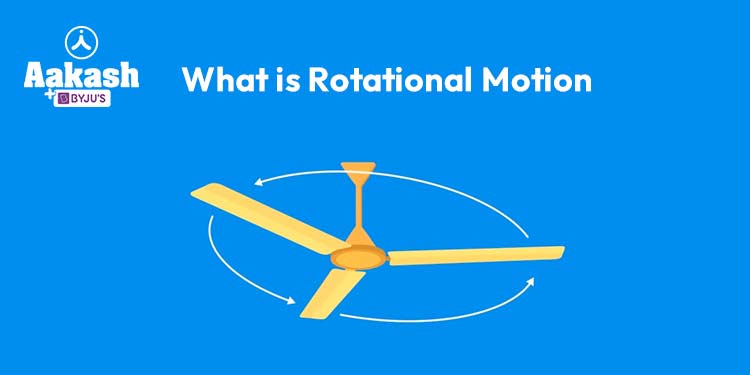

Motion is a captivating phenomenon that surrounds us, from the graceful flight of birds to the spinning wheels of a car. Among the diverse types of motion, rotational motion stands out for its elegance and importance in various aspects of life, technology, and nature. In this blog, we will embark on a journey to explore the captivating world of rotational motion, understanding its fundamental principles, equations, and real-world applications that make it a fascinating realm of study.
Defining Rotational Motion
Rotational motion, also known as circular motion, is a type of motion where an object rotates or spins around a fixed point or axis. Unlike linear motion, where an object moves in a straight line, rotational motion involves movement along a circular path. This motion is common in numerous natural phenomena and artificial devices, ranging from celestial bodies in the cosmos to the wheels of vehicles.
Characteristics of Rotational Motion
Axis of Rotation:
In rotational motion, there is an axis or a fixed point around which the object spins. This axis can be internal or external to the object, depending on the context.
Angular Displacement:
The angle through which the object rotates is known as angular displacement. It measures the change in orientation of the object over time.
Angular Velocity:
Angular velocity describes the rate of change of angular displacement with respect to time. It is the speed at which the object rotates and is measured in radians per second (rad/s).
Angular Acceleration:
Angular acceleration represents the rate of change of angular velocity with respect to time. It determines how quickly or slowly the object’s rotational speed changes.
Equations of Rotational Motion
Angular Displacement (θ):
Angular displacement is given by the equation θ = θf – θi, where θf is the final angle and θi is the initial angle.
Angular Velocity (ω):
Angular velocity is calculated as ω = (θf – θi) / t, where t is the time taken for the rotation.
Angular Acceleration (α):
Angular acceleration is determined by the formula α = (ωf – ωi) / t, where ωf is the final angular velocity, ωi is the initial angular velocity, and t is the time interval.
Applications of Rotational Motion
Celestial Mechanics:
Rotational motion plays a significant role in understanding the movement of celestial bodies, such as planets, stars, and galaxies.
Robotics and Manufacturing:
In robotics, rotational motion is employed in the design of robotic arms and mechanisms, allowing precise movements and tasks.
Transportation:
Rotational motion is essential in vehicle wheels and engines, enabling the motion of cars, bicycles, and aircraft.
Sports and Recreation:
Rotational motion is evident in various sports, such as figure skating, gymnastics, and discus throwing.
Mechanical Systems:
Rotational motion is widely used in machines and mechanical systems, including gears, turbines, and motors.
Conclusion:
Rotational motion is a captivating aspect of physics and engineering that influences our world in numerous ways. Whether it’s the graceful spin of a figure skater or the powerful motion of a turbine, rotational motion showcases the beauty of circular movement and its significance in various real-world applications. By understanding the principles and equations of rotational motion, we gain insights into the mechanisms that drive our technological innovations and natural phenomena. As we continue to explore the wonders of rotational motion, we unveil the dance of spinning objects that enrich our lives and inspire further discoveries in the field of science and engineering.
FAQs
What is rotational motion?
Rotational motion, also known as circular motion, refers to the movement of an object around a fixed point or axis. Unlike linear motion, which involves movement in a straight line, rotational motion occurs along a circular path.
What is the axis of rotation?
The axis of rotation is the fixed point or line around which an object rotates. It serves as the center of the circular path.
What is angular displacement?
Angular displacement is the change in orientation of an object as it rotates around an axis. It is measured in radians and represents the angle through which the object has rotated.
How is angular velocity different from linear velocity?
Angular velocity is the rate of change of angular displacement with respect to time. It measures how quickly an object is rotating. Linear velocity, on the other hand, is the rate of change of linear displacement with respect to time and measures how quickly an object is moving in a straight line.
How is rotational motion relevant in everyday life?
Rotational motion is present in various aspects of everyday life, such as the spinning of wheels on vehicles, the movement of fans, the rotation of Earth and other celestial bodies, and the motions involved in sports activities like figure skating and gymnastics.
How is rotational motion used in engineering and technology?
Rotational motion is essential in engineering and technology for designing machines, turbines, motors, robotic arms, and various mechanical systems. It enables precise movements, power generation, and mechanical functions.