
In the field of mathematics, particularly in geometry and linear algebra, a position vector is a fundamental concept used to represent the location of a point in space relative to a fixed reference point or origin. It plays a crucial role in describing the position of objects, points, and particles in both two-dimensional and three-dimensional spaces. Understanding position vectors is essential in various disciplines, including physics, engineering, computer graphics, and many other applications involving spatial analysis. In this article, we will delve into the definition, representation, and properties of position vectors.
Definition and Representation
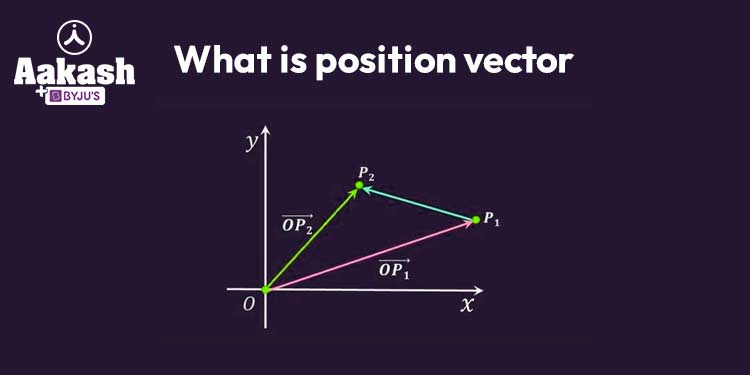
A position vector is a vector that defines the displacement from a fixed reference point (usually denoted as the origin) to a specific point or particle in space. It uniquely specifies the location of the point relative to the origin and can be described using coordinates. In a two-dimensional space, the position vector is typically represented as:
r = xi + yj
where:
r is the position vector.
x is the coordinate along the x-axis.
y is the coordinate along the y-axis.
i and j are unit vectors along the x and y axes, respectively.
In three-dimensional space, the position vector can be represented as:
r = xi + yj + zk
where:
r is the position vector.
x is the coordinate along the x-axis.
y is the coordinate along the y-axis.
z is the coordinate along the z-axis.
i, j, and k are unit vectors along the x, y, and z axes, respectively.
Properties of Position Vectors
Length and Magnitude: The magnitude of the position vector represents the distance from the origin to the point in space. In two-dimensional space, the magnitude is given by ||r|| = √(x^2 + y^2), and in three-dimensional space, it is ||r|| = √(x^2 + y^2 + z^2).
Direction: The direction of the position vector is the direction from the origin to the point represented by the vector. This direction is determined by the angles that the vector makes with the coordinate axes.
Addition and Subtraction: Position vectors can be added or subtracted to find the displacement between two points. Adding two position vectors gives a new position vector pointing from the initial point to the final point while subtracting one position vector from another gives a vector representing the displacement between the two points.
Scaling: Position vectors can be scaled by multiplying them with a scalar value. This operation changes the magnitude of the vector without affecting its direction and represents a change in position relative to the origin.
Conclusion
In conclusion, a position vector is a fundamental concept in mathematics used to represent the location of a point in space relative to a fixed reference point or origin. It provides a concise and effective way to describe the position of objects in both two-dimensional and three-dimensional spaces. Understanding position vectors is crucial for a wide range of applications, from physics and engineering to computer graphics and beyond. By grasping the properties and representation of position vectors, one gains a powerful tool for spatial analysis and problem-solving in various fields.
FAQs (Frequently Asked Questions) on Position Vectors:
What is a position vector?
A position vector is a mathematical representation that defines the location of a point in space relative to a fixed reference point or origin. It uniquely specifies the position of the point using coordinates and can be described using the x, y, and z axes in three-dimensional space.
How are position vectors represented in two-dimensional space?
In two-dimensional space, a position vector is typically represented as r = xi + yj, where x is the coordinate along the x-axis, y is the coordinate along the y-axis, and i and j are unit vectors along the x and y axes, respectively.
How are position vectors represented in three-dimensional space?
In three-dimensional space, a position vector is represented as r = xi + yj + zk, where x is the coordinate along the x-axis, y is the coordinate along the y-axis, z is the coordinate along the z-axis, and i, j, and k are unit vectors along the x, y, and z axes, respectively.
What is the significance of the magnitude of a position vector?
The magnitude of a position vector represents the distance from the origin to the point in space. In two-dimensional space, the magnitude is calculated as ||r|| = √(x^2 + y^2), while in three-dimensional space, it is ||r|| = √(x^2 + y^2 + z^2). It provides valuable information about the spatial position of the point.
How are position vectors used in practical applications?
Position vectors are widely used in various fields such as physics, engineering, computer graphics, and navigation. They play a vital role in analyzing the motion of objects, calculating distances, determining displacements, and representing the positions of particles in three-dimensional space. Applications include robotics, 3D modeling, video game development, satellite navigation systems, and more.