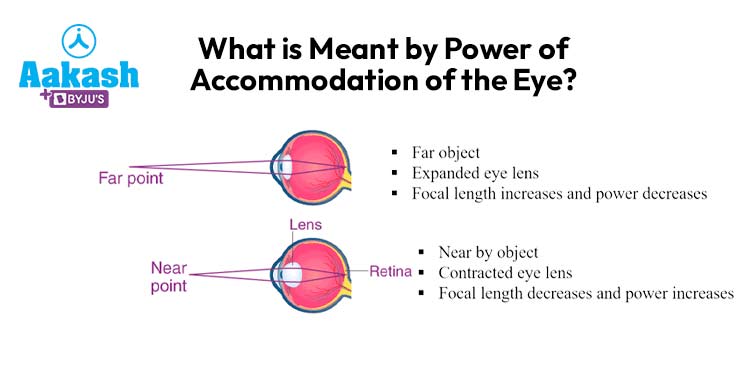

The power of accommodation of the eye, also known as the accommodative power or accommodation ability, refers to the eye’s capability to adjust its focal length and focus on objects at varying distances. This dynamic process is essential for clear vision across different distances, allowing us to see objects up close as well as those at a distance with relative clarity.
The primary structure responsible for this remarkable ability is the crystalline lens, a transparent and flexible structure located just behind the iris. The ciliary muscles, which encircle the lens, play a crucial role in adjusting its shape. When the ciliary muscles contract, the tension on the suspensory ligaments attached to the lens decreases, allowing the lens to become thicker and more curved. This increased curvature results in an increased refractive power, enabling the eye to focus on nearby objects. Conversely, when the ciliary muscles relax, the lens becomes thinner and flatter, decreasing its refractive power to focus on objects at a distance.
The power of accommodation of the eye is at its peak during childhood and gradually declines as a person ages. This natural aging process is known as presbyopia, and it typically becomes noticeable around the age of 40. As the crystalline lens loses some of its elasticity, the ability to easily shift focus between near and far objects diminishes. Individuals with presbyopia often find it challenging to focus on close objects, leading to the need for reading glasses or bifocals to aid in clear vision.
The accommodation process is a complex interplay between the lens, ciliary muscles, and the neural pathways that regulate these mechanisms. When the eye needs to switch focus, the brain sends signals to the ciliary muscles to adjust the lens accordingly. This process is automatic and usually occurs without conscious effort.
Factors that affect the power of accommodation include lighting conditions, fatigue, and certain medical conditions such as diabetes. Adequate lighting is crucial for maintaining optimal accommodation, as poor lighting can strain the ciliary muscles and impact the ability to focus effectively. Additionally, extended periods of visual strain, such as prolonged reading or staring at digital screens, can cause temporary fatigue in the ciliary muscles, leading to blurred vision and discomfort.
In summary, the power of accommodation of the eye is a remarkable physiological process that allows us to perceive objects clearly at various distances. It is an essential aspect of our visual system, enabling us to adapt to our environment and engage in activities that require focusing on both near and distant objects. Understanding how the eye’s accommodation works can lead to better eye care practices and strategies for maintaining clear vision throughout different stages of life.
FAQs about the Power of Accommodation of the Eye
1. What is the power of accommodation of the eye?
The power of accommodation of the eye refers to the eye’s ability to adjust its focal length in order to focus on objects at varying distances. This dynamic process is controlled by the ciliary muscles and the flexibility of the crystalline lens, allowing us to see both nearby and distant objects clearly.
2. How does the power of accommodation work?
The power of accommodation is primarily controlled by the ciliary muscles surrounding the lens in the eye. When these muscles contract, they alter the tension on the suspensory ligaments connected to the lens. This causes the lens to change its shape, becoming thicker for near objects and thinner for distant objects, thus adjusting its refractive power accordingly.
3. Is the power of accommodation the same for everyone?
No, the power of accommodation varies from person to person and can change with age. Children and young adults typically have a more flexible crystalline lens and stronger ciliary muscles, allowing them to accommodate a wide range of distances. As people age, the lens becomes less elastic, resulting in a gradual decline in the eye’s ability to focus on nearby objects, a condition known as presbyopia.
4. What is presbyopia, and how does it relate to accommodation?
Presbyopia is a common age-related condition that affects the eye’s ability to focus on close objects. As the crystalline lens loses elasticity over time, the ciliary muscles struggle to adjust the lens for near vision. This results in difficulties reading or performing tasks that require close-up focus, typically becoming noticeable around age 40. Reading glasses, bifocals, or progressive lenses are often used to correct presbyopia.
5. Can the power of accommodation be improved or maintained?
While the natural decline in accommodation cannot be entirely prevented, there are practices that can help maintain good accommodative ability. Taking breaks during prolonged reading or screen use, maintaining proper lighting conditions, and following a healthy lifestyle that includes a balanced diet and regular eye check-ups can contribute to maintaining better accommodative function for a longer period of time.