
All of you once in your life must have gone through the experience of flying kites to flying paper rockets in classroom. Most of us, usually look at the sky whenever a plane crosses above us. If even you dream to rule the sky one day and create innovative flying machines, then Aeronautical Engineering is one of the best career options for you.
What is Aeronautical Engineering?
Aeronautical Engineering is a branch of aerospace engineering that deals with the study and creation of advanced technologies in the field of aviation, defence system and space technology. This course prepares you for designing, development, testing and maintenance of the commercial airplanes and their components. Although, aeronautical engineers do not fly aircraft but still they have a large contribution towards the field of aviation. Let’s know a little more about Aeronautical Engineers in detail.
What Do Aeronautical Engineers Do?
Aeronautical Engineers are responsible for creating innovative, eco-friendly, economic and energy-efficient methods of air transportation. An aeronautical engineer has to adept with the laws of physics and aerodynamics. Those who want to design aircraft have to master several designing software’s like CAD or CAM. This career demands high dedication and during projects, you might be expected to burn the midnight oil and be prepared to carry some work back home.
Aeronautical Engineering Course: Highlights
The BTech programme in Aeronautical Engineering course is spread over eight semesters whereas MTech Aeronautical Engineering course is spread over four semesters. Listed below are some of the major highlights of the course such as course structure, course level, examination type, average starting salary, top recruiters and top job profiles:
| Highlights | Details |
|---|---|
| Course Level | Diploma, Undergraduate, Postgraduate, Doctorate |
| Eligibility | Diploma: Class 10
UG: Class 12 along with entrance examination PG: BTech + GATE Doctorate: MTech |
| Duration | Diploma: 3 years
UG: 4 years PG: 2 years PhD: 3- 6 years |
| Examination Type | Semester-wise |
| Course Fee | INR 6-10 lakh |
| Top Colleges | Manipal Institute of Technology, LPU, Amity University, SASTRA Deemed to be University |
| Average Salary | INR 8- 10 lakh |
| Job Positions | Aeronautical Engineers, Aeronautical Mechanical Engineers, Aeronautical Electronics Engineers, Flight Engineers, Systems Engineer, Aircraft Designer, Payload Specialist, Testing Engineer, Avionics Engineer |
| Admission Process | JEE Main, LPUNEST, JEE Advanced, MET, GATE |
| Top Recruiting Companies | Air India, Pawan Hans, DRDO, Hindustan Aeronautics Limited, Private Airlines, Indian Air Force |
How to Become an Aeronautical Engineer?
There are several points of entry in the field of engineering depending upon the amount of education. The minimum eligibility for becoming an aeronautical engineer is a diploma in aeronautical engineering.
Aeronautical Engineering Eligibility Criteria:
| Course | Description |
|---|---|
| Diploma |
|
| Undergraduate |
|
| Postgraduate and Doctoral |
|
Aeronautical Engineering Courses Offered
- B. Tech in Aeronautical Engineering
- B. E. in Aeronautical Engineering
- M. Tech in Aeronautical Engineering
- M. Tech in Avionics
- M.E. in Aeronautical Engineering
- M.E. in Avionics
Who can pursue Aeronautical Engineering?
Individuals who have completed Class 12th with Physics, Chemistry, and Mathematics (PCM) are eligible to pursue Aeronautical Engineering courses after 12th. Some institutions might consider candidates with Physics, Chemistry, and Biology (PCB) but this is less common.
Aptitude and Interest:
-
- A strong aptitude for science and mathematics, particularly physics, is crucial.
- A keen interest in aviation, aircraft, and understanding how they fly is essential for motivation and success.
- Problem-solving and analytical skills are highly valuable in this field.
Additional Considerations:
-
- While there’s no specific age limit, most candidates are typically between 17-20 years old upon starting the program.
- Good spatial reasoning and visualization skills are beneficial for comprehending complex aircraft designs.
Overall, anyone with the required academic qualifications, a passion for aeronautics, and strong analytical skills can pursue Aeronautical Engineering
Top Aeronautical Engineering Entrance Exams 2024
- JEE Main
- JEE Advanced
- MHT CET
- CUET
- TS EAMCET
- BITSAT
- KCET
- KEAM
- WBJEE
- VITEEE
- COMEDK UGET
- GATE
Top Colleges Offering Aeronautical Engineering
This program is available in very selective colleges. Due to the high demand in the aviation field and fewer seats, there is a high level of competition among students. Some of the top colleges are:
| 1. Institute of Aeronautical Engineering, Hyderabad |
| 2. Manipal Institute of Technology, Manipal University, Manipal |
| 3. Hindustan Institute of Technology and Science, Hindustan University, Chennai |
| 4. Institute of Aeronautical and Marine Engineering, Bengaluru |
| 5. PEC University of Technology, Chandigarh |
| 6. Madras Institute of Technology, Anna University, Chennai |
| 7. Indian Institute of Aeronautical Engineering & Information Technology, Pune |
| 8. CIIAE (Centre for Internationally Recognised Aeronautical/Aerospace/Aircraft Engineering), Dehradun |
| 9. Indian Academy of Aeronautical Technology, Lucknow |
Aeronautical Engineering Fee Structure
Since this is a specialized field, therefore the cost of pursuing a degree in aeronautical engineering can be significantly high. The fees for this program varies depending on whether it is a government college or a private one. The fees in government colleges in India might be around 25 to 40 thousand while the same in private colleges can start from INR 70,000 and go up to 3 lakhs per annum. The fees for pursuing the course abroad can be significantly higher and can cost around 23 lakhs for the graduation course.
Aeronautical Engineering Syllabus
Given below is the tentative syllabus for Aeronautical Engineering Semester-wise:
Aeronautical Engineering Subjects- Semester 1 |
||
|---|---|---|
| Mathematics | Engineering Physics | Engineering Chemistry |
| Introduction to Aerospace Engineering | Basic Electrical Engineering | |
Aeronautical Engineering Subjects- Semester 2 |
||
| Vector Calculus and Ordinary Differential Equations | Physics II | Materials Science and Metallurgy |
| Basic Electronics Engineering | Engineering Graphics | |
Aeronautical Engineering Subjects- Semester 3 |
||
| Engineering Thermodynamics | Mechanics of Solids | Fluid Mechanics |
| Manufacturing Technology | Introduction to Machine Elements and Drawing | |
Aeronautical Engineering Subjects- Semester 4 |
||
| Aerodynamics | Heat Transfer | Applied Dynamics and Vibration |
| Machining and Precision Manufacturing | Introduction to Social Science and Ethics | |
Aeronautical Engineering Subjects- Semester 5 |
||
| Compressible Flow | Atmospheric Flight Mechanics | Spaceflight Mechanics |
| Theory of Elasticity | Automatic Control | |
Aeronautical Engineering Subjects- Semester 6 |
||
| Air-Breathing Propulsion | Aerospace Structures | Optimization Techniques in Engineering |
| Principles of Management Systems | Solar Thermal Energy | |
Aeronautical Engineering Subjects- Semester 7 |
||
| Aerospace Vehicle Design | Environmental Science and Engineering | Structural Dynamics |
| Two-Phase Flow and Heat Transfer | Flight Mechanics and Propulsion Lab | |
Aeronautical Engineering Subjects- Semester 8 |
||
| Comprehensive Viva-Voce | Project Work | |
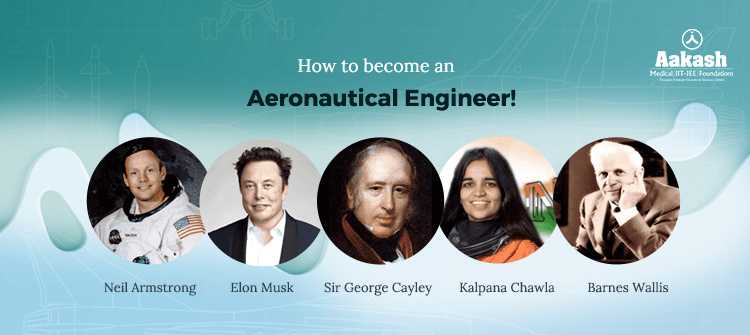
Greatest Aeronautic Engineers of all Time!
1. Neil Armstrong
Neil Armstrong is a well-known figure in the history of Aerospace Engineering. Neil Armstrong is an American astronaut and aeronautical engineer who was the first person to walk on the moon.
2. Elon Musk
Elon Musk is an entrepreneur and engineer. He founded SpaceX, an aerospace manufacturer and space transport company of which he is the CEO and lead designer. He is also the co-founder and CEO of Tesla, Inc, Co-founder of PayPal and co-founder and CEO of Neuralink. He has also stated his commitment to reducing global warming through sustainable energy and reducing the risk of human extinction by establishing a human colony on mars.
3. Sir George Cayley
Sir George Cayley is considered to be one of the most important people in the history of aeronautics. He was one of the first person to understand the principles of flight. As an English engineer and aviator, he is viewed as the first scientific aerial investigator. He was one of the first person to understand the principles of flight. Regarded as the “Father of Aviation” his impact is long-lasting and telling.
4. Kalpana Chawla
Kalpana Chawla was the first female of Indian origin who went to space. She was an American astronaut who first flew on the Space Shuttle Columbia. She was also one of the seven members to die when the Space Shuttle Columbia aircraft disintegrated on its re-entry into the Earth’s atmosphere.
5. Barnes Wallis
Barnes Wallis is one of the most famous for his invention of the bouncing bomb, used by the Royal Air Force during the Dambusters raid during the Second World War. He was an English scientist, engineer, and inventor. Other works assigned to him also include the earthquake bomb.
Aeronautical Engineering is certainly one of the best professions and is not only highly paid but also ensures high social status and standard of living. There is a high demand for skilled aeronautic engineers and both private and government organizations pay high benefits to retain all the talented and efficient ones. Along with everything being so good, there are several challenges as well. In addition to this, you would also be required to travel a lot. So, if you think you can rise above all of these challenges and take the flight of your dreams, then no one can stop you from moving towards your goal.