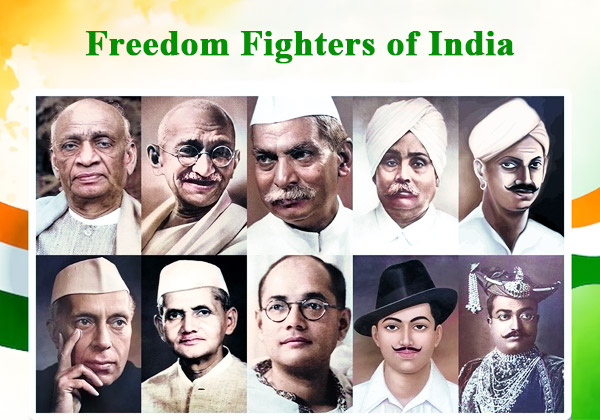

India’s struggle for independence was a long and arduous journey that saw the contributions of numerous freedom fighters. These brave individuals fought against British colonial rule and laid the foundation for a free and democratic India. Here, we celebrate the lives and legacies of 11 freedom fighters who played pivotal roles in shaping the nation’s destiny.
Detailed Insights about the top 10 Freedom Fighters of India
1. Mahatma Gandhi (1869-1948)
Mahatma Gandhi, born Mohandas Karamchand Gandhi on October 2, 1869, in Porbandar, India, is a towering figure in Indian and world history. Known for his philosophy of non-violence (ahimsa) and his pivotal role in India’s struggle for independence, Gandhi’s legacy continues to inspire movements for civil rights and freedom across the globe.
Mahatma Gandhi Early Life and Education
Gandhi hailed from a Hindu merchant family. His father, Karamchand Gandhi, served as the dewan (chief minister) of Porbandar, and his mother, Putlibai, was a deeply religious woman. Gandhi was married to Kasturba Gandhi at the age of 13, in keeping with the customs of the time.
| Year | Event |
| 1869 | Birth in Porbandar |
| 1888 | Went to London to study law |
| 1891 | Returned to India as a barrister |
South Africa and Satyagraha Movement
In 1893, Gandhi went to South Africa to work as a legal representative for an Indian firm. It was in South Africa that Gandhi faced racial discrimination firsthand, which profoundly impacted him and shaped his social activism. He developed his philosophy of satyagraha, or non-violent resistance, during this period.
Key South African Events
| Year | Event |
| 1893 | Thrown off a train for being in a whites-only compartment |
| 1906 | Organized the first satyagraha campaign |
| 1914 | Returned to India with new strategies for resistance |
Role of Mahatma Gandhi in Indian Independence Movement
Upon returning to India, Gandhi quickly became a prominent leader in the Indian National Congress. He led numerous campaigns against British colonial rule, employing tactics of non-violent civil disobedience.
Major Campaigns
| Campaign | Year | Description |
| Non-Cooperation Movement | 1920-1922 | Boycott of British goods and institutions |
| Salt March | 1930 | 240-mile march to the Arabian Sea to produce salt, defying British salt laws |
| Quit India Movement | 1942 | Mass protest demanding an end to British rule in India |
Principles of Gandhi’s Philosophy
| Principle | Description |
| Ahimsa | Non-violence towards all living beings |
| Satyagraha | Non-violent resistance as a means of protest |
| Sarvodaya | Welfare for all, a vision of social justice |
| Self-sufficiency | Encouragement of self-reliance and rural self-sufficiency, epitomized by the spinning wheel (charkha) |
Legacy and Impact
Gandhi’s influence extended beyond India’s borders. His principles of non-violence inspired civil rights movements worldwide, including the American Civil Rights Movement led by Martin Luther King Jr. and the anti-apartheid struggle in South Africa.
Gandhi’s Global Influence
| Country/Region | Leader/Movement Inspired |
| United States | Martin Luther King Jr., Civil Rights Movement |
| South Africa | Nelson Mandela, Anti-Apartheid Movement |
| Myanmar (Burma) | Aung San Suu Kyi, Democracy Movement |
Assassination and Commemoration
Mahatma Gandhi was assassinated on January 30, 1948, by Nathuram Godse, a Hindu nationalist. His death marked the end of an era, but his teachings continue to resonate.
Commemoration
| Memorial | Location | |||
| Raj Ghat | New Delhi, India | |||
| Gandhi Museum | Madurai, India | |||
| Various statues and memorials | Worldwide | |||
Mahatma Gandhi Key Contributions:
|
Mahatma Gandhi’s life and legacy remain integral to the story of India and the broader global struggle for justice and equality. His unwavering commitment to non-violence and his relentless pursuit of truth and justice continue to inspire generations.
For more detailed information on Mahatma Gandhi, his works, and his philosophy, numerous books, documentaries, and scholarly articles are available, shedding light on the remarkable life of this extraordinary leader.
2. Jawaharlal Nehru (1889-1964)
India’s First Prime Minister
Jawaharlal Nehru, born on November 14, 1889, in Allahabad, was a pivotal figure in Indian history. As the first Prime Minister of independent India and a central figure in Indian politics both before and after independence, Nehru’s contributions to the nation are immense. He was instrumental in shaping the modern Indian state, its political structure, and its socio-economic policies.
Jawaharlal Nehru Early Life and Education
Nehru was born into a prosperous family. His father, Motilal Nehru, was a prominent lawyer and nationalist leader. Nehru was educated in some of the best institutions in the world, which played a significant role in shaping his worldview.
| Year | Event | |||
| 1889 | Born in Allahabad, India | |||
| 1907 | Went to Harrow School, England | |||
| 1910 | Attended Trinity College, Cambridge | |||
| 1912 | Returned to India after studying law at the Inner Temple, London | |||
Jawaharlal Nehru Key Contributions:
|
Jawaharlal Nehru’s Involvement in Freedom Struggle
Nehru’s political career began with his involvement in the Indian National Congress. He was deeply influenced by Mahatma Gandhi and became one of his closest associates.
Jawaharlal Nehru Key Contributions
| Year | Event |
| 1920 | Joined Non-Cooperation Movement |
| 1929 | Became President of the Indian National Congress |
| 1942 | Played a crucial role in the Quit India Movement |
Nehru was arrested several times during the freedom struggle, showcasing his commitment to India’s independence.
Prime Minister of India
Nehru became the first Prime Minister of India on August 15, 1947. His vision for India was that of a secular, socialist, and democratic republic.
Major Policies and Reforms
| Policy | Description |
| Five-Year Plans | Focused on the economic development and modernization of India |
| Industrialization | Established key industries and public sector enterprises |
| Non-Alignment Policy | Adopted a policy of not aligning with any major power bloc during the Cold War |
| Educational Reforms | Established institutions of higher learning like IITs, AIIMS, and promoted science and technology |
Five-Year Plans
| Plan | Duration | Focus Areas |
| First Plan | 1951-1956 | Agriculture and Irrigation |
| Second Plan | 1956-1961 | Industrialization and Infrastructure |
| Third Plan | 1961-1966 | Self-sufficiency in Food Production |
International Relations
Nehru was a proponent of world peace and played a key role in the establishment of the Non-Aligned Movement, which sought to maintain neutrality during the Cold War.
Jawaharlal Nehru Key Contributions
| Event | Year | Description |
| Bandung Conference | 1955 | Pioneering meeting for the Non-Aligned Movement |
| Founding of NAM | 1961 | Co-founded the Non-Aligned Movement with other world leaders |
Legacy
Jawaharlal Nehru passed away on May 27, 1964. His legacy is visible in the institutions he helped establish and the democratic framework he helped create. Nehru’s birthday, November 14, is celebrated as Children’s Day in India, reflecting his deep affection for children.
Key Institutions Established
| Institution | Year Established | Description |
| Indian Institutes of Technology (IITs) | 1951 | Premier engineering institutions |
| All India Institute of Medical Sciences (AIIMS) | 1956 | Leading medical college and hospital |
| Indian Space Research Organisation (ISRO) | 1962 | National space agency focused on space exploration and satellite development |
Jawaharlal Nehru’s contributions to India are unparalleled. As the first Prime Minister, he laid the foundation for a modern, democratic, and secular India. His vision and policies continue to influence the country’s development trajectory. Nehru’s life and work remain a source of inspiration for millions, reflecting his enduring legacy in shaping modern India.
3. Bhagat Singh (1907-1931)
The Revolutionary Hero
Bhagat Singh, born on September 28, 1907, in Banga, Punjab, was a legendary figure in India’s struggle for independence. Known for his fearless activism and revolutionary ideas, Singh became a symbol of the fight against British colonial rule. His dedication to the cause of Indian independence and his willingness to sacrifice his life made him an iconic hero of the Indian freedom movement.
Bhagat Singh’s Early Life and Education
Bhagat Singh was born into a Sikh family deeply involved in political activities. His family was heavily influenced by the nationalist sentiments of the time, which shaped Singh’s early views on British rule in India.
| Year | Event |
| 1907 | Born in Banga, Punjab |
| 1916 | Enrolled in Dayanand Anglo Vedic School |
| 1923 | Joined the National College in Lahore |
Bhagat Singh’s Key Contributions:
| Assassination of British Officer John Saunders |
| Bombing of Central Legislative Assembly |
| Influential Writings and Martyrdom |
Revolutionary Activities
Bhagat Singh’s revolutionary activities began at a young age. He was deeply influenced by the Jallianwala Bagh massacre of 1919, which fueled his desire to fight against British oppression.
Key Revolutionary Actions
| Year | Event |
| 1928 | Involved in the assassination of British officer John Saunders |
| 1929 | Bombed the Central Legislative Assembly in Delhi |
| 1930 | Arrested and jailed for his activities |
Major Revolutionary Actions
| Action | Date | Description |
| Assassination of John Saunders | December 17, 1928 | Retaliatory action against the killing of Lala Lajpat Rai by police |
| Assembly Bombing | April 8, 1929 | Protest against repressive laws, resulted in his arrest |
Ideology and Writings
Bhagat Singh was a voracious reader and writer. He was influenced by Marxist ideologies and believed in the power of socialism to address India’s problems. His writings reflect his revolutionary fervor and his vision for an independent India.
Key Writings
| Title | Description |
| Why I Am an Atheist | Autobiographical essay detailing his rejection of religion |
| Jail Notebook | Collection of notes and quotes from various revolutionary texts |
Trial and Martyrdom
Bhagat Singh’s trial was a turning point in the Indian freedom struggle. Despite being given the death sentence, he remained resolute and fearless, inspiring millions of Indians to join the fight for independence.
Key Events Leading to Martyrdom
| Event | Date | Description |
| Trial for Assembly Bombing | 1929-1930 | Singh and his associates used the trial as a platform to propagate their views |
| Execution | March 23, 1931 | Singh, along with Rajguru and Sukhdev, was hanged in Lahore Central Jail |
Legacy
Bhagat Singh’s legacy is immortalized in Indian history. He is remembered not just as a freedom fighter, but as a thinker, a visionary, and an inspiration for generations of Indians.
Memorials and Tributes
| Memorial | Location | Description |
| Shaheed Bhagat Singh Museum | Khatkar Kalan, Punjab | Museum dedicated to his life and legacy |
| Bhagat Singh Memorial | Hussainiwala, Punjab | Memorial at the site where his body was cremated |
| Numerous statues and roads named after him | Across India | Reflects his widespread influence and remembrance |
Bhagat Singh’s life and sacrifices remain a powerful testament to the spirit of the Indian freedom struggle. His fearless approach, intellectual depth, and unwavering commitment to India’s independence continue to inspire countless individuals. Bhagat Singh’s contributions to the fight against British colonialism are etched in the annals of history, making him a timeless hero of India’s journey to freedom.
Bhagat Singh’s Key Contributions:
| Assassination of British Officer John Saunders |
| Bombing of Central Legislative Assembly |
| Influential Writings and Martyrdom |
4. Subhas Chandra Bose (1897-1945)
The Leader of Indian National Army
Subhas Chandra Bose, popularly known as Netaji, was a prominent leader in the Indian independence movement. His relentless quest for freedom and his revolutionary approach set him apart from other leaders of his time. Born on January 23, 1897, in Cuttack, Odisha, Bose’s legacy continues to inspire generations of Indians.
Subhas Chandra Bose Early Life and Education
Subhas Chandra Bose was the ninth of fourteen children in his family. His father, Janakinath Bose, was a well-known lawyer, and his mother, Prabhavati Devi, was a devout and religious woman. Bose was an intelligent and diligent student from a young age.
| Year | Event |
| 1897 | Born in Cuttack, Odisha |
| 1913 | Joined Presidency College, Calcutta |
| 1919 | Went to England to prepare for the ICS exam |
Bose excelled academically, securing the second position in the matriculation examination of the Calcutta province. He later pursued higher education in England, where he passed the Indian Civil Services (ICS) examination with distinction. However, driven by his patriotic fervor, he resigned from his civil service post to join India’s struggle for independence.
Subhas Chandra Bose Key Contributions:
| Formation of the Indian National Army |
| INA’s involvement in Imphal and Kohima |
| Provisional Government of Free India |
Political Career and Revolutionary Activities
Subhas Chandra Bose’s political career was marked by his radical approach and his determination to achieve complete independence for India. He was influenced by the teachings of Swami Vivekananda and was an ardent follower of Mahatma Gandhi initially.
Key Political Milestones
| Year | Event |
| 1921 | Joined Indian National Congress (INC) |
| 1938 | Elected President of the INC |
| 1939 | Resigned from INC and formed Forward Bloc |
Bose’s differences with the Congress leadership, especially with Gandhi, led to his resignation from the INC. He then founded the Forward Bloc, aiming to consolidate the anti-British forces in India. His belief in aggressive resistance against British rule distinguished him from other leaders who preferred non-violent methods.
Formation of the Indian National Army (INA)
During World War II, Subhas Chandra Bose sought international support to free India from British rule. He traveled to Germany and Japan, seeking assistance from Axis powers. In 1943, he assumed leadership of the Indian National Army (INA) in Singapore, formed with Indian prisoners of war and expatriates.
INA’s Key Campaigns
| Year | Campaign/Battle | Outcome |
| 1944 | Battle of Imphal and Kohima | INA faced defeat |
| 1945 | INA’s final offensive in Burma | INA’s efforts were unsuccessful |
Bose’s famous slogan, “Give me blood, and I will give you freedom,” resonated deeply with Indians and inspired many to join the INA. Despite military setbacks, the INA’s efforts significantly impacted the Indian independence movement by galvanizing public support and weakening British resolve.
Legacy and Impact
Subhas Chandra Bose’s legacy is enshrined in the annals of Indian history as that of a fearless and visionary leader. His contributions to India’s struggle for independence were instrumental in shaping the country’s destiny.
Major Contributions and Legacy
| Contribution | Description |
| Establishment of the INA | Created a formidable force to fight against British rule |
| Promotion of Indian Nationalism | Fostered a sense of unity and patriotism among Indians |
| Influence on Post-Independence India | Inspired subsequent generations of Indian leaders and freedom fighters |
Bose’s vision for India extended beyond political independence; he envisioned a nation with social and economic justice, free from poverty and inequality. His forward-thinking ideas on industrialization and education continue to be relevant in contemporary India.
Subhas Chandra Bose remains a towering figure in India’s history, symbolizing the spirit of resistance and the quest for freedom. His dedication to the cause of Indian independence, his strategic acumen, and his ability to inspire masses make him an enduring icon of patriotism and courage.
Bose’s life and legacy serve as a powerful reminder that the fight for justice and freedom requires unwavering determination and a willingness to challenge the status quo. His contributions to India’s independence movement are celebrated and remembered, ensuring that his spirit lives on in the hearts of millions of Indians.
5. Rani Lakshmibai (1828-1858)
The Warrior Queen
Rani Lakshmibai, also known as the Queen of Jhansi, is one of the most revered figures in Indian history. Her courage, valor, and determination during the Indian Rebellion of 1857 have made her an enduring symbol of resistance against British rule. Born on November 19, 1828, in Varanasi, she was named Manikarnika and later became known as Lakshmibai after her marriage to the Maharaja of Jhansi, Raja Gangadhar Rao.
Early Life and Marriage
Lakshmibai was born to Moropant Tambe and Bhagirathi Sapre. Her upbringing was unconventional for a girl of her time; she was trained in martial arts, horsemanship, and archery.
| Year | Event |
| 1828 | Born in Varanasi |
| 1842 | Married Raja Gangadhar Rao of Jhansi |
| 1851 | Birth of her son, Damodar Rao |
Rani Lakshmibai Key Contributions:
| Leadership in the Indian Rebellion of 1857 |
| Battle of Jhansi |
| Legacy as a Symbol of Resistance |
Her marriage to Raja Gangadhar Rao in 1842 marked her entry into the royal family of Jhansi. However, after the death of their son in 1851 and later the Maharaja in 1853, Jhansi faced the threat of annexation by the British under the Doctrine of Lapse.
The Doctrine of Lapse and Rebellion
The Doctrine of Lapse was a policy implemented by the British East India Company, which allowed them to annex any princely state where the ruler did not have a biological male heir. After the death of her husband, the British refused to recognize the adopted son, Damodar Rao, as the legitimate heir, leading to the annexation of Jhansi.
Key Events Leading to Rebellion
| Year | Event |
| 1853 | Annexation of Jhansi under Doctrine of Lapse |
| 1857 | Indian Rebellion begins |
| 1858 | Battle of Jhansi |
The annexation of Jhansi fueled Lakshmibai’s resolve to fight against British rule. The outbreak of the Indian Rebellion in 1857 provided her with the opportunity to lead her people in the struggle for independence.
Leadership and Battle of Jhansi
Rani Lakshmibai’s leadership during the rebellion was marked by her strategic acumen and bravery. She assembled an army, which included both men and women, and fortified the city of Jhansi.
Battle of Jhansi
| Date | Event |
| March 1858 | British forces lay siege to Jhansi |
| April 1858 | Fierce battle ensues |
| June 1858 | Lakshmibai escapes to Gwalior |
During the siege of Jhansi in March 1858, Lakshmibai displayed exceptional courage. She fought valiantly, leading her troops from the front. Despite being heavily outnumbered, she managed to hold off the British forces for two weeks. After the fall of Jhansi, she escaped to Gwalior, where she continued to resist until her death in June 1858.
Legacy and Impact
Rani Lakshmibai’s legacy as a fearless warrior and a symbol of resistance against oppression remains unparalleled. Her bravery and determination have inspired countless freedom fighters and continue to be celebrated in Indian culture and history.
Major Contributions and Legacy
| Contribution | Description |
| Symbol of Resistance | Became a symbol of defiance against British rule |
| Inspiration for Future Generations | Inspired freedom fighters during the Indian independence movement |
| Cultural Icon | Immortalized in literature, folklore, and popular culture |
Lakshmibai’s story has been immortalized in numerous poems, songs, and films, making her an enduring icon of Indian resistance and empowerment.
Rani Lakshmibai’s life and legacy are a testament to the power of courage and determination in the face of adversity. Her leadership during one of India’s most turbulent times has left an indelible mark on the nation’s history. She remains a source of inspiration, reminding us that true strength lies in standing up for one’s beliefs and fighting for justice, regardless of the odds.
6. Sardar Vallabhbhai Patel (1875-1950)
The Iron Man of India
Sardar Vallabhbhai Patel, known as the “Iron Man of India,” played a crucial role in the Indian independence movement and the integration of the princely states into the Indian Union. Born on October 31, 1875, in Nadiad, Gujarat, Patel’s dedication to the nation and his pragmatic approach to politics made him a key figure in shaping modern India.
Sardar Vallabhbhai Patel Early Life and Education
Vallabhbhai Patel was born into a humble farmer’s family. Despite the financial constraints, he pursued his education with determination and resilience.
| Year | Event |
| 1875 | Born in Nadiad, Gujarat |
| 1897 | Completed high school |
| 1913 | Passed the law examination in England |
After completing his high school education, Patel went to England to study law. He passed the law examination with flying colors and returned to India to practice law in Ahmedabad. His successful legal career earned him respect and recognition in the community.
Sardar Vallabhbhai Patel Key Contributions:
| Integration of Princely States |
| First Deputy Prime Minister and Home Minister of India |
| Leadership in the Bardoli Satyagraha |
Role in the Independence Movement
Patel’s entry into politics was inspired by Mahatma Gandhi’s call for non-cooperation against British rule. He became an ardent follower of Gandhi and played a significant role in various movements for India’s freedom.
Key Contributions to the Freedom Struggle
| Year | Event |
| 1918 | Led the Kheda Satyagraha |
| 1928 | Led the Bardoli Satyagraha |
| 1930 | Participated in the Salt March |
| 1942 | Arrested during the Quit India Movement |
One of Patel’s most notable contributions was his leadership in the Kheda Satyagraha of 1918 and the Bardoli Satyagraha of 1928. In both movements, he mobilized farmers to protest against unjust British policies and successfully negotiated their demands. His leadership in these movements earned him the title “Sardar,” meaning leader.
Integration of Princely States
After India gained independence in 1947, Patel was appointed as the first Deputy Prime Minister and Minister of Home Affairs. One of his most significant achievements was the integration of over 500 princely states into the Indian Union.
Integration Process
| Princely State | Method of Integration |
| Hyderabad | Military action (Operation Polo) |
| Junagadh | Plebiscite |
| Kashmir | Instrument of Accession |
| Others (e.g., Travancore, Mysore) | Negotiation and diplomacy |
Patel used a combination of diplomacy, persuasion, and military action to ensure that these states acceded to India. His firm approach and strategic thinking were instrumental in unifying the country.
Legacy and Impact
Sardar Patel’s legacy is multifaceted, reflecting his contributions as a freedom fighter, a unifier, and a nation-builder. His pragmatic approach and steadfastness earned him the moniker “Iron Man of India.”
Major Contributions and Legacy
| Contribution | Description |
| Unification of India | Integrated 500+ princely states into the Indian Union |
| Strong Administration | Established a robust administrative framework for the newly independent nation |
| Inspirational Leadership | Inspired future generations with his dedication and leadership |
Patel’s vision and leadership were pivotal in laying the foundation of a united and strong India. His efforts in integrating the princely states ensured the territorial integrity and political stability of the country.
Sardar Vallabhbhai Patel’s life and work are a testament to his unwavering commitment to the nation. His role in the Indian independence movement, coupled with his monumental efforts in unifying the country, makes him an enduring figure in Indian history. Patel’s legacy as the “Iron Man of India” continues to inspire and guide the nation towards unity, integrity, and strength.
7. Bal Gangadhar Tilak (1856-1920)
The Father of Indian Unrest
Bal Gangadhar Tilak, often hailed as the “Father of Indian Unrest,” was a prominent freedom fighter, nationalist, teacher, and social reformer who played a vital role in India’s struggle for independence. Born on July 23, 1856, in Ratnagiri, Maharashtra, Tilak’s contributions to the Indian freedom movement were profound and far-reaching. His fearless attitude, nationalist fervor, and dedication to India’s independence have left an indelible mark on the country’s history.
Bal Gangadhar Tilak Early Life and Education
Tilak was born into a Chitpavan Brahmin family, known for its scholarly pursuits. His father, Gangadhar Tilak, was a school teacher and a Sanskrit scholar, which greatly influenced Tilak’s educational path.
| Year | Event |
| 1856 | Born in Ratnagiri, Maharashtra |
| 1877 | Graduated with a degree in mathematics |
| 1879 | Completed law studies at Government Law College, Mumbai |
Despite his formal education in mathematics and law, Tilak was deeply interested in the social and political issues of his time. He began his career as a teacher and later became involved in various social reform activities.
Bal Gangadhar Tilak Key Contributions:
| Advocate for Swaraj |
| Founding of Deccan Education Society |
| Role in Indian National Congress |
Political Involvement and Ideology
Tilak was a firm believer in Swaraj, or self-rule, and was one of the first leaders to demand complete independence from British rule. He was a strong advocate for the use of traditional Indian cultural symbols and festivals to foster a sense of unity and nationalism among the masses.
Key Contributions to the Freedom Struggle
| Year | Event |
| 1890s | Founded the Deccan Education Society |
| 1894 | Revived the celebration of Ganesh Chaturthi |
| 1895 | Started the festival of Shivaji Jayanti |
| 1896-1908 | Published fiery articles in Kesari and Maratha |
| 1905 | Promoted the Swadeshi Movement |
Tilak’s use of cultural revivalism as a political tool was groundbreaking. By promoting festivals like Ganesh Chaturthi and Shivaji Jayanti, he aimed to unite Indians against colonial rule and instill a sense of pride in their heritage.
Literary Contributions and Social Reform
Tilak was not only a political leader but also a prolific writer and social reformer. His works, both in English and Marathi, were aimed at awakening the consciousness of the Indian populace. His famous slogan, “Swaraj is my birthright, and I shall have it,” became a rallying cry for the freedom movement.
Major Publications
| Year | Publication | Description |
| 1908 | The Arctic Home in the Vedas | Explored the origins of the Aryans |
| 1915 | Geeta Rahasya | Commentary on the Bhagavad Gita |
Tilak’s Geeta Rahasya is considered one of his most significant contributions to Indian philosophy, emphasizing the importance of action (Karma Yoga) over renunciation.
Imprisonment and Later Years
Tilak’s nationalist activities often brought him into direct conflict with the British authorities. He was imprisoned multiple times for his outspoken criticism and revolutionary ideas.
| Year | Event |
| 1908 | Imprisoned for six years in Mandalay |
| 1916 | Formed the All India Home Rule League |
Despite the hardships of imprisonment, Tilak continued to inspire and mobilize Indians. His efforts culminated in the formation of the All India Home Rule League, which sought to achieve self-governance within the British Empire.
Legacy and Impact
Bal Gangadhar Tilak’s contributions to India’s independence movement were immense. His advocacy for self-rule, promotion of Indian culture, and relentless pursuit of freedom made him a towering figure in Indian history.
Major Contributions and Legacy
| Contribution | Description |
| Advocate of Swaraj | First leader to demand complete independence from British rule |
| Cultural Revivalism | Used festivals to unite and inspire the Indian populace |
| Literary Works | Authored influential works that continue to inspire generations |
Tilak’s legacy as a fearless freedom fighter and a visionary leader continues to inspire millions of Indians. His life and work underscore the importance of self-reliance, cultural pride, and unwavering commitment to justice and freedom.
In conclusion, Bal Gangadhar Tilak was a pioneer in India’s struggle for independence. His multifaceted contributions as a political leader, social reformer, and cultural revivalist have left a lasting impact on the nation, making him a true patriot and a hero of India.
8. Annie Besant (1847-1933)
The Champion of Home Rule
Annie Besant was a remarkable figure in both British and Indian history, known for her tireless work as a social reformer, women’s rights activist, and a leader in India’s struggle for independence. Born on October 1, 1847, in London, Besant’s life journey from England to India and her contributions to social and political causes have left an indelible mark on history.
Early Life and Activism in England
Annie Besant’s early life was marked by a strong commitment to social justice. She married Frank Besant at the age of 20, but the marriage ended due to her growing radical views, leading to a separation in 1873. She became actively involved in various social causes, including the promotion of secularism, birth control, and workers’ rights.
| Year | Event |
| 1847 | Born in London, England |
| 1873 | Separated from husband Frank Besant |
| 1877 | Published “The Law of Population” advocating birth control |
Besant’s involvement in the secular and socialist movements in England led her to join the Fabian Society and the Marxist Social Democratic Federation. Her activism brought her into contact with leading socialists and reformers of the time.
Annie Besant Key Contributions:
| Founding of Home Rule League |
| Advocacy for Women’s Education |
| Influence in the Indian National Congress |
Theosophy and Move to India
In 1889, Besant joined the Theosophical Society, which aimed to promote universal brotherhood and the study of comparative religion, philosophy, and science. Her involvement with the society marked a significant turn in her life, eventually leading her to India in 1893.
Key Contributions to Theosophy
| Year | Event |
| 1889 | Joined the Theosophical Society |
| 1907 | Became President of the Theosophical Society |
As president of the Theosophical Society, Besant moved to its headquarters in Adyar, Chennai, and became deeply involved in Indian culture and spirituality. Her work with the society aimed to foster a sense of unity among people of different religions and backgrounds.
Role in Indian Independence Movement
Besant’s arrival in India marked the beginning of her active participation in the Indian independence movement. She was deeply moved by the plight of the Indian people under British colonial rule and began advocating for self-rule (Swaraj) for India.
Key Contributions to Indian Independence
| Year | Event |
| 1914 | Founded the All India Home Rule League |
| 1916 | Launched the Home Rule Movement with Bal Gangadhar Tilak |
Besant’s Home Rule Movement sought to achieve self-governance for India and was instrumental in awakening national consciousness. She used her oratory skills and writings to rally support for the cause, becoming a beloved figure among Indians.
Social Reforms and Educational Initiatives
In addition to her political activism, Besant was a strong advocate for social reforms and education. She believed that education was key to India’s progress and worked tirelessly to promote it.
Major Social and Educational Contributions
| Contribution | Description |
| Women’s Rights Advocate | Fought for women’s education and social reforms |
| Founder of Central Hindu College | Established in Varanasi, it later became part of Banaras Hindu University |
| Promotion of Indian Culture | Worked to revive and promote Indian culture and heritage |
Besant’s work in education included the founding of the Central Hindu College in Varanasi, which later became a part of Banaras Hindu University. She was a vocal advocate for women’s rights, working to improve access to education and social freedoms for women in India.
Legacy and Impact
Annie Besant’s contributions to social reform, education, and the Indian independence movement have left a lasting legacy. Her life’s work demonstrated a commitment to justice, equality, and the betterment of society.
Major Contributions and Legacy
| Contribution | Description |
| Champion of Indian Independence | Advocated for self-rule and helped lay the groundwork for future movements |
| Promoter of Education | Founded educational institutions and promoted education for all |
| Advocate for Women’s Rights | Worked tirelessly for the advancement of women’s rights and social reforms |
Besant’s legacy continues to inspire future generations. Her role in India’s struggle for independence and her efforts to promote education and social justice have earned her a place among the most influential figures in Indian and British history.
In conclusion, Annie Besant’s life and work exemplify the power of dedication and activism in bringing about social and political change. Her contributions to Indian independence, education, and social reform remain a testament to her enduring impact on society.
9. Dr. B.R. Ambedkar (1891-1956)
The Architect of the Indian Constitution
Dr. Bhimrao Ramji Ambedkar, popularly known as Babasaheb Ambedkar, was a towering figure in Indian history. He was a social reformer, economist, politician, and the principal architect of the Indian Constitution. Born on April 14, 1891, Ambedkar dedicated his life to fighting against social discrimination and championing the rights of the marginalized sections of society.
Dr. B.R. Ambedkar Early Life and Education
Born into a Dalit family in the town of Mhow in Madhya Pradesh, Ambedkar faced severe social discrimination from an early age. Despite the oppressive caste system, he showed extraordinary academic talent and perseverance.
| Year | Event |
| 1891 | Born in Mhow, Madhya Pradesh |
| 1907 | Matriculated from Elphinstone High School |
| 1912 | Graduated in Economics and Political Science from Bombay University |
| 1915 | M.A. in Economics from Columbia University |
| 1923 | D.Sc. in Economics from the London School of Economics |
Ambedkar’s pursuit of education took him to prestigious institutions in the United States and the United Kingdom, where he earned multiple degrees, including doctorates in economics. His education equipped him with the knowledge and skills to challenge the status quo and work towards social justice.
B.R Ambedkar’s Key Contributions:
| Drafting the Indian Constitution |
| Advocacy for Dalit Rights |
| Reformation of Social Laws |
Social Reform and Activism
Ambedkar’s experiences with discrimination fueled his determination to fight for the rights of the oppressed. He became a leading advocate for the Dalits, working tirelessly to eradicate untouchability and promote social equality.
Key Contributions to Social Reform
| Year | Event |
| 1927 | Led the Mahad Satyagraha to assert the right of Dalits to draw water from public tanks |
| 1930 | Launched the Kalaram Temple Entry Satyagraha to allow Dalits to enter temples |
| 1936 | Published “Annihilation of Caste,” a critical text against the caste system |
Ambedkar’s activism extended to various spheres of public life, where he advocated for equal rights and opportunities for the Dalits and other marginalized communities. His leadership in the Mahad Satyagraha and the Kalaram Temple Entry Satyagraha were significant milestones in the fight against caste-based discrimination.
Political Career and Role in Drafting the Constitution
Ambedkar’s political career was marked by his relentless pursuit of justice and equality. He founded the Independent Labour Party in 1936, which aimed to represent the interests of the laboring classes, including the Dalits.
Key Political Milestones
| Year | Event |
| 1942 | Appointed as a member of the Viceroy’s Executive Council |
| 1947 | Became the first Law Minister of independent India |
| 1950 | Elected as the Chairman of the Drafting Committee of the Indian Constitution |
As the Chairman of the Drafting Committee, Ambedkar played a pivotal role in framing the Indian Constitution. He ensured that the Constitution embodied principles of justice, liberty, equality, and fraternity. His efforts resulted in the inclusion of provisions to abolish untouchability, protect fundamental rights, and promote social welfare.
Legacy and Impact
Dr. B.R. Ambedkar’s legacy is profound and multifaceted. He is revered as a champion of social justice, a visionary leader, and the principal architect of the Indian Constitution. His contributions have left an enduring impact on Indian society and governance.
Major Contributions and Legacy
| Contribution | Description |
| Social Reformer | Fought against caste discrimination and untouchability |
| Principal Architect of the Constitution | Ensured the inclusion of fundamental rights and social justice provisions |
| Advocate for Women’s Rights | Promoted gender equality and women’s rights in the Constitution |
Ambedkar’s work laid the foundation for a more just and equitable society. His advocacy for the rights of the marginalized and his role in shaping the Indian Constitution have inspired generations of Indians to continue the fight for equality and justice.
Dr. B.R. Ambedkar’s life and work are a testament to his unwavering commitment to social justice and equality. His efforts to eradicate social discrimination and his instrumental role in drafting the Indian Constitution have made him an enduring symbol of resilience and reform. Ambedkar’s legacy continues to inspire and guide the nation towards a more inclusive and equitable future.
10. Maulana Abul Kalam Azad (1888-1958)
The Scholar and Freedom Fighter
Maulana Abul Kalam Azad, born on November 11, 1888, in Mecca, was a prominent Indian scholar, freedom fighter, and a senior leader of the Indian National Congress. Azad’s contributions to India’s struggle for independence and his role in shaping the nation’s educational landscape have left an indelible mark on Indian history.
Maulana Abul Kalam Azad Early Life and Education
Azad’s early life was marked by a rich blend of traditional Islamic education and exposure to modern scientific thought. Born into a family of scholars, his father, Maulana Khairuddin, was a noted Islamic theologian. Azad’s early education included the study of classical Arabic, Persian literature, and philosophy.
| Year | Event |
| 1888 | Born in Mecca |
| 1890 | Moved to Calcutta, India |
| 1905 | Published the monthly journal Lissan-ul-Sidq |
From a young age, Azad displayed an aptitude for learning and a keen interest in various subjects. He mastered several languages, including Arabic, Persian, Urdu, and English, and engaged deeply with contemporary socio-political issues.
Maulana Azad Key Contributions:
| Role in the Khilafat Movement |
| First Minister of Education |
| Establishment of University Grants Commission |
Role in the Indian Freedom Struggle
Azad was a staunch advocate for India’s independence from British colonial rule. His involvement in the freedom struggle began in earnest in the early 20th century, and he quickly became a leading voice in the movement.
Key Contributions to the Freedom Struggle
| Year | Event |
| 1912 | Launched the Urdu weekly Al-Hilal to promote nationalism |
| 1923 | Elected as the President of the Indian National Congress |
| 1942 | Played a crucial role in the Quit India Movement |
Azad’s journalistic endeavors, particularly through Al-Hilal, were instrumental in spreading nationalist ideas and mobilizing public opinion against British rule. Despite facing suppression from the British authorities, his writings continued to inspire the masses.
Leadership in the Indian National Congress
Azad held various significant positions within the Indian National Congress, reflecting his leadership and commitment to the cause. His tenure as the President of the Congress was marked by efforts to bridge communal divides and promote unity.
Contributions to Education
After India’s independence, Azad’s focus shifted towards nation-building, with a particular emphasis on education. As the first Minister of Education in independent India, he laid the groundwork for the country’s educational policies and institutions.
Major Contributions to Education
| Contribution | Description |
| Founding of Institutions | Played a key role in establishing institutions like the Indian Institutes of Technology (IITs) and the University Grants Commission (UGC) |
| Advocacy for Primary Education | Emphasized the importance of universal primary education |
| Promotion of Scientific Research | Encouraged the development of scientific research and higher education |
Azad believed that education was the cornerstone of a free and progressive society. His policies aimed at democratizing education and making it accessible to all sections of society, regardless of caste, creed, or gender.
Legacy and Impact
Maulana Abul Kalam Azad’s legacy is multifaceted, encompassing his contributions as a freedom fighter, educationist, and leader. His vision for an inclusive and educated India continues to influence the country’s educational and social policies.
Major Contributions and Legacy
| Contribution | Description |
| Freedom Fighter | Played a pivotal role in India’s struggle for independence |
| First Minister of Education | Laid the foundation for India’s modern educational system |
| Advocate for Communal Harmony | Worked tirelessly to promote communal harmony and national integration |
Azad’s efforts to promote communal harmony were particularly significant during the tumultuous period leading up to and following India’s partition. He consistently advocated for unity and mutual respect among India’s diverse communities.
Maulana Abul Kalam Azad remains a towering figure in Indian history. His unwavering commitment to India’s independence, his visionary approach to education, and his efforts to promote communal harmony have left an enduring legacy. As India continues to evolve, Azad’s principles and vision serve as a guiding light, reminding the nation of the importance of unity, education, and social justice.
11. Sarojini Naidu (1879-1949)
The Nightingale of India
Sarojini Naidu, often referred to as the Nightingale of India, was a distinguished poet, freedom fighter, and politician. Born on February 13, 1879, in Hyderabad, she left an indelible mark on Indian history through her literary contributions and her role in the Indian independence movement. Naidu’s multifaceted legacy continues to inspire generations.
Sarojini Naidu Early Life and Education
Sarojini Naidu was born into a progressive family. Her father, Aghornath Chattopadhyay, was a scientist and philosopher, while her mother, Varada Sundari Devi, was a poetess. Naidu’s intellectual environment nurtured her literary talents from a young age.
| Year | Event |
| 1879 | Born in Hyderabad |
| 1895 | Completed matriculation at 12 years old |
| 1898 | Graduated from King’s College, London |
Naidu’s exceptional academic prowess earned her a scholarship to study in England, where she attended King’s College, London, and later Girton College, Cambridge. It was during this period that she honed her poetic skills and began to develop her unique voice.
Sarojini Naidu Key Contributions:
| Role in Civil Disobedience Movement |
| President of Indian National Congress |
| Advocacy for Women’s Rights |
Literary Achievements
Sarojini Naidu’s poetry is celebrated for its lyrical beauty and exploration of Indian themes and landscapes. Her work often reflected the cultural richness of India and the experiences of its people.
Major Literary Works
| Publication Year | Work |
| 1905 | The Golden Threshold |
| 1912 | The Bird of Time |
| 1917 | The Broken Wing |
Naidu’s poetry received widespread acclaim both in India and abroad. Her collections, such as The Golden Threshold and The Bird of Time, are considered classics of Indian English literature. Her evocative verses earned her the title “Nightingale of India.”
Role in the Indian Independence Movement
Beyond her literary pursuits, Sarojini Naidu was deeply involved in India’s struggle for independence. Inspired by leaders like Mahatma Gandhi, she joined the Indian National Congress and became an influential voice in the freedom movement.
Key Contributions to the Independence Movement
| Year | Event |
| 1916 | Joined the Indian National Congress |
| 1925 | Elected as the first female President of the Indian National Congress |
| 1930 | Participated in the Salt March |
Naidu’s political activism was marked by her eloquence and charisma. She played a crucial role in mobilizing support for the cause of independence and was a key participant in the Civil Disobedience Movement and the Quit India Movement. Her leadership and oratory skills earned her respect and admiration from her contemporaries.
Advocacy for Women’s Rights
Sarojini Naidu was also a passionate advocate for women’s rights. She worked tirelessly to promote education and social reform for women in India.
Major Contributions to Women’s Rights
| Contribution | Description |
| Advocate for Female Education | Promoted women’s education and empowerment |
| All India Women’s Conference | Helped establish and lead the conference |
| Representation in Politics | Fought for greater female participation in politics |
Naidu’s efforts to improve the status of women were instrumental in advancing the cause of gender equality in India. She believed that empowering women was essential for the progress of the nation and worked to create opportunities for women in education and public life.
Legacy and Impact
Sarojini Naidu’s legacy is multifaceted, encompassing her contributions as a poet, freedom fighter, and advocate for women’s rights. Her life and work continue to inspire and resonate with people around the world.
Major Contributions and Legacy
| Contribution | Description |
| Poet and Literary Icon | Celebrated for her lyrical and evocative poetry |
| Freedom Fighter | Played a pivotal role in India’s struggle for independence |
| Advocate for Women’s Rights | Championed education and empowerment for women |
Naidu’s legacy is commemorated in various ways, including institutions and awards named in her honor. Her birthday, February 13, is celebrated as National Women’s Day in India, reflecting her enduring influence on the nation’s social and political landscape.
Sarojini Naidu’s life is a testament to the power of words and the strength of conviction. As a poet, she captured the essence of India’s beauty and spirit; as a freedom fighter, she fought for the nation’s sovereignty; and as an advocate for women’s rights, she worked towards a more equitable society. Her legacy continues to inspire and remind us of the profound impact one individual can have on the world.
11 Freedom Fighters of India – FAQs
Q1. Who was the leader of the Indian National Army?
Subhas Chandra Bose, also known as Netaji, was the leader of the Indian National Army. He sought to liberate India from British rule through armed struggle and sought assistance from Axis powers during World War II.
Q2. What was Mahatma Gandhi's philosophy?
Mahatma Gandhi's philosophy was centered around non-violence (ahimsa) and civil disobedience. He believed in peaceful protests and mass movements to achieve political and social goals.
Q3. Who is known as the Father of the Indian Constitution?
Dr. B.R. Ambedkar is known as the Father of the Indian Constitution. He played a pivotal role in drafting the Constitution of India and championed the rights of marginalized communities.
Q4. What was the significance of the Salt March?
The Salt March, led by Mahatma Gandhi in 1930, was a significant act of civil disobedience against the British salt monopoly. It was a key event in the Indian independence movement and garnered international attention.
Q5. Which freedom fighter was known as the Iron Man of India?
Sardar Vallabhbhai Patel was known as the Iron Man of India. He played a crucial role in the integration of princely states into the newly independent India and served as the first Deputy Prime Minister and Home Minister.