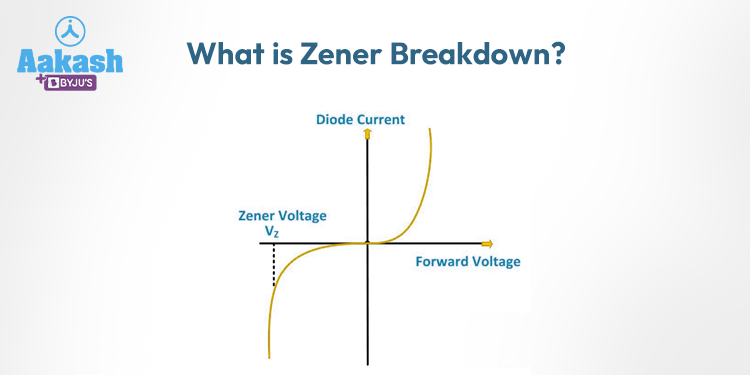

In the world of electronics, precision, and control over voltage levels are paramount. Whether in power supplies, electronic circuits, or communication systems, maintaining a stable and reliable voltage is crucial for proper device operation and preventing damage. This is where the concept of “Zener breakdown” steps in, providing a fascinating mechanism that enables voltage regulation and protection.
Defining Zener Breakdown:
Zener breakdown, often simply referred to as the “Zener effect,” is a fundamental phenomenon that occurs in semiconductors, particularly in diode structures. Named after physicist Clarence Zener, who first described the effect in the 1930s, Zener breakdown involves the sudden and controlled breakdown of a semiconductor diode under reverse bias conditions.
In a standard diode, when a reverse voltage is applied beyond a certain threshold, the diode enters a breakdown region where the voltage across the diode increases dramatically, leading to a significant current flow. This uncontrolled breakdown can potentially damage the diode and connected circuits. However, in a Zener diode, the semiconductor material is specifically designed and doped to exhibit a controlled breakdown behavior.
The Mechanism Behind Zener Breakdown:
Zener breakdown occurs due to a quantum mechanical phenomenon called “quantum tunneling.” Under reverse bias, the electric field across the depletion region of the diode becomes intense. In a Zener diode, this strong electric field enables electrons to tunnel through the depletion region barrier, creating electron-hole pairs. This tunneling effect allows a controlled current to flow through the diode while maintaining a relatively constant voltage across it.
Applications and Benefits:
The controlled breakdown characteristic of Zener diodes makes them invaluable components in various electronic applications:
Voltage Regulation: Zener diodes are widely used as voltage regulators, maintaining a constant voltage across a load even when the input voltage fluctuates. This is crucial in scenarios where a stable voltage is required, such as in power supplies for sensitive electronics.
Voltage Reference: Zener diodes serve as accurate voltage references in electronic circuits, providing a known and stable voltage for comparison purposes.
Overvoltage Protection: Zener diodes offer protection against voltage spikes by diverting excess voltage away from sensitive components. When the voltage exceeds the Zener breakdown voltage, the diode starts conducting, preventing potential damage.
Clipping and Clamping Circuits: Zener diodes are used in clipping and clamping circuits to limit or shift the amplitude of signals, which is essential in communication and signal processing systems.
Conclusion:
Zener breakdown is a remarkable phenomenon rooted in quantum mechanics that has found its way into practical electronic applications, offering precise voltage regulation, reference, and protection. From powering electronic devices to ensuring their safety, Zener diodes play a critical role in modern electronics, highlighting the beautiful synergy between theoretical physics and real-world technology.
FAQs About Zener Breakdown and Zener Diodes:
1. What is Zener breakdown, and how does it differ from regular diode breakdown?
Zener breakdown is a controlled phenomenon that occurs in specially designed semiconductor diodes known as Zener diodes. Unlike regular diodes, which experience an uncontrolled breakdown under reverse bias, Zener diodes exhibit a controlled breakdown behavior due to quantum tunneling, allowing a regulated current flow while maintaining a relatively constant voltage across the diode.
2. How does Zener breakdown enable voltage regulation?
Zener breakdown enables voltage regulation by maintaining a constant voltage drop across the Zener diode, even when the input voltage fluctuates. As the reverse bias voltage increases beyond the Zener breakdown voltage, the diode starts conducting, allowing a controlled current to flow through it and maintaining a stable output voltage across the load.
3. What are the practical applications of Zener diodes in electronics?
Zener diodes have several practical applications, including:
Voltage Regulation: They are used to provide a stable output voltage in power supplies for electronic devices.
Voltage Reference: Zener diodes serve as accurate voltage references for comparison in various circuits.
Overvoltage Protection: They protect sensitive components by diverting excess voltage away from them during voltage spikes.
Clipping and Clamping: Zener diodes are used in signal processing circuits to limit or shift signal amplitudes.
4. How does Zener breakdown offer overvoltage protection?
Zener breakdown provides overvoltage protection by acting as a “voltage clamping” component. When the voltage across the Zener diode exceeds its breakdown voltage, it begins to conduct, effectively shunting excess voltage away from the rest of the circuit. This prevents voltage spikes from damaging sensitive components by limiting the voltage to a safe level.
5. Can Zener breakdown be used for both positive and negative voltage regulation?
Yes, Zener breakdown can be utilized for both positive and negative voltage regulation. While the Zener diode is commonly used for positive voltage regulation, a similar effect, known as the “avalanche breakdown,” can occur in diodes under reverse bias, providing a mechanism for negative voltage regulation. In this context, the term “avalanche diode” is often used to refer to diodes designed for negative voltage regulation using the avalanche breakdown phenomenon.