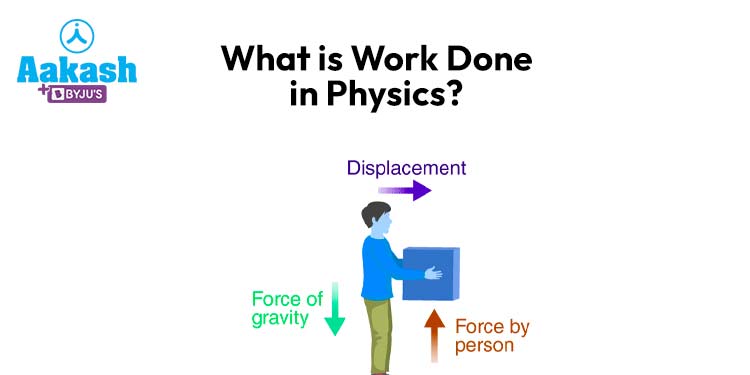

Work is a fundamental concept in physics that plays a crucial role in understanding the interactions between objects and the energy transfers that occur as a result. In the realm of physics, “work” has a very specific definition that may differ from its everyday usage. Let’s delve into what work done means in the context of physics.
Definition of Work:
In physics, work is defined as the product of force and displacement, where the force is applied to an object in the direction of the object’s motion.
Key Points:
Work Requires Displacement: To perform work on an object, there must be both a force acting on the object and a displacement of the object in the direction of that force. If an object doesn’t move or the force is not applied in the direction of motion, no work is done.
Units of Work: In the International System of Units (SI), work is measured in joules (J). One joule is equivalent to the work done when a force of one Newton acts over a distance of one meter in the direction of the force.
Sign of Work: Work can be positive, negative, or zero. Positive work is done when the force applied causes an object to move in the direction of the force. Negative work is done when the force opposes the object’s motion, and zero work occurs when the force and displacement vectors are perpendicular.
Applications of Work in Physics:
Mechanical Work: Work is extensively used to analyze mechanical systems, such as lifting objects, pushing or pulling them, and calculating the energy transfers involved.
Kinetic and Potential Energy: Work is related to kinetic and potential energy. The work-energy theorem states that the work done on an object is equal to the change in its kinetic energy. Work done against gravity is stored as potential energy.
Thermodynamics: In thermodynamics, work is central to concepts like the expansion and compression of gases in engines and the conversion of heat into mechanical work.
Electricity and Magnetism: In these fields, work is vital for understanding the movement of charged particles and the generation of electrical energy.
Fluid Mechanics: Work is employed in understanding fluid flow, such as in pumps and turbines.
In conclusion, work done in physics quantifies the transfer of energy from one object to another when a force is applied, and that object is displaced in the direction of the force. This concept is crucial for understanding a wide range of physical phenomena and has practical applications in various branches of science and engineering.
FAQs
1. What is the significance of work in physics?
Work is essential in physics because it quantifies the transfer of energy between objects due to the application of force and displacement. It allows us to understand and analyze various physical phenomena, from mechanical systems to thermodynamics, electricity, and more.
2. How is the direction of the force related to the work done?
The direction of the force applied to an object is crucial in calculating work. Work is maximized when the force and displacement are in the same direction, resulting in positive work. When the force and displacement are perpendicular, no work is done (zero work). If the force opposes the direction of motion, it results in negative work.
3. What are the units of work, and how are they defined?
The units of work in the International System of Units (SI) are joules (J). One joule is defined as the work done when a force of one Newton is applied to an object, causing it to move one meter in the direction of the force.
4. Can work be negative?
Yes, work can be negative. Negative work occurs when the force applied opposes the direction of motion of an object. For example, when lifting an object against gravity, the work done by gravity is negative because it acts in the opposite direction of the displacement.
5. What is the work-energy theorem, and how is it related to work?
The work-energy theorem states that the work done on an object is equal to the change in its kinetic energy. It relates the concept of work to the energy of an object, emphasizing that work results in a transfer of energy. This theorem is fundamental in understanding how forces and motion are interconnected in physics.