
Voltage and current are two fundamental concepts in the field of electronics and electrical engineering. They are essential for understanding how electricity works and play a crucial role in the operation of electrical circuits and devices. Let’s explore each concept in detail:
Voltage:
Voltage, also known as electric potential difference or electromotive force (EMF), is a measure of the electric potential energy difference between two points in an electric circuit. It is the driving force that pushes electric charges to flow from one point to another. Voltage is often represented by the symbol “V” and is measured in volts (V).
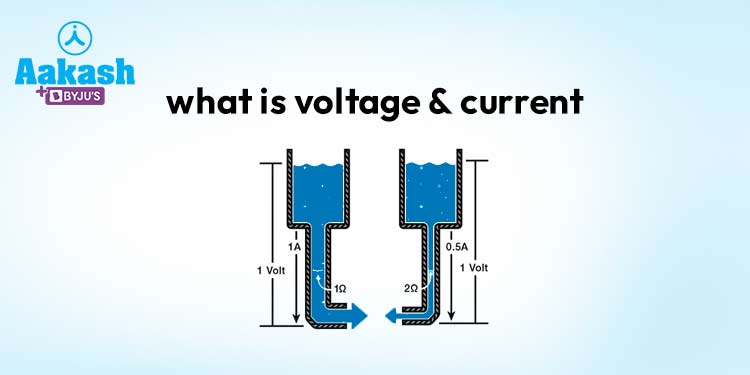
In simple terms, voltage can be compared to the pressure in a water pipe. Just as water flows from high pressure to low pressure, electric charges move from higher voltage to lower voltage. The higher the voltage across a circuit, the more potential energy the electric charges possess, and the greater the push they have to move through the circuit.
Voltage is essential for the operation of electrical devices and systems. For example, batteries generate voltage to power portable electronic devices like smartphones and laptops. Similarly, the voltage provided by power outlets in our homes and workplaces enables the functioning of various appliances and electronics.
Current:
Current refers to the flow of electric charges in an electrical circuit. It is a measure of the rate at which electric charges move through a conductor. Current is represented by the symbol “I” and is measured in amperes (A).
Analogous to the flow of water in a pipe, current represents the flow of electric charges (usually electrons) in a circuit. When a voltage is applied across a conductor, such as a wire, it creates an electric field that exerts a force on the free electrons in the material, causing them to move. The rate of movement of these charges is the electric current.
There are two types of electric current: direct current (DC) and alternating current (AC). In direct current, the flow of charges is constant and unidirectional, as found in batteries. Alternating current, on the other hand, periodically reverses direction in a sinusoidal pattern and is commonly used in power distribution systems.
Relationship between Voltage and Current:
Voltage and current are interrelated through Ohm’s Law, named after the German physicist Georg Simon Ohm. Ohm’s Law states that the current flowing through a conductor is directly proportional to the voltage applied across it and inversely proportional to its resistance:
I = V / R
Where:
I = Current in amperes (A)
V = Voltage in volts (V)
R = Resistance in ohms (Ω)
In summary, voltage and current are fundamental concepts in the study of electricity. Voltage provides the driving force for the movement of electric charges, while current represents the flow of these charges through a circuit. Understanding these concepts is essential for designing and analyzing electrical circuits and ensuring the proper functioning of electronic devices and systems.
Frequently Asked Questions (FAQs) on Voltage and Current:
1. What is the difference between voltage and current?
Voltage and current are both fundamental properties of electricity but serve different purposes. Voltage (V) is the electric potential difference between two points in a circuit and represents the driving force that pushes electric charges. Current (I), on the other hand, is the flow of electric charges through a conductor, such as a wire. In simple terms, voltage is the pressure that causes charges to move, while current is the actual flow of charges.
2. What unit is used to measure voltage and current?
Voltage is measured in volts (V), while current is measured in amperes (A). A volt represents one joule of electric potential energy per coulomb of charge, and an ampere represents one coulomb of charge flowing per second.
3. How are voltage and current related?
Voltage and current are related through Ohm’s Law, which states that current (I) is equal to the voltage (V) across a circuit divided by its resistance (R): I = V / R. This relationship shows that for a given voltage, the current increases with decreasing resistance, and vice versa.
4. What is the significance of voltage in electrical devices?
Voltage is crucial for the operation of electrical devices and systems. It is the energy source that powers electronic devices, such as smartphones, laptops, and household appliances. Different devices require specific voltage levels for proper functioning, and incorrect voltage levels can lead to damage or malfunction.
5. What is direct current (DC) and alternating current (AC)?
Direct current (DC) is a type of electric current that flows in one direction through a circuit. It is commonly produced by batteries and is used in devices that require a constant and steady flow of current. Alternating current (AC), on the other hand, periodically reverses direction in a sinusoidal pattern. AC is the type of current used in most power distribution systems because it can be easily transformed to different voltage levels for efficient long-distance transmission.