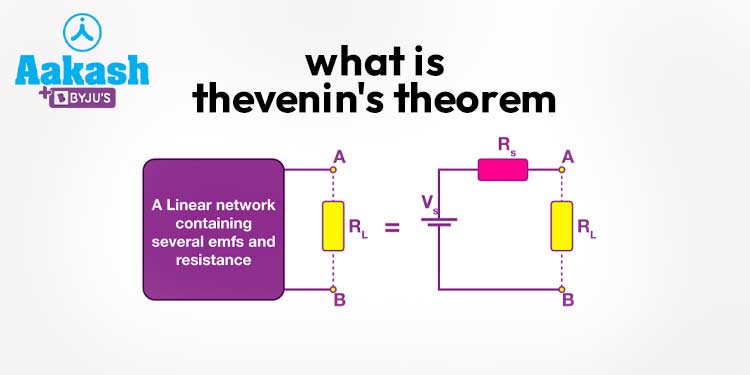

Thevenin’s Theorem is a fundamental concept in electrical engineering and circuit analysis. It provides a powerful method to simplify complex electrical circuits and analyze their behavior, especially when dealing with interconnected networks of resistors, voltage sources, and current sources. Named after the French engineer Léon Charles Thévenin, the theorem is widely used in various applications to predict the behavior of electrical systems.
At its core, Thevenin’s Theorem states that any linear electrical network containing voltage sources, current sources, and resistors can be replaced with an equivalent circuit, which consists of a single voltage source in series with a single resistor. This simplified representation, known as the Thevenin equivalent circuit, accurately models the behavior of the original circuit at a specific pair of terminals.
The Thevenin equivalent circuit comprises two main components:
Thevenin Voltage (Vth): The Thevenin voltage (Vth) is the voltage across the terminals of interest when the original circuit is disconnected from the load. To find Vth, all voltage sources in the original circuit are replaced with short circuits, and the resulting voltage across the terminals is measured.
Thevenin Resistance (Rth): Thevenin resistance (Rth) is the resistance between the terminals of interest when all the independent sources in the original circuit are turned off (replaced with open circuits). Rth can be calculated by removing all voltage and current sources and then determining the equivalent resistance seen from the terminals.
The Thevenin equivalent circuit is particularly useful for determining the behavior of a complex circuit when it is connected to various external loads. Instead of performing detailed analysis on the original circuit for every load condition, engineers can use the Thevenin equivalent circuit to quickly and accurately predict the voltage and current across any connected load.
To use Thevenin’s Theorem for analysis:
- Identify the terminals of interest in the circuit.
- Remove any load or component connected to those terminals.
- Analyze the circuit to find the Thevenin voltage (Vth) by shorting all voltage sources.
- Analyze the circuit to find the Thevenin resistance (Rth) by turning off all sources.
- Reconnect the load to the terminals and use the Thevenin equivalent circuit to analyze the circuit behavior as seen by the load.
Thevenin’s Theorem is incredibly versatile and simplifies circuit analysis, making it a valuable tool in various engineering applications, such as circuit design, power distribution, electronic systems, and telecommunications. It is also an essential concept for students and professionals working in the field of electrical and electronics engineering, as it helps them understand and solve complex electrical circuits with ease and efficiency.
FAQs about Thevenin’s Theorem:
What is Thevenin's Theorem used for?
Thevenin's Theorem is used to simplify complex electrical circuits and analyze their behavior when interconnected with various loads. It allows engineers to determine the equivalent circuit of a more intricate network, reducing it to a single voltage source and a single resistor. This simplified representation is particularly useful in predicting circuit behavior under different load conditions without the need for detailed analysis of the original circuit.
Can Thevenin's Theorem be applied to non-linear circuits?
No, Thevenin's Theorem is specifically applicable to linear circuits only. A linear circuit is one in which the relationship between voltage and current remains constant, following Ohm's Law. If the circuit contains elements like diodes, transistors, or nonlinear components, Thevenin's Theorem cannot be directly used. In such cases, other methods, like the Superposition Theorem, may be applied for analysis.
How do I find the Thevenin voltage and resistance?
To find the Thevenin voltage (Vth), you need to disconnect all independent sources (voltage and current sources) in the original circuit and calculate the voltage across the terminals of interest. To find the Thevenin resistance (Rth), you need to deactivate all the independent sources and calculate the equivalent resistance seen from the terminals. Vth and Rth values together constitute the Thevenin equivalent circuit.
Can Thevenin's Theorem be applied to AC circuits?
Yes, Thevenin's Theorem can be used with AC circuits, as long as the circuit components follow linear behavior. The process of finding the Thevenin voltage and resistance remains the same for AC circuits as it is for DC circuits. However, complex impedances are used instead of resistors when dealing with AC circuits.
What are the advantages of using Thevenin's Theorem in circuit analysis?
Thevenin's Theorem offers several advantages:
Simplification: It reduces complex circuits to a single voltage source and resistor, making analysis more manageable.
Efficiency: Engineers can quickly predict circuit behavior under different load conditions without detailed calculations for every scenario.
Flexibility: The Thevenin equivalent circuit can be easily updated when external loads change, allowing for quick adjustments to the circuit design.
Intuitive understanding: The theorem provides a clear and intuitive picture of how a circuit behaves at its terminals, improving the understanding of circuit behavior.