
Proposed by the renowned physicist Albert Einstein in the early 20th century, the theory of relativity consists of two major components: the Special Theory of Relativity and the General Theory of Relativity.
The Theory of Relativity is a fundamental scientific framework that revolutionized our understanding of the physical universe. Proposed by the renowned physicist Albert Einstein in the early 20th century, it consists of two major components: the Special Theory of Relativity and the General Theory of Relativity. These groundbreaking theories have had a profound impact on various fields of science, including physics, astronomy, and cosmology.
Special Theory of Relativity
The Special Theory of Relativity, published by Albert Einstein in 1905, fundamentally changed our understanding of space, time, and motion. It introduces two postulates that lay the foundation for the theory:
The Principle of Relativity:
The laws of physics are the same for all observers, regardless of their relative velocities. This means that there is no preferred frame of reference, and the laws of physics apply universally.
The Speed of Light Postulate:
The speed of light in a vacuum is constant and is the same for all observers, regardless of their relative motions. This constant speed of light is denoted by ‘c’ and is approximately 299,792 kilometers per second (km/s).
Based on these postulates, the Special Theory of Relativity derives several remarkable conclusions, including time dilation and length contraction. Time dilation suggests that time moves slower for objects in motion relative to an observer, while length contraction means that objects appear shorter in the direction of motion. Additionally, the theory introduces the famous equation E=mc^2, which shows the equivalence of mass (m) and energy (E) and reveals the enormous energy locked within matter.
General Theory of Relativity
Building upon the Special Theory of Relativity, Einstein formulated the General Theory of Relativity, published in 1915. This theory addresses the force of gravity and presents a new understanding of gravitation, replacing Newton’s classical theory of gravity.
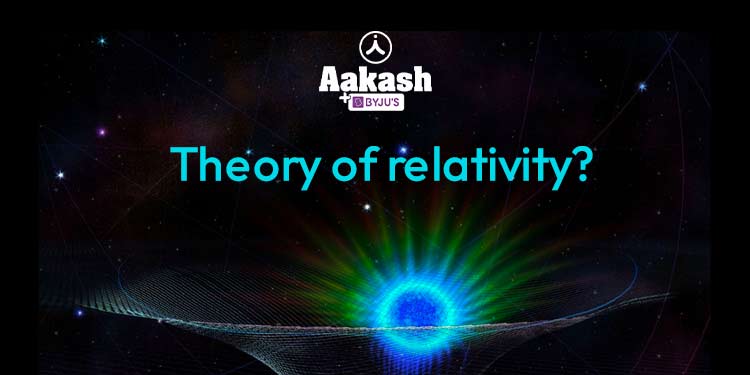
The core idea of the General Theory of Relativity is that gravity is not a force transmitted through space as Newton suggested but rather a consequence of the curvature of spacetime caused by the presence of mass and energy. Massive objects, such as planets, stars, and galaxies, bend the fabric of spacetime around them, and other objects move along curved paths in response to this curvature, creating the effect we perceive as gravity.
The General Theory of Relativity has successfully explained various phenomena, including the precession of the orbit of Mercury, the bending of light around massive objects (gravitational lensing), and the time dilation near massive bodies.
The implications of the Theory of Relativity go far beyond the realm of physics and have been influential in fields like cosmology and astrophysics. Concepts like black holes, time travel, and the expanding universe are all intertwined with the principles established by Einstein’s theories.
In summary, the Theory of Relativity is one of the cornerstones of modern physics, redefining our understanding of the fundamental aspects of the universe. Its profound insights continue to shape scientific research and technological advancements, leaving an enduring legacy that has stood the test of time.
FAQs on the Theory of Relativity
What is the Theory of Relativity?
The Theory of Relativity is a scientific framework proposed by Albert Einstein in the early 20th century. It consists of two major components: the Special Theory of Relativity and the General Theory of Relativity. These theories revolutionized our understanding of space, time, motion, and gravity, and have had a profound impact on various fields of science.
What is the difference between the Special Theory of Relativity and the General Theory of Relativity?
The Special Theory of Relativity, published in 1905, deals with objects moving at constant velocity in the absence of gravitational forces. It introduces concepts like time dilation, length contraction, and the equivalence of mass and energy (E=mc^2). On the other hand, the General Theory of Relativity, published in 1915, addresses gravity as the curvature of spacetime caused by mass and energy, providing a new understanding of gravitation that replaces Newton's classical theory of gravity.
How does the Theory of Relativity impact everyday life?
The Theory of Relativity has significant effects on everyday life, although they might not always be directly noticeable. One of the most relevant impacts is in the functioning of the Global Positioning System (GPS). The satellites that make up the GPS network have to take into account the time dilation effects of their motion in orbit and the gravitational fields they experience to provide accurate positioning information.
Does the Theory of Relativity support time travel?
The Theory of Relativity allows for the theoretical possibility of time travel, especially in the context of the General Theory of Relativity. According to some solutions to Einstein's equations, objects like black holes or wormholes could create "time loops" or paths through spacetime that might allow for time travel. However, the practicality and feasibility of such travel remain highly speculative and have not been experimentally verified.
Are there any experimental confirmations of the Theory of Relativity?
Yes, both the Special Theory of Relativity and the General Theory of Relativity have been confirmed through various experiments and observations. The Special Theory of Relativity's predictions, such as time dilation, have been verified in particle accelerators and high-speed experiments. The General Theory of Relativity's predictions, such as the bending of light around massive objects, have been confirmed through observations of gravitational lensing during astronomical events. Additionally, precision tests of gravity have validated the theory's predictions on the behavior of spacetime near massive objects.