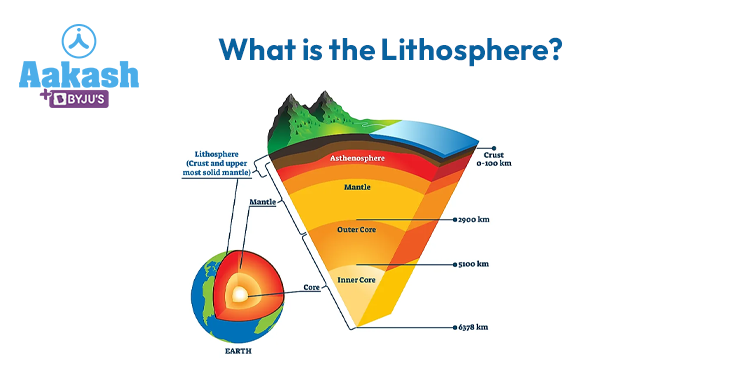

The lithosphere, a term derived from the Greek words “lithos” meaning rock, and “sphaira” meaning sphere, constitutes one of the Earth’s fundamental layers. It encompasses the outermost shell of our planet and serves as the sturdy foundation upon which the intricate web of life, geological processes, and human civilization rests. Comprising both the Earth’s crust and the uppermost part of the mantle, the lithosphere plays a vital role in shaping the physical and geological dynamics of our planet.
Composition and Structure:
The lithosphere is divided into two main components: the continental crust and the oceanic crust, each possessing distinct characteristics and compositions. The continental crust is predominantly composed of granitic rocks, which are less dense and generally older than the oceanic crust. In contrast, the oceanic crust consists mainly of basaltic rocks and is comparatively denser and younger. Beneath the crust lies the uppermost portion of the mantle, which exhibits solid behavior due to high pressure and relatively cooler temperatures.
The Lithospheric Plates:
One of the most intriguing aspects of the lithosphere is the concept of tectonic plates. The lithosphere is fragmented into several large and small sections known as tectonic plates. These plates float on the semi-fluid asthenosphere beneath them. The movement of these plates, known as plate tectonics, is responsible for a range of geological phenomena, including earthquakes, volcanic activity, mountain formation, and the creation of oceanic trenches.
Dynamic Earth:
The lithosphere is far from static; it’s a dynamic and ever-changing realm. The movement of tectonic plates is driven by the heat generated within the Earth’s core, which creates convection currents in the mantle. These currents cause the plates to move, collide, or diverge, resulting in the creation and destruction of landforms over vast timescales.
Interaction with Other Spheres:
While the lithosphere is distinct from the other Earth spheres – namely the atmosphere, hydrosphere, and biosphere – it is intricately connected to them. For instance, the lithosphere influences the atmosphere through processes like erosion and volcanic activity, while the hydrosphere interacts with the lithosphere through the shaping of coastlines, the movement of sediments, and the formation of oceans and other bodies of water. Furthermore, the lithosphere supports the biosphere by providing habitats for various organisms, including humans.
Human Impact:
Human activities have a profound impact on the lithosphere. From mining and quarrying to urbanization and deforestation, these activities alter the natural landscape and can lead to erosion, soil degradation, and habitat loss. Additionally, the extraction of minerals and fossil fuels from the lithosphere contributes to both environmental and geopolitical challenges.
In conclusion, the lithosphere stands as a testament to the Earth’s intricate and interconnected systems. Its solid structure, shaped by eons of geological processes, serves as the foundation upon which the planet’s diverse ecosystems and civilizations thrive. The concept of the lithosphere and its interactions with other Earth spheres underscore the dynamic nature of our planet and its ongoing evolution.
FAQs About the Lithosphere
1. What exactly is the lithosphere?
The lithosphere refers to the outermost layer of the Earth, encompassing both the crust and the uppermost part of the mantle. It is composed of solid rocks and is divided into tectonic plates that float on the semi-fluid asthenosphere beneath them. The lithosphere plays a crucial role in shaping geological processes and supporting life on Earth.
2. How is the lithosphere different from the other Earth spheres?
The Earth is divided into several interconnected spheres, including the atmosphere, hydrosphere, biosphere, and lithosphere. While the lithosphere deals with solid rocks and tectonic activity, the atmosphere involves gases, the hydrosphere encompasses water bodies, and the biosphere comprises all living organisms. These spheres interact and influence each other in complex ways.
3. What are tectonic plates, and why are they important?
Tectonic plates are large and small sections into which the lithosphere is fragmented. They float on the semi-fluid asthenosphere beneath them. The movement of tectonic plates, driven by convection currents in the mantle, leads to phenomena like earthquakes, volcanic eruptions, mountain formation, and the creation of oceanic features like trenches. Plate tectonics is a fundamental process that shapes the Earth’s surface over time.
4. How does the lithosphere affect human activities?
The lithosphere has a profound impact on human activities and vice versa. Humans extract minerals, metals, and fossil fuels from the lithosphere for various purposes. However, these activities can lead to environmental degradation, habitat destruction, and even geopolitical tensions. Urbanization, deforestation, and agriculture also alter the lithosphere and its ecosystems.
5. Can you explain the concept of the lithosphere’s dynamic nature?
The lithosphere is far from static; it’s a dynamic and ever-changing layer of the Earth. The movement of tectonic plates is caused by the heat generated within the Earth’s core, resulting in convection currents in the mantle. These currents drive the plates to move, collide, or separate, leading to the formation of new landforms and the modification of existing ones. This dynamic nature underscores the Earth’s ongoing geological evolution.