
Understanding the concepts of mass and weight is fundamental to our understanding of the physical world around us. While these terms are often used interchangeably in everyday language, they hold distinct scientific meanings that are crucial in various fields, including physics and engineering. Mass and weight are two fundamental properties that describe an object’s interaction with gravity, yet they differ in fundamental ways. In this article, we’ll delve into the nuances of mass and weight, exploring their definitions, units of measurement, and the intriguing ways they influence our perception of the universe.
Here’s the Difference between Mass and Weight
Mass:
Mass is a fundamental property of matter that measures the amount of substance in an object. It is a scalar quantity, meaning it has magnitude but no direction. Mass is an intrinsic property of an object and remains constant regardless of the object’s location. In other words, an object’s mass is the same whether it’s on Earth, the Moon, or in space.
The standard unit of mass in the International System of Units (SI) is the kilogram (kg). Mass can also be measured in grams (g) or other units, but the kilogram is the base unit.
Weight:
Weight, on the other hand, is the force exerted on an object due to gravity. It depends on both the mass of the object and the acceleration due to gravity at the object’s location. Weight is a vector quantity because it has both magnitude and direction (toward the center of the Earth).
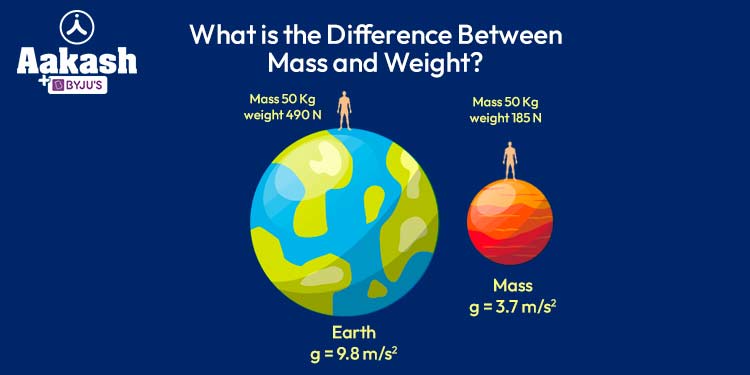
The formula to calculate weight is: Weight (W) = mass (m) × acceleration due to gravity (g)
On Earth, the acceleration due to gravity is approximately 9.81 meters per second squared (9.81 m/s²), but this value can vary slightly depending on your location on Earth’s surface.
Since weight is dependent on gravity, it changes when an object is moved to a different location with a different gravitational field. For example, an object that weighs a certain amount on Earth would weigh less on the Moon due to the Moon’s weaker gravitational pull.
In summary, the key differences between mass and weight are:
Definition: Mass is the amount of matter in an object and remains constant regardless of location. Weight is the force exerted on an object due to gravity and changes with location.
Units: Mass is measured in kilograms (kg) or other mass units, while weight is measured in newtons (N) or pounds (lb) in most cases.
Invariance: Mass doesn’t change, but weight can vary based on the strength of gravity at different locations.
Remember that understanding the distinction between mass and weight is crucial in various scientific and everyday contexts, as they are often used interchangeably but have distinct meanings and implications.
FAQs about the difference between Mass and Weight:
1. What is the main difference between mass and weight?
Mass is the measure of the amount of matter in an object and remains constant regardless of location. Weight is the force exerted on an object due to gravity and varies depending on the gravitational field strength of the object’s location.
2. Is mass the same everywhere in the universe?
Yes, an object’s mass remains the same regardless of its location in the universe. Mass is an intrinsic property of an object and is independent of external factors.
3. Why does weight change with location, but mass doesn’t?
Weight changes with location because it depends on the strength of the gravitational field. Gravity is weaker on the Moon than on Earth, for example, so an object’s weight would be different on the Moon. Mass, however, remains unchanged as it is a measure of the amount of matter in the object.
4. Can an object have a mass of zero?
No, an object cannot have a mass of zero. Mass is a fundamental property of matter, and all matter has some amount of mass. However, there are particles, like photons, that have zero rest mass, but they still have energy.
5. Why do we measure weight in newtons instead of kilograms?
Weight is a force, and forces are measured in newtons (N). The weight of an object is the force exerted on it due to gravity, so using newtons as the unit makes sense. Mass, on the other hand, is measured in kilograms (kg) because it is a measure of the amount of substance in an object.