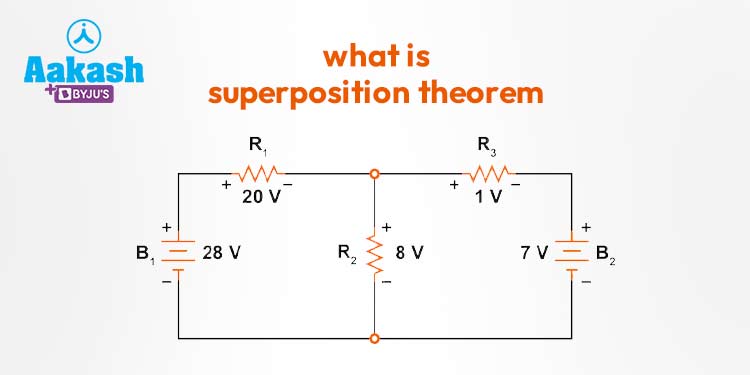

In the realm of electrical engineering, analyzing complex circuits can be a challenging task. Engineers often encounter circuits with multiple voltage sources, current sources, and interconnected components, making traditional analysis techniques laborious and time-consuming. Fortunately, the Superposition Theorem offers a powerful and efficient method to solve such complex circuits and gain valuable insights into their behavior.
Definition of Superposition Theorem:
The Superposition Theorem is a fundamental principle used to analyze linear electrical circuits that contain multiple sources of voltage or current. It states that the response (current or voltage) in any branch of a linear circuit with multiple sources can be determined by calculating the individual contributions of each source, considering one source at a time while keeping the rest turned off (replaced by their internal resistances).
Conditions for Applying the Superposition Theorem:
The Superposition Theorem applies only to circuits that satisfy two essential conditions:
Linearity: The circuit elements must be linear, which means that their responses (currents or voltages) are directly proportional to the applied voltage or current. Most passive electronic components, such as resistors, capacitors, and inductors, exhibit linear behavior within their operating limits.
Superposition: This principle holds true only for circuits with sources that are independent of each other. Independent sources are those whose values are not affected by the presence of other sources in the circuit. For instance, two voltage sources are independent if their values do not depend on each other.
Applying the Superposition Theorem:
To analyze a circuit using the Superposition Theorem, follow these steps:
Identify the independent sources: Determine all voltage sources and current sources present in the circuit.
Turn off all sources but one: Disable all independent sources in the circuit, except for one whose effect you want to analyze.
Calculate the response: Analyze the circuit as if it contains only the active source (the one not turned off). Determine the current or voltage in the desired branch of the circuit.
Repeat for all sources: Repeat steps 2 and 3 for each independent source, considering them individually while the others remain inactive.
Superposition: Finally, find the overall response by adding the contributions of each source. For currents, use algebraic summation, taking care of the direction and sign conventions.
Advantages of the Superposition Theorem:
The Superposition Theorem offers several advantages in circuit analysis:
Simplicity: It simplifies the analysis of complex circuits, breaking them down into smaller, more manageable parts.
Efficiency: By analyzing the circuit one source at a time, engineers can quickly obtain solutions for specific voltages or currents without needing to solve complex simultaneous equations.
Widely applicable: The theorem is applicable to various types of linear circuits, allowing engineers to use it across a broad range of applications.
Limitations of the Superposition Theorem:
Although the Superposition Theorem is a powerful tool, it does have some limitations:
Limited to linear circuits: It can only be applied to linear circuits. Non-linear elements, such as diodes and transistors, cannot be analyzed using this method.
Complex circuits: In some cases, circuits with many sources may require substantial computation, making the process cumbersome.
In conclusion, the Superposition Theorem is an invaluable tool for analyzing linear electrical circuits with multiple sources. By breaking down complex circuits into simpler parts, engineers can efficiently solve for currents and voltages, gaining valuable insights into the behavior of the circuit and enabling them to design and troubleshoot electronic systems more effectively.
Frequently Asked Questions (FAQs) about the Superposition Theorem:
1. What types of circuits can be analyzed using the Superposition Theorem?
The Superposition Theorem can be applied to linear circuits, which consist of passive components like resistors, capacitors, and inductors, as well as independent voltage and current sources. It is essential to ensure that all circuit elements exhibit linear behavior within their operating limits.
2. Can the Superposition Theorem be used for circuits with non-linear components?
No, the Superposition Theorem is limited to linear circuits only. It cannot be applied to circuits containing non-linear elements such as diodes, transistors, or any components with non-linear voltage-current characteristics.
3. Is it necessary to turn off all sources in the circuit while applying the Superposition Theorem?
Yes, to analyze the effect of each individual source, all other independent sources must be turned off (replaced by their internal resistances or short-circuited for voltage sources) one at a time. This step is crucial to obtain accurate results.
4. Are dependent sources considered when applying the Superposition Theorem?
No, the Superposition Theorem only applies to independent sources. Dependent sources, which are controlled by other elements in the circuit, are not directly considered in this method.
5. What are the practical benefits of using the Superposition Theorem?
The Superposition Theorem simplifies the analysis of complex circuits by breaking them down into smaller, more manageable parts. It allows engineers to efficiently solve for specific currents or voltages without needing to solve complex simultaneous equations, making it a powerful tool for circuit analysis and design.