
Understanding the concepts of the shielding effect and screening effect is crucial for students learning about atomic structure and periodic trends in chemistry. These effects play a significant role in determining the properties of elements.
What is Shielding Effect?
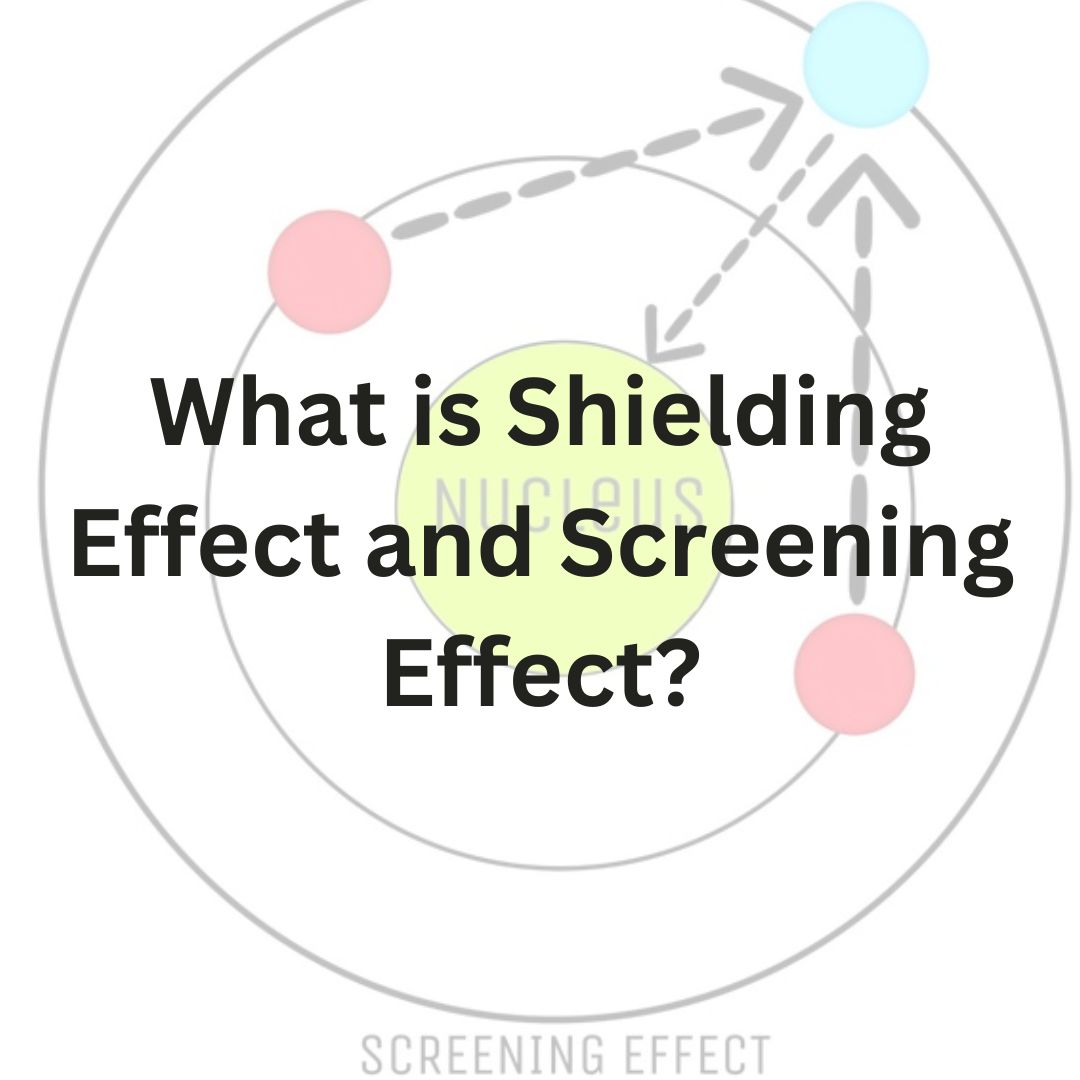
The shielding effect, also known as the screening effect, refers to the phenomenon where inner-shell electrons reduce the effective nuclear charge felt by the outer-shell electrons. In an atom, electrons are arranged in various shells or energy levels around the nucleus. The positively charged nucleus attracts the negatively charged electrons. However, electrons in the inner shells repel electrons in the outer shells, thus reducing the overall attractive force exerted by the nucleus on the outer-shell electrons.
For example, in a sodium atom (Na), the single electron in the outermost shell is shielded by the ten electrons in the inner shells. This shielding effect makes the outermost electron less tightly bound to the nucleus, making it easier to remove.
What is Screening Effect?
The screening effect is essentially another term for the shielding effect. Both terms describe the same phenomenon where inner electrons block or screen the outer electrons from the full attractive force of the nucleus. The screening effect can be quantified using Slater’s rules, which provide a way to calculate the effective nuclear charge on an electron.
Importance of Shielding and Screening Effects
These effects are essential in understanding several atomic properties:
- Atomic Size: The more significant the shielding effect, the larger the atomic radius, as the outer electrons are less tightly held by the nucleus.
- Ionization Energy: Atoms with a strong shielding effect have lower ionization energies because it is easier to remove an outer electron.
- Chemical Reactivity: Elements with high shielding effects tend to be more reactive, especially metals, because their outer electrons can be more easily lost or shared in chemical reactions.
In summary, the shielding or screening effect is a fundamental concept in chemistry that explains the influence of inner-shell electrons on the behavior of outer-shell electrons. Understanding these effects helps students grasp how atomic structure impacts element properties and periodic trends.
Shielding Effect and Screening Effect FAQs
Q1. What is the shielding effect in chemistry?
Ans. The shielding effect refers to the phenomenon where inner-shell electrons reduce the effective nuclear charge felt by outer-shell electrons. This occurs because the inner electrons repel the outer electrons, lessening the attractive force of the nucleus on the outer electrons.
Q2. How does the shielding effect impact atomic size?
Ans. The shielding effect increases atomic size. When inner electrons shield outer electrons from the nucleus’s full attractive force, the outer electrons are held less tightly, allowing the atom to expand.
Q3. What is the difference between the shielding effect and the screening effect?
Ans. There is no difference between the shielding effect and the screening effect. Both terms describe the same phenomenon where inner-shell electrons block or screen the outer-shell electrons from the full attractive force of the nucleus.
Q4. How does the shielding effect influence ionization energy?
Ans. The shielding effect decreases ionization energy. With more shielding, the outer electrons are less tightly bound to the nucleus, making them easier to remove. Therefore, atoms with a significant shielding effect have lower ionization energies.
Q5. Why is understanding the shielding effect important in chemistry?
Ans. Understanding the shielding effect is crucial because it helps explain various atomic properties and periodic trends. It impacts atomic size, ionization energy, and chemical reactivity, providing insights into how elements behave and interact in chemical reactions.