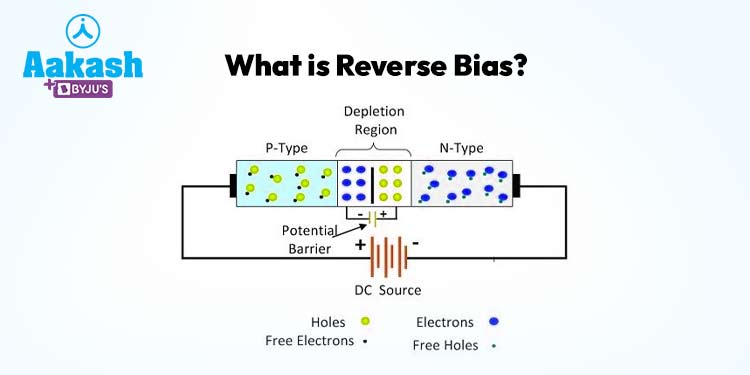

Semiconductor diodes are fundamental electronic components that play a crucial role in modern electronics. One important characteristic of diodes is their ability to conduct electrical current in only one direction, thanks to a property known as biasing. Biasing refers to the application of an external voltage to a diode to control its behavior. One of the common biasing configurations is reverse bias.
Definition of Reverse Bias:
Reverse bias occurs when the voltage applied to a diode creates a potential barrier that opposes the flow of current across the diode. In other words, the voltage is applied in a way that the positive terminal of the power supply is connected to the diode’s N-type material (the side with excess electrons), and the negative terminal is connected to the diode’s P-type material (the side with fewer electrons).
How Reverse Bias Works?
In a diode under reverse bias, the external voltage works against the natural charge flow. This external voltage adds to the existing potential barrier created by the junction of the P and N materials within the diode. This increased potential barrier prevents the majority carriers (electrons in the N-type and holes in the P-type) from crossing the junction, effectively reducing the flow of current.
Impact on Current Flow:
Due to the reverse bias, the width of the depletion region – the region near the junction where no majority carriers exist – increases. This leads to a significant decrease in the flow of current across the diode. In an ideal diode, under reverse bias conditions, the current is nearly zero. However, in real-world diodes, there might be a small leakage current due to minority carrier drift and other effects.
Applications of Reverse Bias:
Reverse bias has several practical applications in electronic circuits:
Photodiodes and Solar Cells: Photodiodes and solar cells use reverse bias to create a larger depletion region, allowing them to efficiently detect light or convert light energy into electrical energy.
Avalanche Breakdown: At a high enough reverse bias voltage, the electric field across the depletion region can become strong enough to cause an avalanche breakdown, where electrons gain enough energy to knock additional electrons from the crystal lattice, leading to a sudden increase in current. This is used in avalanche diodes and some types of Zener diodes.
Varactor Diodes: Varactor diodes are used in tuning circuits, oscillators, and voltage-controlled oscillators. Their capacitance changes with the applied reverse bias voltage, which is useful in electronic tuning applications.
PIN Diodes: These diodes are used as RF switches and in photodetectors. The intrinsic layer between the P and N layers helps control the resistance under reverse bias.
Cautions with Reverse Bias:
Applying excessive reverse bias voltage can lead to permanent damage to the diode due to breakdown phenomena. The reverse voltage should always be kept within the manufacturer’s specifications.
In summary, reverse bias is a fundamental concept in the world of semiconductor devices. It forms the basis for several applications that capitalize on the behavior of diodes under this biasing condition, allowing for the creation of versatile and efficient electronic circuits.
FAQs About Reverse Bias in Semiconductor Diodes
1. What is reverse bias in a diode?
Reverse bias refers to the condition in which the voltage applied to a semiconductor diode is oriented in a way that opposes the natural flow of current. In this configuration, the positive terminal of the power supply is connected to the diode’s N-type material, and the negative terminal is connected to the P-type material, creating an increased potential barrier at the junction.
2. How does reverse bias affect diode behavior?
Under reverse bias, the depletion region near the junction of the diode widens due to the increased potential barrier. This inhibits the flow of majority carriers (electrons in the N-type and holes in the P-type), leading to a significant reduction in current through the diode. Ideally, the current is very close to zero under reverse bias.
3. What are some applications of reverse bias?
Reverse bias has practical applications in various electronic components:
Photodiodes and Solar Cells: Reverse bias enhances the sensitivity of photodiodes and the efficiency of solar cells by widening the depletion region, enabling better light detection and energy conversion.
Avalanche Breakdown: High reverse bias can trigger avalanche breakdown, useful in avalanche diodes and Zener diodes.
Varactor Diodes: These diodes exhibit capacitance changes under reverse bias, making them valuable in tuning circuits and voltage-controlled oscillators.
PIN Diodes: Under reverse bias, PIN diodes exhibit controlled resistance, used in RF switches and photodetectors.
4. Is there any current under reverse bias?
In an ideal diode, the current under reverse bias is negligible. However, due to factors like minority carrier drift, there might be a small leakage current. It’s crucial to consider the manufacturer’s specifications and operating conditions to avoid excessive reverse bias and associated leakage current.
5. What precautions should be taken with reverse bias?
Applying excessive reverse bias voltage can lead to breakdown, causing permanent damage to the diode. To prevent this, it’s essential to adhere to the manufacturer’s recommended reverse bias limits. Always ensure that the reverse voltage remains within these limits to maintain the integrity and longevity of the diode.