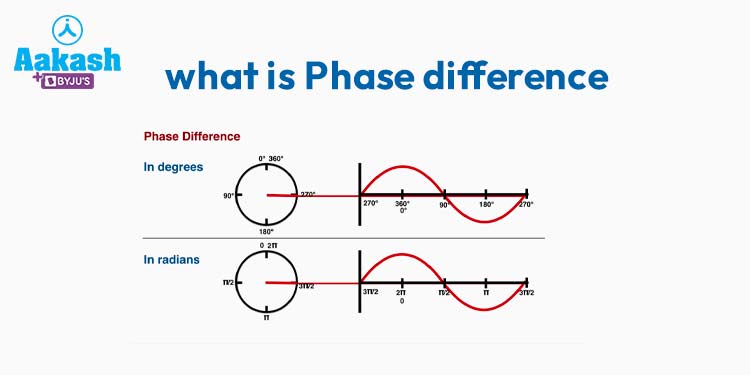

Phase difference is a concept commonly encountered in various fields, including physics, engineering, and signal processing. It refers to the angular difference or displacement between two waveforms, oscillations, or periodic events. This phenomenon is fundamental to understanding wave behavior and is essential in many real-world applications.
Understanding Waveforms:
Before delving into phase differences, it is crucial to understand the nature of waveforms. Waves are characterized by their periodicity, which means they repeat in a regular pattern over time. The most common types of waves include sine waves, square waves, and triangular waves. These waves can represent various physical phenomena like sound waves, electromagnetic waves, and electrical signals.
Defining Phase Difference:
The phase of a waveform is a measure of its position within one full cycle. A full cycle represents a complete oscillation or a 360-degree rotation. Phase difference, on the other hand, measures the shift in degrees or radians between two waveforms. It indicates how much one waveform leads or lags behind the other concerning time.
Phase Difference in Sinusoidal Waves:
The concept of phase difference is frequently illustrated using sinusoidal waves. A sine wave is a smooth oscillation that can be described mathematically as:
y(t)=A⋅sin(2πft+ϕ)
Where:
- y(t) is the value of the sine wave at time t,
- A is the amplitude of the wave (the peak value),
- f is the frequency (number of cycles per unit time),
- t is the time variable, and
- ϕ is the phase angle.
Positive and Negative Phase Difference:
A positive phase difference occurs when one waveform lags behind the other in time. In contrast, a negative phase difference indicates that one waveform leads the other. The phase difference is expressed in degrees or radians, with a full cycle representing 360 degrees or
2π radians.
Applications of Phase Difference:
Phase difference has numerous practical applications across different domains, including:
Audio and Sound Engineering: In audio processing, the phase difference is crucial for stereo sound, sound mixing, and the design of acoustic environments.
Electronics and Communications: In signal processing and telecommunications, the phase difference is used for modulation, demodulation, and synchronization of signals.
Vibration Analysis: In mechanical and structural engineering, a phase difference is employed to study vibrations and resonant frequencies in structures.
Electrical Power Systems: In power engineering, the phase difference is essential for understanding power factors and correcting phase imbalances in three-phase power systems.
Medical Imaging: In medical imaging techniques such as MRI, understanding phase differences is essential for generating accurate images.
Conclusion:
Phase difference is a fundamental concept that plays a significant role in wave analysis and signal processing. It describes the angular displacement between two waveforms and finds applications in a wide range of fields, from physics to engineering and beyond. Understanding phase difference is crucial for solving complex problems and optimizing various systems and processes that rely on wave behavior.