
Mass is a fundamental property of matter, representing the amount of substance in an object or a system. It is one of the most essential concepts in physics and plays a crucial role in understanding the behavior of objects in the universe. Mass is a scalar quantity, meaning it only has a magnitude and no direction.
Measuring ass:
The standard unit for measuring mass in the International System of Units (SI) is the kilogram (kg). One kilogram is defined as the mass of the international prototype of the kilogram, a specific platinum-iridium cylinder kept at the International Bureau of Weights and Measures in France.
Mass can also be measured in other units, such as grams (g) or metric tons (tonnes), depending on the size of the object being measured. For everyday purposes, people often use units like grams or kilograms, while larger masses like those of celestial bodies are expressed in metric tons.
Differences between Mass and Weight:
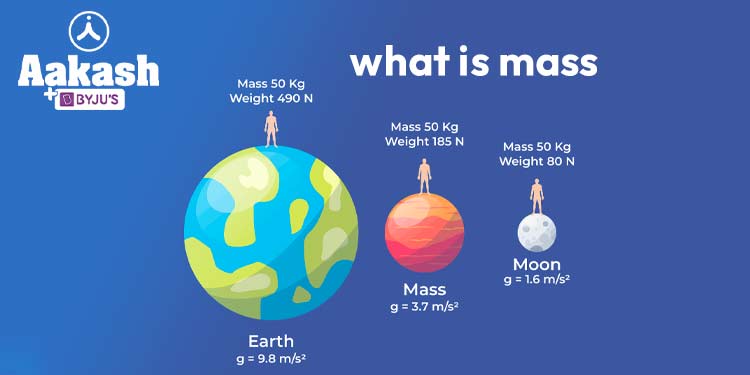
Although often used interchangeably in everyday language, mass, and weight are distinct concepts in physics. Weight is the force exerted on an object due to gravity, and it depends on both the object’s mass and the strength of the gravitational field where the object is located.
The formula to calculate a weight (W) is: W = m * g
Where:
W = Weight (in newtons, N)
m = Mass (in kilograms, kg)
g = Acceleration due to gravity (in meters per second squared, m/s²)
On the surface of the Earth, where the acceleration due to gravity is approximately 9.81 m/s², the weight of an object is approximately equal to its mass multiplied by 9.81. However, the value of gravity varies depending on the location, so an object’s weight would be different on the Moon, Mars, or any other celestial body.
In contrast, mass remains the same regardless of the object’s location in the universe. An object with a mass of 5 kilograms on Earth would also have a mass of 5 kilograms on the Moon or any other planet.
The Role of Mass in Physics:
Mass is a fundamental parameter in many physical laws and equations. It appears in Newton’s second law of motion, which states that the force (F) applied to an object is proportional to its mass (m) and the acceleration (a) it experiences. The law is often expressed as F = m * a, where F is measured in newtons (N), m in kilograms (kg), and a in meters per second squared (m/s²).
Moreover, mass is a critical factor in understanding gravitation. According to Newton’s law of universal gravitation, the gravitational force (F) between two objects is directly proportional to the product of their masses (m1 and m2) and inversely proportional to the square of the distance (r) between their centers. Mathematically, it can be expressed as F = (G * m1 * m2) / r^2, where G is the gravitational constant.
In Einstein’s theory of general relativity, mass plays a central role in the curvature of spacetime. Massive objects, such as stars and planets, curve the fabric of spacetime around them, causing the path of light and other objects to bend as they pass near these massive bodies.
Conclusion:
Mass is a fundamental concept in physics that defines the quantity of matter in an object or system. It is distinct from weight, which depends on the strength of the gravitational field. Mass plays a crucial role in various physical laws and equations, influencing the motion of objects and the force of gravity between them. Understanding mass is fundamental to comprehending the behavior of matter in the universe, from the tiniest particles to the grandest celestial bodies.
Frequently Asked Questions (FAQs) About Mass:
1. What is mass?
Mass is a fundamental property of matter that measures the amount of substance in an object or a system. It is a scalar quantity, representing only magnitude and not direction.
2. How is mass different from weight?
Mass and weight are different concepts. Mass is a measure of the amount of matter in an object and remains constant regardless of the object’s location. On the other hand, weight depends on the object’s mass and the strength of the gravitational field where the object is located.
3. How is mass measured?
The standard unit for measuring mass in the International System of Units (SI) is the kilogram (kg). Mass can also be measured in grams (g) or metric tons (tonnes) depending on the size of the object being measured.
4. Why is mass an important concept in physics?
Mass is crucial in understanding the behavior of objects in the universe. It appears in fundamental laws such as Newton’s second law of motion and Newton’s law of universal gravitation. Mass is also central to Einstein’s theory of general relativity, where it influences the curvature of spacetime.
5. Does mass change with location in the universe?
No, mass remains constant regardless of the object’s location. An object with a mass of 5 kilograms on Earth would also have a mass of 5 kilograms on the Moon, Mars, or any other celestial body. However, an object’s weight would vary with the strength of the gravitational field at different locations.