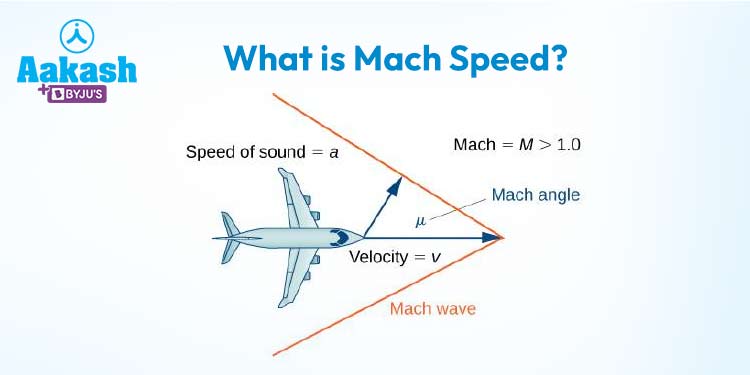

Mach speed, often simply referred to as “Mach,” is a term used to describe an object’s speed relative to the speed of sound in the surrounding medium. This concept is named after Ernst Mach, an Austrian physicist and philosopher who made significant contributions to the understanding of fluid dynamics and the behavior of objects traveling at high speeds.
The speed of sound, denoted as “Mach 1,” varies depending on the medium through which it travels. In dry air at sea level and at a temperature of 20 degrees Celsius (68 degrees Fahrenheit), the speed of sound is approximately 343 meters per second (1,125 feet per second) or about 1,235 kilometers per hour (767 miles per hour). However, this speed can change with altitude, temperature, and the composition of the medium, such as air or water.
When an object exceeds the speed of sound in its surrounding medium, it is said to be traveling at a speed greater than Mach 1 and is said to be “supersonic.” Conversely, if the object is traveling at a speed less than the speed of sound, it is considered “subsonic.”
The Mach number is a dimensionless representation of an object’s speed relative to the speed of sound. It is defined as the ratio of the object’s speed to the speed of sound in the same medium. Mathematically, it is expressed as:
Mach Number (M) = Object Speed / Speed of Sound
For example, if an aircraft is traveling at twice the speed of sound, its Mach number would be 2 (Mach 2). If it were traveling at three times the speed of sound, it would be Mach 3, and so on.
Different ranges of Mach numbers are used to categorize an object’s speed:
Subsonic (Mach 0 to Mach 1): Objects traveling at speeds below the speed of sound are considered subsonic. Most everyday vehicles, such as cars, trucks, and traditional passenger aircraft, operate in this range.
Transonic (Mach 1 to Mach 1.2): This range encompasses speeds just below and just above the speed of sound. Aircraft operating in this range often encounter the challenges associated with airflow transitioning from subsonic to supersonic.
Supersonic (Mach 1.2 to Mach 5): Objects traveling at speeds greater than the speed of sound are considered supersonic. Supersonic flight has been achieved by military aircraft and certain specialized passenger planes like the Concorde.
Hypersonic (Mach 5 and above): Hypersonic speeds are extremely high and often associated with experimental aerospace vehicles, spaceplanes, and missiles. These speeds are five times the speed of sound or more.
Understanding and controlling Mach speed is crucial in aerospace engineering, as it directly impacts an object’s aerodynamic behavior, heat generation, and propulsion requirements. Achieving and sustaining high Mach speeds present significant engineering challenges due to the effects of shock waves, temperature increases, and the need for specialized materials.
In summary, Mach speed is a measure of an object’s speed relative to the speed of sound in a given medium. It is a fundamental concept in aerodynamics and aerospace engineering, with different ranges of Mach numbers defining various categories of speed, from subsonic to hypersonic.
FAQs:
1. What is the significance of Mach speed in aviation and aerospace?
Mach speed is crucial in these fields because it determines an object’s behavior as it approaches and exceeds the speed of sound. Understanding Mach numbers helps engineers design efficient and safe aircraft and spacecraft.
2. Why is Mach 1 often referred to as the “speed of sound”?
Mach 1 is called the “speed of sound” because it represents the point at which an object travels at the same speed as sound waves propagate through a medium, like air. At this speed, an object creates a shock wave known as a sonic boom.
3. What are the challenges of achieving and maintaining supersonic and hypersonic speeds?
Achieving supersonic and hypersonic speeds involves overcoming significant engineering challenges, including managing heat generated by air friction, designing aerodynamically stable vehicles, and developing materials that can withstand extreme conditions.
4. Are there different Mach numbers for different mediums, such as air and water?
Yes, Mach numbers can vary depending on the medium through which an object is traveling. The speed of sound is different in air, water, and other substances due to differences in density and compressibility.
5. What are some practical applications of supersonic and hypersonic travel?
Supersonic and hypersonic travel have potential applications in faster long-distance commercial air travel, military aircraft, space exploration, and even transportation systems like the Hyperloop. These technologies could significantly reduce travel times.