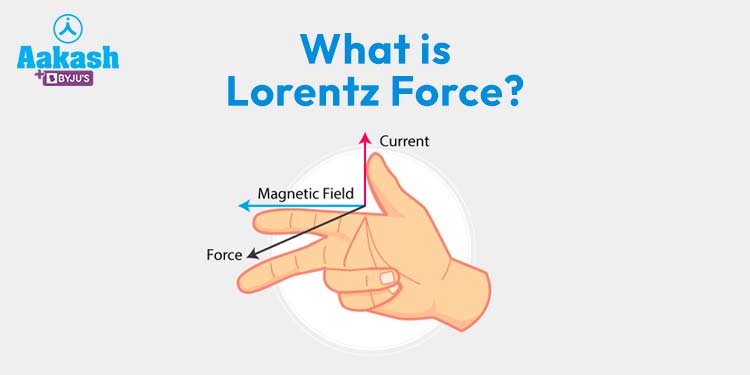

The Lorentz Force is a fundamental concept in the field of electromagnetism, providing a crucial understanding of how charged particles behave when subjected to both electric and magnetic fields. Named after the Dutch physicist Hendrik Antoon Lorentz, who made significant contributions to the development of the theory, the Lorentz Force is central to explaining various phenomena in physics and plays a pivotal role in modern technology.
Components of the Lorentz Force:
The Lorentz Force describes the force experienced by a charged particle, such as an electron or a proton, when it moves through an electric field and a magnetic field simultaneously. This force can be broken down into two components:
Electric Force (F_e): The electric force is exerted on a charged particle due to the presence of an electric field. It acts along the direction of the electric field and depends on the charge of the particle and the strength of the electric field. Mathematically, it is given by F_e = q * E, where “q” represents the charge of the particle, and “E” is the electric field vector.
Magnetic Force (F_m): The magnetic force is exerted on a charged particle due to the presence of a magnetic field. Unlike the electric force, the magnetic force is perpendicular to both the magnetic field and the velocity of the particle. Its magnitude depends on the charge of the particle, its velocity, the strength of the magnetic field, and the angle between the velocity vector and the magnetic field vector. Mathematically, it is expressed as F_m = q * (v × B), where “v” represents the velocity of the particle, “B” is the magnetic field vector, and “×” denotes the cross product.
Combined Lorentz Force:
When a charged particle experiences both electric and magnetic fields simultaneously, the total force it undergoes is the sum of the electric and magnetic forces. This combined force is called the Lorentz Force (F_L) and can be expressed as:
F_L = F_e + F_m
Applications of the Lorentz Force:
Understanding the Lorentz Force is crucial in various areas of science and technology:
Particle Physics: In particle accelerators like the Large Hadron Collider (LHC), charged particles are manipulated using magnetic fields to study fundamental particles and their interactions.
Electromagnetic Devices: Electric motors, generators, and transformers rely on the principles of the Lorentz Force to convert electrical energy into mechanical energy and vice versa.
Magnetic Resonance Imaging (MRI): MRI machines use strong magnetic fields to create detailed images of the human body by manipulating the behavior of charged particles in tissues.
Space Exploration: Understanding the Lorentz Force is essential for spacecraft navigation in Earth’s magnetic field and studying the interaction of charged particles with solar and cosmic magnetic fields.
Plasma Physics: The Lorentz Force plays a significant role in the behavior of charged particles in plasmas, which are crucial in fusion research and astrophysics.
In summary, the Lorentz Force is a fundamental concept in electromagnetism that describes the interaction between charged particles and electric and magnetic fields. Its applications span a wide range of fields, from particle physics to everyday technology, making it a cornerstone of modern science and engineering.
FAQs
1. What is the Lorentz Force, and how does it work?
The Lorentz Force is the combined effect of electric and magnetic forces acting on a charged particle. When a charged particle moves through both an electric field and a magnetic field, it experiences a force that can change its trajectory. The force is perpendicular to both the particle’s velocity and the magnetic field direction.
2. What are the key factors that determine the magnitude of the Lorentz Force?
The magnitude of the Lorentz Force depends on several factors, including the charge of the particle, its velocity, the strength and direction of the electric field, and the strength and direction of the magnetic field. The angle between the velocity vector and the magnetic field vector also plays a crucial role.
3. How is the Lorentz Force applied in practical technology?
The Lorentz Force has numerous practical applications. It is central to the operation of devices like electric motors, generators, and transformers. It also plays a vital role in technologies such as particle accelerators, magnetic resonance imaging (MRI), and spacecraft navigation.
4. What are some real-world examples of the Lorentz Force in action?
One of the most well-known examples is the operation of an electric motor, where the Lorentz Force is used to convert electrical energy into mechanical energy to power various devices. Additionally, the Lorentz Force is essential for creating high-energy particle beams in accelerators like the Large Hadron Collider (LHC).
5. How does the Lorentz Force affect charged particles in space?
Charged particles in space, such as those in the solar wind, interact with the magnetic fields of celestial bodies. This interaction, described by the Lorentz Force, influences the motion of these particles and can lead to phenomena like the auroras on Earth. Understanding these interactions is crucial for space exploration and studying the space environment.