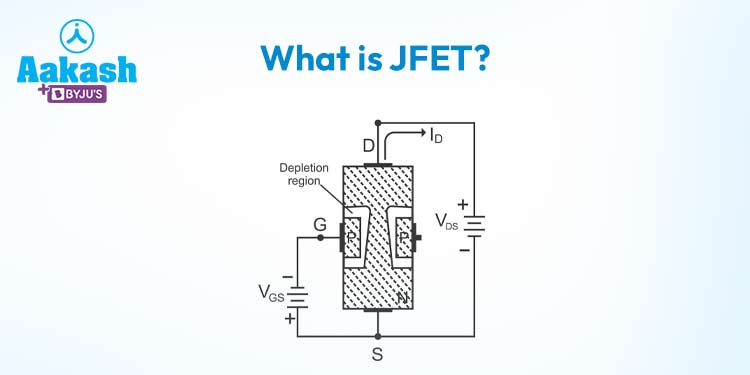

Junction Field-Effect Transistor, commonly known as JFET, is a type of transistor used in electronics to control the flow of electrical current. It belongs to the family of field-effect transistors, which also includes Metal-Oxide-Semiconductor Field-Effect Transistors (MOSFETs). JFETs are essential components in various electronic circuits, and they find applications in amplifiers, switches, voltage-controlled resistors, and other electronic devices.
Here are some key characteristics and features of JFETs:
1. Basic Operation:
- JFETs operate based on the principle of controlling the flow of current through a semiconductor channel using an electric field. Unlike bipolar transistors, which use current to control current, JFETs use voltage to control current.
- The basic JFET consists of a semiconductor material with two regions: the channel and the gate. The gate region is used to control the flow of current through the channel.
2. Types of JFETs:
- There are two main types of JFETs: N-channel JFETs and P-channel JFETs. N-channel JFETs have an N-type semiconductor channel, while P-channel JFETs have a P-type semiconductor channel.
- N-channel JFETs typically operate with negative gate-source voltage (Vgs) to control the current flow, while P-channel JFETs require a positive Vgs.
3. Voltage-Controlled Device:
- JFETs are voltage-controlled devices, meaning that the current flowing through the channel is controlled by the voltage applied to the gate terminal.
- When a voltage is applied to the gate terminal, it creates an electric field that either enhances or restricts the flow of charge carriers (electrons or holes) in the channel, depending on the type of JFET.
4. High Input Impedance:
One of the significant advantages of JFETs is their high input impedance, which makes them suitable for use in high-impedance input stages of amplifiers.
High input impedance means that JFETs draw very little current from the preceding circuit, which minimizes loading effects.
5. Applications:
- JFETs are commonly used in amplifier circuits, such as audio amplifiers and radio frequency (RF) amplifiers.
- They can also be used as voltage-controlled resistors, allowing for precise control of signal amplitudes.
- JFETs find applications in switching circuits and as signal modulators in various electronic systems.
6. Advantages:
- JFETs have low noise characteristics, making them suitable for high-fidelity audio amplifiers.
- They are relatively simple to use and require minimal external components in many applications.
7. Disadvantages:
- JFETs have limited power-handling capabilities compared to other types of transistors like MOSFETs or bipolar junction transistors (BJTs).
- Their gain and performance can be affected by temperature variations.
In summary, the Junction Field-Effect Transistor (JFET) is a voltage-controlled semiconductor device used in electronic circuits to control the flow of electrical current. Its high input impedance, low noise characteristics, and simplicity make it a valuable component in various applications, especially in amplifiers and signal processing circuits. Understanding JFETs is fundamental for electronic engineers and hobbyists alike when designing and troubleshooting electronic circuits.
FAQs:
1. What is the main difference between N-channel and P-channel JFETs?
N-channel JFETs have an N-type semiconductor channel and operate with negative gate-source voltage (Vgs) to control current flow, while P-channel JFETs have a P-type semiconductor channel and require a positive Vgs. The direction of current flow and the polarity of the voltage used to control them are the primary distinctions.
2. How does a JFET differ from a MOSFET or a BJT?
JFETs, MOSFETs (Metal-Oxide-Semiconductor Field-Effect Transistors), and BJTs (Bipolar Junction Transistors) are all transistors, but they operate on different principles. JFETs are voltage-controlled devices that use an electric field to control current. MOSFETs also use voltage control but have a gate insulated by a thin oxide layer. BJTs, on the other hand, are current-controlled devices that use the flow of current to control current.
3. What is the significance of the high input impedance of JFETs in amplifier circuits?
The high input impedance of JFETs is crucial in amplifier circuits because it minimizes the loading effect on the preceding circuit. High input impedance allows the amplifier to draw very little current from the source, ensuring that the input signal is not significantly attenuated or distorted as it enters the amplifier stage.
4. Can JFETs be used in high-power applications like power amplifiers?
JFETs are not commonly used in high-power applications because they have limited power-handling capabilities compared to other transistors like MOSFETs. MOSFETs are better suited for high-power applications due to their ability to handle higher currents and voltages.
5. What are the advantages of using JFETs in low-noise audio amplifier designs?
JFETs are favored in low-noise audio amplifier designs because they exhibit minimal noise characteristics. This means they introduce very little unwanted noise into the amplified signal, resulting in high-fidelity audio output. Their low noise performance makes them ideal for applications where audio quality is critical, such as in high-end audio equipment and professional audio systems.