
Intrinsic semiconductors are fundamental materials that play a crucial role in the world of modern electronics. These materials serve as the building blocks for many electronic devices we rely on daily, such as transistors, diodes, and integrated circuits. To grasp the significance of intrinsic semiconductors, it is essential to comprehend their unique properties and behavior. In this article, we will explore what intrinsic semiconductors are, how they differ from other types of semiconductors, and their relevance in today’s technology-driven world.
Definition of Intrinsic Semiconductors:
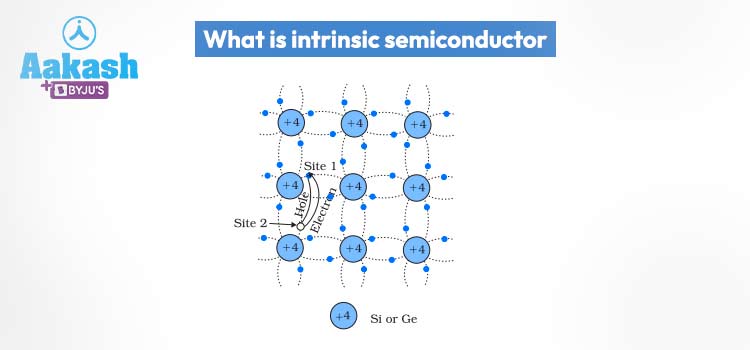
An intrinsic semiconductor is a pure, undoped semiconductor material with an equal number of electrons and holes. Unlike extrinsic semiconductors, which have impurities intentionally introduced into their crystal lattice to alter their electrical properties, intrinsic semiconductors remain in their natural state. As a result, the electrical conductivity of intrinsic semiconductors is relatively low compared to metals but higher than insulators.
Crystal Structure and Band Gap:
Intrinsic semiconductors are typically crystalline materials with a well-defined crystal structure. Common examples include silicon (Si) and germanium (Ge). The arrangement of atoms in their crystal lattice gives rise to unique electronic energy bands – the valence band and the conduction band – separated by a band gap.
Valence Band: The valence band is the energy band that contains electrons at their lowest energy level in a material. These electrons are tightly bound to their parent atoms and play a significant role in determining a material’s chemical properties.
Conduction Band: The conduction band is the energy band located just above the valence band. Electrons in the conduction band have higher energy levels and are relatively free to move within the material. They contribute to the material’s electrical conductivity.
Band Gap: The band gap is the energy range between the valence and conduction bands where no electron energy levels exist. In intrinsic semiconductors, this gap is relatively small, which allows electrons to transition from the valence band to the conduction band with the input of thermal or photon energy.
Electrical Conductivity of Intrinsic Semiconductors:
Intrinsic semiconductors exhibit unique electrical properties that are significantly influenced by temperature. At absolute zero temperature, the valence band is fully occupied, and the conduction band is entirely empty due to the energy gap between them. Consequently, the material behaves as an insulator.
However, as the temperature increases, some electrons in the valence band acquire enough thermal energy to jump across the band gap into the conduction band. This creates mobile charge carriers (electrons) in the conduction band and positive charge carriers (holes) in the valence band. These mobile carriers contribute to the material’s electrical conductivity, making it an excellent medium for electronic devices.
Applications of Intrinsic Semiconductors:
Intrinsic semiconductors serve as the foundation for various electronic components and integrated circuits. By carefully controlling the doping of intrinsic semiconductors with specific impurities, engineers can create either N-type (negative) or P-type (positive) extrinsic semiconductors, forming the basis for diodes, transistors, and other essential devices.
Conclusion:
Intrinsic semiconductors are indispensable materials that underpin the functioning of modern electronics. Their unique properties, including the energy band gap and electrical conductivity, allow for precise control and manipulation of electron flow, leading to the development of sophisticated electronic devices that have revolutionized the way we communicate, compute, and interact with technology in our daily lives. As technology continues to evolve, intrinsic semiconductors will undoubtedly remain a critical aspect of the ever-changing landscape of electronics and computing.
FAQs
1. What is an intrinsic semiconductor?
An intrinsic semiconductor is a pure, undoped semiconductor material, such as silicon (Si) or germanium (Ge), that contains an equal number of electrons and holes. It has a well-defined crystal structure and exhibits a small energy band gap between the valence and conduction bands. This energy gap allows the material to behave as a semiconductor, with intermediate electrical conductivity between insulators and conductors.
2. How does an intrinsic semiconductor differ from an extrinsic semiconductor?
The main difference between intrinsic and extrinsic semiconductors lies in their doping levels. Intrinsic semiconductors are in their natural, undoped state, meaning they contain no intentional impurities. Extrinsic semiconductors, on the other hand, have been deliberately doped with specific impurities to increase their electrical conductivity and tailor their electronic properties for specific applications.
3. What is the significance of the band gap in intrinsic semiconductors?
The band gap is a crucial feature of intrinsic semiconductors. It represents the energy range between the valence and conduction bands, where no electron energy levels exist. The small band gap in intrinsic semiconductors allows electrons to transition from the valence band to the conduction band when provided with thermal or photon energy, making them conductive at elevated temperatures.
4. How does temperature affect the electrical conductivity of intrinsic semiconductors?
Temperature plays a vital role in influencing the electrical conductivity of intrinsic semiconductors. At absolute zero temperature, the material behaves as an insulator since the valence band is fully occupied, and the conduction band is empty. However, as the temperature increases, electrons in the valence band gain enough thermal energy to move to the conduction band, creating mobile charge carriers and increasing the material’s electrical conductivity.
5. What are the practical applications of intrinsic semiconductors?
Intrinsic semiconductors serve as the foundation for a wide range of electronic devices and integrated circuits. They are essential components in the manufacturing of diodes, transistors, and integrated circuits, which are the backbone of modern electronic devices like computers, smartphones, and communication systems. By controlling the doping of intrinsic semiconductors, engineers can precisely engineer the electronic properties needed for various applications, making them indispensable in today’s technology-driven world.