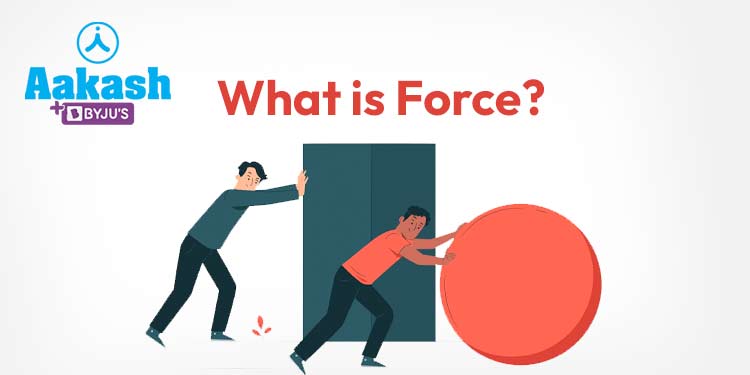

Force is a fundamental concept in physics that plays a pivotal role in understanding the behavior and interactions of objects. It is a fundamental quantity that helps describe and quantify the changes in motion or shape of an object. The concept of force provides a foundation for various branches of physics, including classical mechanics, electromagnetism, and even quantum physics. From the movement of planets to the behavior of subatomic particles, forces are at work all around us, shaping the world we live in.
In Physics, force is defined as any influence that can cause an object to undergo acceleration, change its velocity, or deform its shape. Forces can be described and measured using various mathematical and conceptual frameworks, such as Newton’s laws of motion, which are the fundamental principles governing the behavior of objects under the influence of forces.
According to Newton’s laws, forces have several important characteristics:
Magnitude: Force is a vector quantity, which means it has both magnitude and direction. The magnitude of a force determines its strength or intensity, while the direction indicates the path along which the force acts. Forces are typically measured in units called newtons (N).
Types of Forces: Forces can be classified into different types based on their origin and nature. Some common types of forces include gravitational force, electromagnetic force, frictional force, tension force, normal force, and applied force. Each type of force has distinct properties and effects on objects.
Balanced and Unbalanced Forces: When the forces acting on an object are balanced, the net force is zero, and the object remains in a state of equilibrium. In contrast, unbalanced forces result in a nonzero net force, causing the object to accelerate or change its motion.
Interaction: Forces always occur in pairs, known as action-reaction pairs, as described by Newton’s third law of motion. Whenever one object exerts a force on another object, the second object simultaneously exerts an equal and opposite force on the first object. These forces act on different objects and are independent of each other.
Force Diagrams: Force diagrams, also known as free-body diagrams, are visual representations used to analyze and calculate the effects of forces on an object. They depict the object of interest as a dot or a simple shape and show all the forces acting on it, along with their directions and magnitudes.
Understanding and predicting the effects of forces are crucial for many real-world applications. Engineers rely on the principles of forces to design structures, vehicles, and machines. Astronomers study the gravitational forces that govern the motions of celestial bodies. Electrical engineers harness the electromagnetic force to develop electrical devices and systems. From the macroscopic to the microscopic scale, forces shape the physical world we observe.
It is important to note that force is a concept in physics and should not be confused with the everyday usage of the term. In everyday language, force might imply aggression or physical effort, but in physics, force is a fundamental quantity used to describe the interactions between objects.
FAQs
What is the role of forces in physics?
Forces play a crucial role in physics as they describe and quantify the changes in motion or shape of an object. They provide a foundation for understanding the behavior and interactions of objects, allowing us to analyze and predict various physical phenomena.
How are forces measured in physics?
Forces are typically measured in units called newtons (N). A newton is the amount of force required to accelerate a one-kilogram mass by one meter per second squared. Various instruments such as force gauges or dynamometers are used to measure forces in scientific experiments and practical applications.
What are some common types of forces?
There are several common types of forces encountered in physics. These include gravitational force (which attracts objects towards each other), electromagnetic force (which governs interactions between charged particles), frictional force (which opposes motion between surfaces in contact), tension force (present in stretched or compressed objects), normal force (exerted perpendicular to a surface), and applied force (resulting from direct contact or interaction).
What is the difference between balanced and unbalanced forces?
Balanced forces occur when the net force acting on an object is zero. In such cases, the object remains in a state of equilibrium and experiences no acceleration. Unbalanced forces, on the other hand, result in a nonzero net force, causing the object to accelerate or change its motion. The direction and magnitude of the net force determine the resulting motion of the object.
Can you provide an example of Newton's third law of motion related to forces?
Newton's third law states that for every action, there is an equal and opposite reaction. For example, if you push against a wall, the wall exerts an equal and opposite force back on you. Another example is the propulsion of a rocket. The expulsion of gases from the rocket engine creates a downward force, while an equal and opposite force propels the rocket upward.