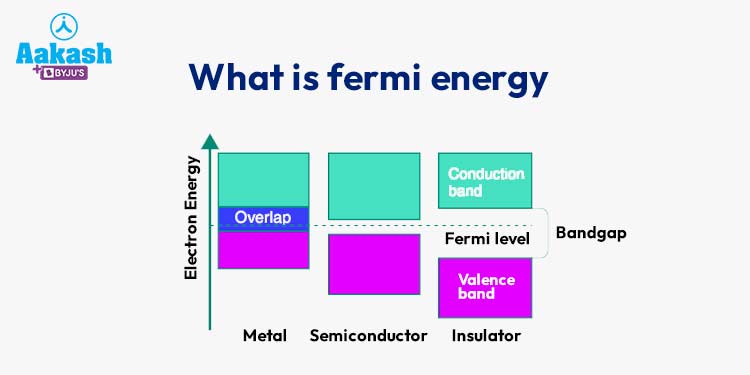

Fermi energy, named after the renowned physicist Enrico Fermi, is a fundamental concept in condensed matter physics and quantum mechanics. It plays a crucial role in understanding the behavior of electrons in materials, especially in solid-state physics. Fermi energy is a key parameter that describes the distribution of electrons in a material and determines its electronic properties.
The Fermi Level:
In a material, electrons occupy various energy levels, forming what is known as an energy band structure. These energy levels are quantized, and at absolute zero temperature (0 Kelvin or -273.15 degrees Celsius), all electrons occupy the lowest available energy levels, starting from the lowest energy state known as the ground state.
The Fermi level is defined as the energy level at which, at absolute zero temperature, the probability of finding an electron is exactly 50%. In other words, it is the highest energy level that is occupied by electrons at 0 Kelvin. At this energy, the electron distribution divides the available energy states into two regions: the filled states below the Fermi level, and the empty states above it.
Fermi Energy and Conductivity:
Fermi energy plays a crucial role in determining the electrical conductivity of a material. In metals, the Fermi energy lies within the energy range of partially filled electronic bands. This means that there are many vacant energy states just above the Fermi level that are easily accessible to electrons, enabling them to move freely through the material. As a result, metals exhibit high electrical conductivity.
In contrast, insulators and semiconductors have fully occupied bands below the Fermi level, and a significant energy gap separates these filled bands from the empty bands above the Fermi level. As a result, there are fewer available energy states for electrons to move into, making it more difficult for them to conduct electricity. In semiconductors, however, a small amount of energy is sufficient to promote some electrons into the empty states above the Fermi level, resulting in a moderate level of electrical conductivity.
Temperature and Fermi Energy:
As the temperature of a material increases, electrons gain thermal energy, and their distribution across energy levels changes. At finite temperatures, some electrons acquire enough energy to move from the filled states below the Fermi level to the empty states above it. This results in an increase in electrical conductivity for both metals and semiconductors.
Applications:
Understanding Fermi energy is essential for various technological applications. For instance:
Semiconductor Devices: The behavior of electrons around the Fermi level is critical for the operation of semiconductor devices, such as transistors, diodes, and integrated circuits.
Superconductors: In superconductors, the Fermi energy is closely related to the energy gap that prevents the scattering of electrons and allows for zero-resistance electrical currents.
Thermoelectric Materials: Knowledge of Fermi energy helps in the design and optimization of thermoelectric materials that efficiently convert heat into electricity or vice versa.
Material Characterization: Fermi energy measurements are crucial in characterizing the electronic properties of materials, aiding in material selection for specific applications.
In summary, Fermi energy is a fundamental concept that governs the electronic behavior of materials and plays a significant role in various technological applications. Its understanding has paved the way for numerous advancements in condensed matter physics and electronic devices, and it continues to be a subject of ongoing research in the scientific community.
FAQs on Fermi Energy:
What is Fermi energy, and why is it important in materials science?
Fermi energy is the highest energy level occupied by electrons at absolute zero temperature. It is a critical parameter in materials science as it defines the distribution of electrons in a material and influences its electrical and thermal properties. Understanding Fermi energy helps in predicting a material's electrical conductivity, thermal behavior, and its classification as a metal, semiconductor, or insulator.
How is Fermi energy related to the Fermi level in materials?
The Fermi energy and the Fermi level are closely related but distinct concepts. The Fermi level is the energy level at which, at absolute zero temperature, the probability of finding an electron is 50%. The Fermi energy, on the other hand, is the energy of the highest occupied state at absolute zero. For conductors and semiconductors, the Fermi energy lies within the energy range of partially filled electronic bands.
How does Fermi energy influence electrical conductivity?
In metals, the Fermi energy lies within partially filled energy bands, providing many vacant energy states for electrons to move through. This allows electrons to flow easily, resulting in high electrical conductivity. In insulators and semiconductors, the Fermi energy is located within fully occupied energy bands, leading to an energy gap that restricts electron movement and lowers electrical conductivity.
How does Fermi energy change with temperature?
At absolute zero temperature, the Fermi energy corresponds to the highest occupied electron state. However, as temperature increases, electrons gain thermal energy and can move to higher energy states. This leads to a broadening of the electron distribution around the Fermi level and an increase in electrical conductivity for both metals and semiconductors.
What are the practical applications of Fermi energy in technology?
Fermi energy has numerous applications in technology. It is crucial in understanding the behavior of semiconductor devices like transistors, diodes, and integrated circuits. Additionally, in superconductors, the energy gap related to the Fermi energy allows for zero-resistance electrical currents. Fermi energy also plays a significant role in designing thermoelectric materials for efficient energy conversion, and it aids in material characterization for various technological advancements.