
Electric flux is a fundamental concept in electromagnetism that helps us understand the flow of electric fields and the interaction between charges and electric fields. It plays a crucial role in various fields, from understanding the behavior of charged particles to designing electrical circuits. In this blog post, we will delve into the concept of electric flux, its significance, and its practical applications.
What exactly is Electric Flux?
Electric flux is a measure of the flow of an electric field through a given area. It quantifies the number of electric field lines passing through a surface and provides insights into the strength and distribution of the electric field.
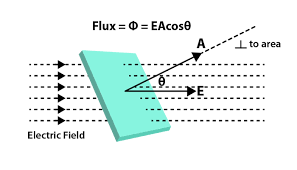
Mathematically, electric flux (Φ) is defined as the dot product of the electric field (E) and the area vector (A) perpendicular to the surface. It is given by the equation Φ = E ⋅ A, where the dot product signifies the projection of the electric field onto the area vector.
Key Concepts and Properties
Electric Field Lines:
Electric field lines represent the direction and strength of the electric field. The number of field lines passing through a given area is proportional to the electric flux passing through that area.
Surface Area and Orientation:
The electric flux depends not only on the magnitude of the electric field but also on the orientation and area of the surface. The electric field lines should be perpendicular to the surface to maximize the flux.
Electric Flux and Charges:
Electric flux is directly proportional to the net charge enclosed by a closed surface. If the surface encloses a positive charge, the electric field lines emanate from the charge, resulting in positive flux. Conversely, if the surface encloses a negative charge, the electric field lines converge towards the charge, resulting in negative flux.
Applications of Electric Flux
Gauss’s Law:
Electric flux is an essential concept in Gauss’s law, one of Maxwell’s equations. It relates the electric flux passing through a closed surface to the net charge enclosed by that surface. Gauss’s law enables us to calculate electric fields in symmetrical situations and is widely used in electromagnetism and electric circuit analysis.
Capacitors and Electrical Circuits:
Understanding electric flux is crucial in designing capacitors, which store electrical energy. The concept helps in analyzing the electric field distribution and the amount of charge stored in a capacitor.
Electric Field Mapping:
Electric flux is utilized in mapping and visualizing electric fields. By observing the pattern of electric field lines and the distribution of electric flux, scientists and engineers can understand the behavior and interactions of charged particles.
Electromagnetic Induction:
Electric flux is involved in the phenomenon of electromagnetic induction, where a changing magnetic field induces an electric field. The concept of flux helps quantify the change in the magnetic field and the resulting induced electromotive force (EMF).
Conclusion
Electric flux provides a quantitative measure of the flow of electric fields through a surface and plays a crucial role in understanding the behavior of charges and electric fields. Whether analyzing electric circuits, designing capacitors, or studying electromagnetic induction, a firm grasp of electric flux enables scientists and engineers to comprehend and manipulate electric fields for practical applications. By exploring electric flux, we unlock insights into the fundamental forces that shape our electrical world.
FAQs
What is electric flux?
Electric flux is a measure of the flow of an electric field through a given area. It quantifies the number of electric field lines passing through a surface.
How is electric flux calculated?
Electric flux (Φ) is calculated by taking the dot product of the electric field (E) and the area vector (A) perpendicular to the surface. The formula is Φ = E ⋅ A.
What is the unit of electric flux?
The unit of electric flux is volts per meter squared (V/m²) or newton meters squared per coulomb (N·m²/C).
How does the orientation of the surface affect electric flux?
The electric flux is maximized when the electric field lines are perpendicular to the surface. The more perpendicular the electric field lines are to the surface, the greater the electric flux.
How is electric flux used in capacitor design?
Electric flux is used in designing capacitors to analyze the electric field distribution and the amount of charge stored in the capacitor. It helps engineers determine the capacitance and energy storage capabilities of a capacitor.
Can electric flux be negative?
Yes, electric flux can be negative. Negative electric flux occurs when the electric field lines converge towards a charge, indicating a net inward flow of the electric field.
How is electric flux used in mapping and visualizing electric fields?
Electric flux is utilized in mapping and visualizing electric fields. By observing the pattern of electric field lines and the distribution of electric flux, scientists and engineers can understand the behavior and interactions of charged particles and the strength of the electric field at different points.