
In the realm of physics, the concepts of distance and displacement stand as fundamental pillars, shaping our understanding of how objects move and interact in space. While these terms might appear interchangeable at first glance, they carry distinct meanings that illuminate the intricacies of motion.
Distance: A Measure of Path Traveled
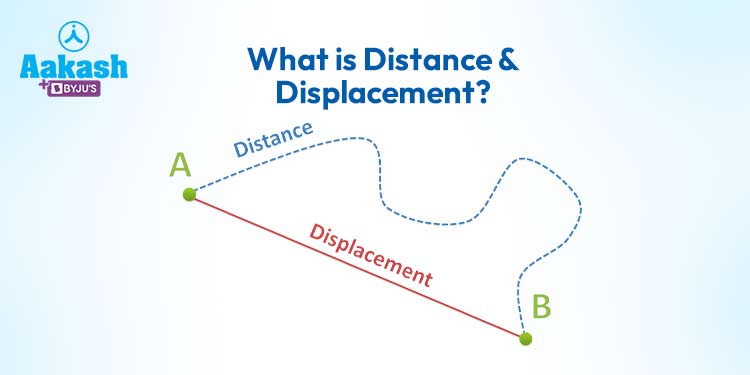
Distance is a scalar quantity that quantifies the extent of the path covered by an object during its motion. In simpler terms, it encapsulates the total ground an object has traversed, regardless of the direction it took. It is represented by a numerical value and a unit of measurement, such as meters or kilometers. Imagine a car traveling along a winding road – the distance it covers accounts for the sum of all the twists and turns it experiences, without consideration of its starting or ending point.
Displacement: Navigating the Change in Position
In contrast, displacement is a vector quantity that pinpoints the change in an object’s position from its initial point to its final point. It embodies both magnitude and direction, making it a more comprehensive descriptor of an object’s motion. For instance, if a person were to walk from one end of a room to the other, their displacement would be a straight line connecting their initial and final positions, regardless of the precise path taken. Displacement delves into the net change in position, emphasizing the ‘as-the-crow-flies’ journey.
Illustrating the Difference:
Consider a scenario where an explorer embarks on a journey through a dense forest. The explorer might wander in various directions, following a complex trail of twists and turns, all contributing to the total distance traveled. However, the displacement of the explorer would be the direct line connecting their starting point to their final destination, irrespective of the convoluted path they took through the trees.
Important Insights:
Magnitude and Direction: Displacement takes into account the overall movement, including the direction, which distance does not consider.
Scalar vs. Vector: Distance is scalar, having only magnitude, while displacement is vector, incorporating both magnitude and direction.
Zero Displacement: If an object returns to its initial position, its displacement is zero, but its distance may still be nonzero if it has covered a path.
Positive and Negative Displacement: Displacement can be positive (when the final position is ahead of the initial) or negative (when the final position is behind the initial), conveying information about the direction of motion.
In summary, distance and displacement are foundational concepts in the study of motion and spatial relations. While distance encapsulates the entirety of the path taken, regardless of direction, displacement encapsulates the change in position and direction. Understanding these concepts is essential for comprehending the intricacies of motion in both the physical world and abstract mathematical models, ultimately enriching our grasp of the laws governing the universe.
FAQs (Frequently Asked Questions) about Distance and Displacement:
1. What is the primary difference between distance and displacement?
Distance is the total length of the path covered by an object, considering all twists and turns, while displacement refers to the change in position from the initial point to the final point, considering both the magnitude and direction of the change.
2. Can an object have a displacement greater than its total distance traveled?
Yes, an object can have a displacement greater than its total distance traveled. This occurs when the object takes a roundabout path, ultimately reaching a position closer to the initial point than it would by taking a more direct route.
3. Is displacement always a straight-line measurement?
Yes, displacement is measured as a straight-line distance between the initial and final positions of an object. This straight-line measurement represents the net change in position and direction.
4. How can displacement be zero if an object has covered a distance?
Displacement can be zero if an object returns to its initial position after traveling a certain distance. This means that despite the distance covered, the overall change in position is null, resulting in a displacement of zero.
5. Are distance and displacement always positive values?
Distance is always positive, as it represents the total path traveled, which cannot be negative. Displacement, on the other hand, can be positive, negative, or even zero, depending on the relative positions of the initial and final points. Positive displacement indicates movement in one direction, negative displacement indicates movement in the opposite direction, and zero displacements signifies returning to the initial position.